Poetic Rendering

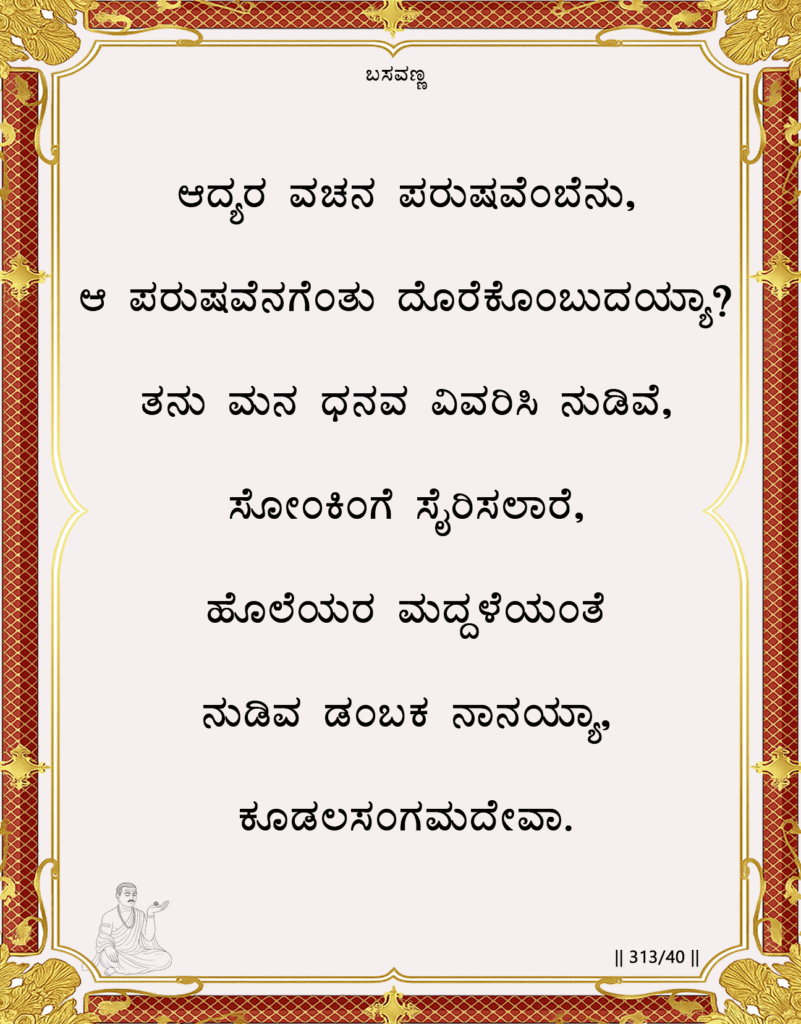
They say the elders’ words are harsh
but how can they be harsh,
when every word of theirs shapes my life for good?
If they ask for body, mind, or wealth,
I shall offer it gladly,
and hold their command as sacred.
For what use is the loud beating of the maddale (Drum)
all noise, empty within?
Let me instead receive the firm, true word
of Kudalasangamadeva’s sharanas,
that burns away falsehood
and makes my life whole.
Basavanna says the words of true elders may seem harsh, but they are meant to transform and guide. Empty displays of religion like loud drumming are useless. What truly reshapes a seeker is the firm, truthful instruction of the sharanas, which one should accept with full surrender of body, mind, and wealth.
Spiritual Context
Core Spiritual Principle: The highest spiritual practice is the total surrender (Sharanagati) of one’s entire being body, mind, and wealth to the guidance of a realized teacher (Guru) or the spiritual community (Sangha). This surrender is not passive defeat but an active, conscious choice to be sculpted by a wisdom greater than one’s own ego.
Cosmic Reality Perspective: The Linga is the supreme sovereign. The individual ego is a rebellious, ignorant subject. The words of the Sharanas are the commands of this sovereignty, designed to dethrone the ego and establish the rule of the Divine Will. To resist is to choose the chaos of the ego; to surrender is to choose the order of the cosmos.
Historical Reality (Anubhava Mantapa context): This vachana defines the Guru-Shishya (teacher-disciple) relationship within the Lingayat path. It establishes the authority of the collective wisdom of the Anubhava Mantapa and calls for a radical, communal spirituality where individual ownership is relinquished for the sake of collective enlightenment and service.
Interpretation
1. Reframing “Harshness”: Basavanna challenges the conventional perception. What the world sees as harshness, the seeker recognizes as the firm, loving hand of a sculptor removing excess stone to reveal the statue within. The pain is part of the liberation.
2. The Total Surrender: “body, mind, or wealth” : This represents the complete triad of human identity: Body (Kayaka): Surrendering control over one’s actions and labor. Mind (Arivu/Achara): Surrendering one’s opinions, judgments, and personal will. Wealth (Dasoha): Surrendering all material possessions and attachments. This is the ultimate act of Dasoha offering everything back to the source.
3. The Contrast: “loud beating of the maddale” : The maddale drum represents all external, noisy, and spectacular forms of religion that stimulate the senses but do not transform the soul. It is religion as entertainment and social performance, “empty within.”
4. The Alchemical Fire: “the firm, true word… that burns away falsehood” : The guidance of the Sharanas is not just advice; it is a purifying fire (Tapas). It burns away the dross of the ego (falsehood) in the crucible of surrender, leaving behind what is real and “whole.”
Practical Implications: The seeker must cultivate a mindset where obedience to the spiritual preceptor and the ethos of the Sangha takes precedence over personal desire and opinion. The test of progress is one’s willingness to let go of attachments to ideas, to possessions, to self-image when guided to do so.
The Cosmic Reality
Anga (Human Dimension): The individual soul offering itself as the raw material to be transformed. The Anga is the sacrificial offering.
Linga (Divine Principle): Kudalasangama Deva as the ultimate goal and the source of the transformative power.
Jangama (Dynamic Interaction): The Jangama is the Guru or the Sangha, who acts as the divine blacksmith. They apply the “firm, true word” (the hammer and fire) to the Anga, shaping it in accordance with the will of the Linga. The relationship itself is the transformative process.
Shata Sthala
Primary Sthala: Sharana. This vachana is the very definition of the Sharana stage one who has taken refuge and lives in a state of conscious, joyful surrender to the Divine will as expressed through the Guru and Sangha.
Supporting Sthala: Maheshwara. The courage and fortitude to undergo this demanding process of surrender without resistance is the power of the Maheshwara.
Practical Integration
Arivu (Awareness): Practice seeing your attachments to your ideas, your plans, your money as the “stone” that needs to be carved away. Welcome life’s challenges and corrections as the sculptor’s tools.
Achara (Personal Discipline): Make your primary discipline obedience to the core principles of your path and trust in your teachers. Practice doing what is right, not what is comfortable.
Kayaka (Sacred Action): Offer your skills and labor to the service of your spiritual community without claiming ownership over the results.
Dasoha (Communal Offering): This vachana is the ultimate expression of Dasoha. It is the offering of the very self. Live with the understanding that your life, your resources, and your capacities are a trust from the Divine, to be used as guided by the wisdom of the Sangha.
Modern Application
We live in a culture of hyper-individualism, where personal autonomy, the right to one’s opinion, and the accumulation of private wealth are supreme values. This often leads to existential loneliness, a lack of deep guidance, and a spirituality that is broad but shallow, as we are unwilling to submit to any authority or discipline that might limit our personal freedom.
This vachana offers liberation from the burden of the isolated self. It presents a path to profound peace through surrender. It teaches that true freedom is not the freedom to do what you want, but the freedom from the tyrannical wants of the ego. By willingly placing oneself in the “crucible” of a sacred tradition and community, one finds a identity that is larger, more stable, and ultimately more free than the fragile construct of the individual ego.
Essence
The drum beats loud, a hollow sound,
While Truth does on the anvil pound.
I choose the fire, the forging pain,
To lose my self, and thereby gain.
Metaphysically, this vachana describes the process of Prapatti (complete surrender) as the means to Jnana (liberating knowledge). The ego (Ahamkara) is a dense concentration of Tamas (inertia) and Rajas (passion). The “firm, true word” of the Jangama is a concentrated burst of Sattvic energy that disrupts this dense structure. The surrender of body, mind, and wealth is the practical dissolution of the Upadhis (limiting conditionings) that bind the soul. The resulting “wholeness” is the state of Sthitaprajna (steadfast wisdom) and the dawn of the realization that the individual self (Anga) was always a part of the cosmic Self (Linga).
The greatest transformations in life in art, science, relationships, or spirit require a period of apprenticeship and surrender to a master or a discipline. You cannot sculpt yourself. To become a masterpiece, you must be willing to be the clay in the hands of a master craftsman. The path to ultimate strength passes through the gateway of conscious, chosen surrender.

Views: 3