

Summary
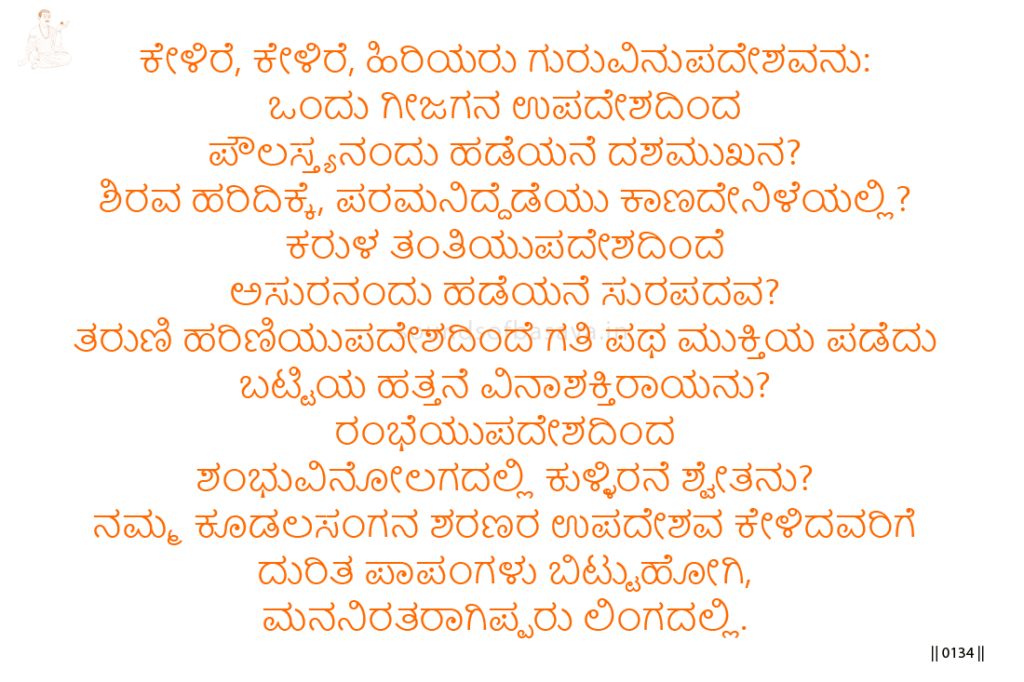
In this vachana, Basavanna calls the elders to listen to the Guru’s upadeśa.
He does not treat instruction as ordinary speech. A true word of guidance can redirect destiny, change the condition of the seeker, and turn the mind toward Linga.
Basavanna gives several examples to show the power of such instruction. Through upadeśa, great transformation becomes possible. He then applies this to the Sharanas of Kudalasangama Deva: those who hear their instruction are freed from accumulated faults, and the mind becomes steady in the Linga.
Imagery & Symbolic Relevance
The opening call, “Listen, listen, O elders,” gives the vachana its urgency.
Basavanna addresses those who may already be respected, learned, or spiritually senior. Even they must become receptive before the Guru’s word.
The first example points to Pulastya and the ten-headed one, Dashamukha. Through the force of instruction, a being of immense consequence came forth. Basavanna uses this image to show that upadeśa is not small speech. When received with power, it can become a cause of great manifestation.
The next references continue the same principle. A word of guidance can turn even fierce or difficult beings toward another destiny. It can redirect what would otherwise remain bound by force, pride, or ignorance.
The image of instruction through unexpected forms is also important. Guidance does not always arrive in the shape expected by the listener. It may come through a strange event, a sharp word, a humbling encounter, or a form that breaks ordinary assumptions.
The examples of Ravana, the asura, the deer, Rambha, and Shveta all point to the same teaching: upadeśa has power when it changes the direction of life.
Basavanna does not include these examples for ornament. Each one prepares the final statement. The instruction of Kudalasangama Deva’s Sharanas is transformative. When truly heard, it removes sins and distortions, and the mind becomes still in the Linga.
Lingayoga
In Lingayoga, Guru-upadeśa gives direction to practice.
The seeker may perform discipline, inquiry, and worship, but without living guidance the mind can remain restless or misdirected.
The word of the Guru and the Sharanas gathers the Anga toward Linga. It does not merely inform the seeker; it turns awareness.
The phrase “the mind becomes still in the Linga” is central. This stillness is not dullness or forced suppression. It is the settling of awareness into its rightful center.
Practice matures when hearing becomes inner assimilation, and the assimilated word becomes steady abidance before Kudalasangama Deva.
Editorial Commentary
This vachana teaches the power of transformative instruction.
Basavanna does not praise every kind of speech. He praises the word that changes the seeker, removes fault, and establishes the mind in Linga.
Related Vachana
Supporting Vachana
Vachana 652 — The Laughter That Awakens
Vachana 652 shows that reading, hearing, and ritual bathing remain fruitless when desire, anger, and inner division persist. Vachana 655 continues by showing what true hearing is: receiving upadeśa that removes impurity and steadies the mind in Linga.
Advancing Vachana
Maheshwara Vachana 586 — The Chant That Never Lands
Vachana 655 teaches that the Guru’s word and the Sharanas’ instruction can turn the mind toward Linga. Maheshwara Vachana 586 advances this into fierce discipline, where the received word must be protected through unwavering practice before Kudalasangama Deva.
