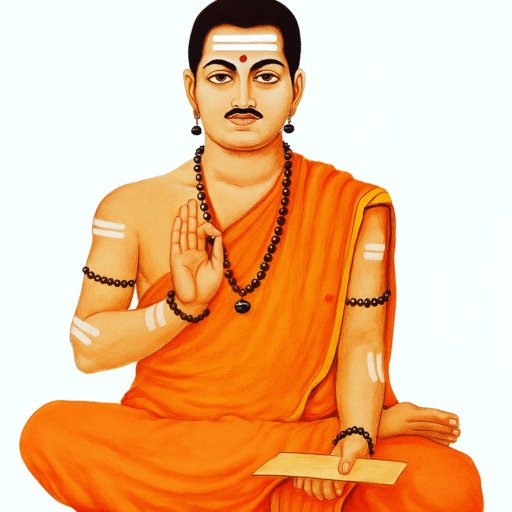

Poetic Rendering
What worth is this pride of birth
you cling to?
Will your lineage guard you
when truth stands before you?
Among sharanas,
who asks, “Whose son are you?”
or searches for clan and pedigree?
In the company of Shiva’s devotees,
all such claims fall away
the old lineages end,
and a new life begins.
O Kudalasangamadeva,
it is only in the fellowship
of Your true ones
that the last trace
of worldly identity
finally dies.
In this vachana, Basavanna dismantles the illusion of superiority based on birth. He declares that caste, clan, and lineage hold no meaning in the spiritual community of sharanas. Wearing the Linga marks a break from inherited identity and the start of a divine lineage rooted in Shiva. True belonging is not determined by ancestry but by inner truth and fellowship with realized beings.
Spiritual Context
Core Spiritual Principle: Spiritual rebirth requires the conscious death of the social self. The identity based on birth, caste, and lineage is a primary obstruction to realizing the universal, non dual Self.
Cosmic Reality Perspective: In the eyes of the Absolute (Linga), all manifested forms are equally divine and equally illusory. To privilege one form (a high caste body) over another is to be deeply entangled in maya (illusion) and to fundamentally misunderstand the nature of reality, which is pure, undifferentiated Consciousness.
Historical Reality (Anubhava Mantapa Context): This Vachana is a direct and powerful assault on the bedrock of the 12th century Hindu social order: the caste system (varna and jati). Basavanna is not merely criticizing caste; he is declaring it spiritually null and void within the Sangha (community). The Anubhava Mantapa was a radical experiment where a minister like Basavanna, a brahmin by birth, and an untouchable could meet as absolute equals, their only identity being that of Sharana.
Interpretation
1. “What worth is this pride of birth you cling to? Will your lineage guard you when truth stands before you?” The Vachana opens with a rhetorical question that exposes the utter futility of worldly identity in the spiritual realm. “Truth” here is the ultimate reality of death and divine judgment, before which all man made hierarchies are meaningless.
2. “Among sharanas, who asks, ‘Whose son are you?’ or searches for clan and pedigree?” This describes the new, enlightened society. The very questions that define conventional society are considered absurd and irrelevant in the spiritual community. The act of asking such a question would itself be a sign of ignorance.
3. “In the company of Shiva’s devotees, all such claims fall away the old lineages end, and a new life begins.” This is the transformative power of the Sangha. It acts as a crucible where the old, impure metal of social identity is melted down. The “new life” is the birth of the soul into its true, divine lineage the lineage of Shiva consciousness.
4. “It is only in the fellowship of Your true ones that the last trace of worldly identity finally dies.” This states that intellectual understanding is not enough. The complete death of this deep seated identity (vasana) occurs only through the sustained, energetic influence (satsang) of those who are already free from it. The community is the graveyard for the ego.
Practical Implications: The seeker is guided to: Consciously renounce pride and identification with family background, nationality, or social status. Actively seek the company of those who see the divine in all, and who will not reinforce their social ego. Understand that initiation (Linga Diksha) is a formal death of the old identity and a birth into a new, universal spiritual family.
The Cosmic Reality
Anga (Human Dimension): The Anga is the individual burdened with the samskaras (impressions) of social identity. Its spiritual work is to actively shed this false skin and embrace its new, formless identity in the Linga.
Linga (Divine Principle): The Linga is the universal, attributeless (nirguna) principle that is the true source and identity of every soul. It is the great equalizer, the common divine core in all.
Jangama (Dynamic Interaction): The Jangama is the community of Sharanas. They are the living proof and the sustaining environment of this new identity. The dynamic interaction is the process of socialization into this community, where one learns a new “language” and a new way of being that does not include caste or lineage.
Shata Sthala
Primary Sthala: Bhakta Sthala. The first and most fundamental step for a devotee is to sever attachment to their prior social and religious identity. Taking refuge in the Linga and the Sangha is the definitive act of the Bhakta.
Supporting Sthala: Maheshwara Sthala. The intense inner purification (virakti) of this stage involves burning away deep seated attachments, and the attachment to social identity is one of the most profound and stubborn to be purified.
Practical Integration
Arivu (Awareness Practices): Contemplation on Equality: Meditate on the truth that the same consciousness animates all bodies, regardless of their external labels. See the Linga in everyone you meet.
Mindfulness of Judgment: Notice when thoughts of superiority or inferiority based on social status arise. See them as remnants of the “old lineage” that must be allowed to die.
Achara (Personal Discipline): Make a conscious effort to treat everyone with equal respect, especially those whom society deems “lower.” Actively break old habits of social discrimination.
Kayaka (Sacred Action): Perform your work as a member of the universal human family, not as a member of a particular caste or class. Let your work be an offering that transcends social boundaries.
Dasoha (Communal Offering): The highest Dasoha is to actively build and protect a community where all are equal. Offer your energy to create a space free from the poison of caste and lineage pride.
Modern Application
“Identity Politics and Tribalism.” While modern society has formally rejected caste, it is rife with new and old forms of tribalism: racism, classism, nationalism, and political factionalism. People derive a sense of identity and superiority from their group affiliations, leading to social fragmentation, conflict, and internal stress.
The Liberative Application: Basavanna’s Vachana provides a radical solution: transcend all group identities by anchoring your sense of self in the universal, divine consciousness. It liberates one from the endless, exhausting battle of us vs them. It allows for the creation of communities based on shared spiritual values and common humanity, rather than on shared enemies or inherited social markers.
Essence
The name you inherited, the clan you boast,
are costumes worn for a fleeting play.
When the curtain falls, and Truth takes the stage,
what role remains for your father’s name?
In the hall of the Lord, one light burns in all lamps.
To see the wick is to forget the shape of the clay.
In this fellowship of fire, my lineage ends,
and I am born again, simply, as a spark of You.
This Vachana performs a metaphysical surgery on the collective human psyche. It severs the soul’s identification with the horizontal, temporal plane of genealogy and re anchors it in the vertical, eternal axis of the Divine. Its multidimensional power operates on the sociological level (creating a new society), the psychological level (freeing the individual from conditioned identity), and the theological level (defining divinity as beyond all attributes, including social ones). It positions the Jangama Sangha as the womb for a new species of human being, one whose primary identity is spiritual consciousness, not social accident.
You are not who your ancestors were. You are not your nationality, your social class, or your family name. These are costumes you inherited, not your soul. True freedom begins when you consciously take off these costumes and stand naked in the truth of your being: a conscious, divine entity. Find your tribe among those who see you for what you truly are.

Views: 17