

Summary
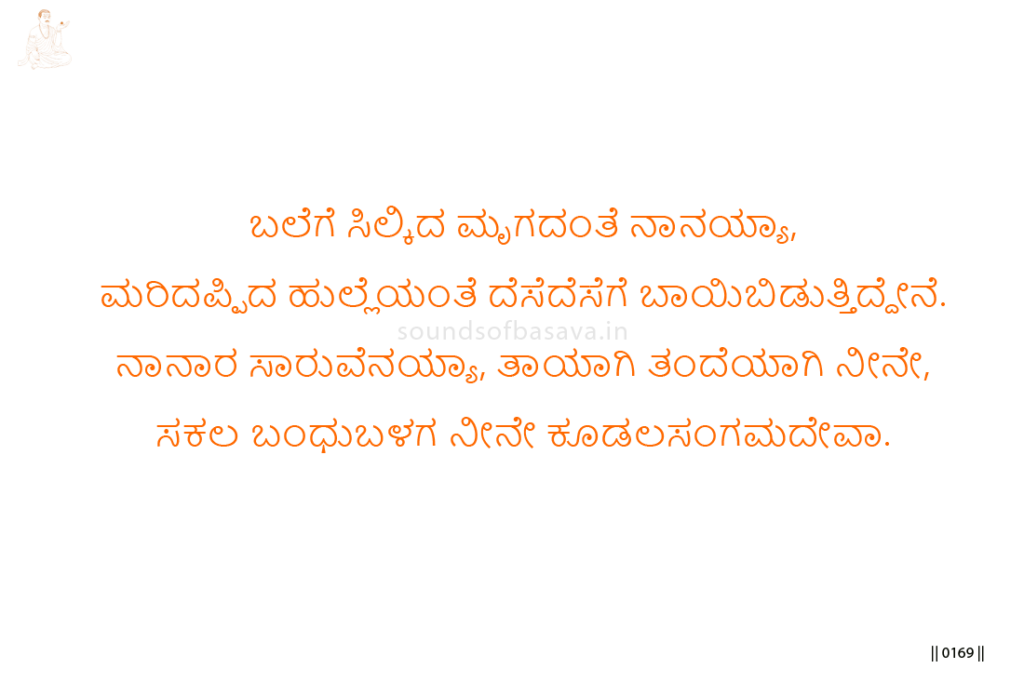
In this vachana, Basavanna speaks from the helplessness of a soul caught in bondage. He compares himself to a deer trapped in a snare.
He then gives a second image: like a mother deer separated from her young, he cries and wanders from place to place. The suffering is not only pain; it is the anguish of separation.
The cry turns into recognition. Basavanna asks whom he can approach, and answers that Kudalasangama Deva alone is Mother, Father, kin, and companion. The soul remembers its true refuge.
Imagery & Symbolic Relevance
The deer caught in the snare is the first image. A deer belongs to freedom and open movement, but once caught, its own struggle can deepen its helplessness.
Basavanna uses this image for the soul entangled in worldly bondage. The problem is not only that the soul suffers, but that it cannot free itself by restless movement.
The mother deer separated from her young gives a deeper emotional force. Here the wound is separation. The mother searches, cries, and moves from place to place because something essential is missing.
This image reveals spiritual longing. The seeker does not merely want relief from suffering; he longs for the lost nearness of Kudalasangama Deva.
The question “To whom shall I speak?” marks the turning point. Worldly supports cannot answer this condition. Ordinary relationships cannot reach the depth of the soul’s hunger.
Basavanna’s answer is complete: Kudalasangama Deva alone is Mother, Father, and all kin. The search through many places ends in one refuge.
The imagery therefore moves from entanglement, to longing, to recognition. The trapped soul remembers where it belongs.
Lingayoga
In Lingayoga, the soul must recognize both its bondage and its source. Without this recognition, practice remains scattered.
The snared deer shows the Anga caught in the net of worldly movement. The separated deer shows the beginning of deeper remembrance: the seeker can no longer be satisfied by outer substitutes.
This vachana also clarifies the emotional truth of the path. Longing is not weakness. It becomes spiritual force when it turns the seeker toward Kudalasangama Deva.
Practice matures when the search for support gathers into one relation. Mother, Father, kin, and companion are no longer sought separately; they are found in the Divine refuge.
Editorial Commentary
This vachana should be read as a movement from helplessness to remembrance.
The teaching is direct: when every other support fails, the soul recognizes Kudalasangama Deva as its only true kin.
Related Vachana
Supporting Vachana
Vachana 1268 — The Fortune Born of Bhakti
Vachana 1268 shows that bhakti gives rise to the merit through which hostility, danger, and distance are transformed. Vachana 1277 turns that devotion inward as longing, where the seeker remembers Kudalasangama Deva as the only true refuge.
Advancing Vachana
Maheshwara Vachana 993 — Blessed by the Sight of the Sharana
Vachana 1277 shows the soul crying from bondage and remembering Kudalasangama Deva as Mother, Father, and all kin. Maheshwara Vachana 993 advances this into the last question, where the seeker must face whether this refuge is complete or still divided. What appears here as longing for the only true relation becomes, in the next movement, the final inquiry into surrender before Kudalasangama Deva.
