

Summary
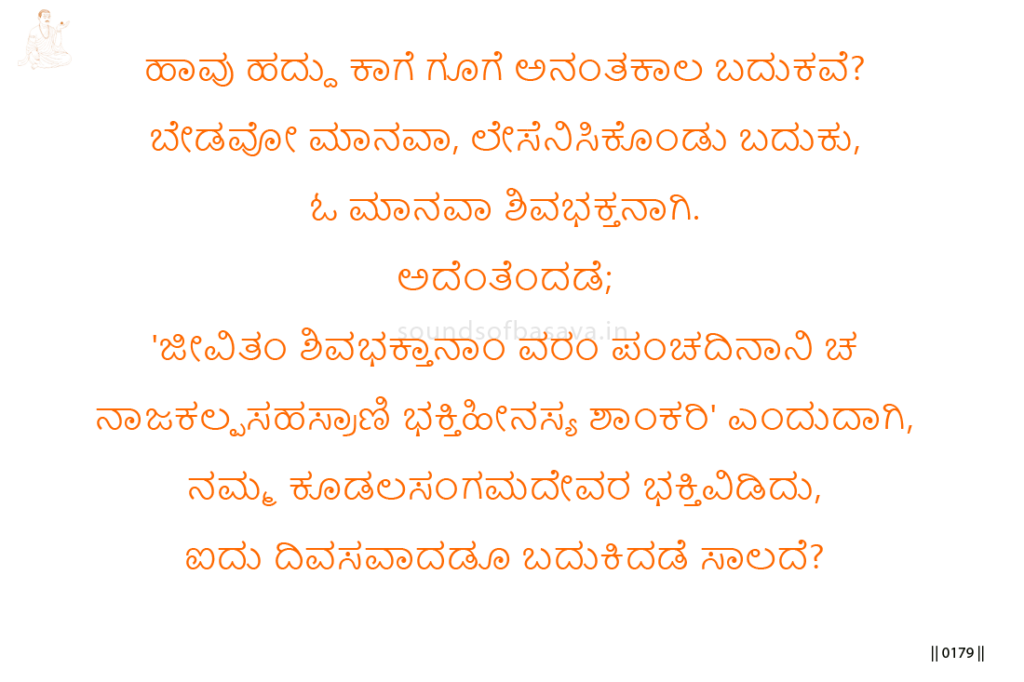
In this vachana, Basavanna asks whether long life by itself has spiritual value. Serpents, vultures, crows, and owls may live long, but endurance alone does not make life worthy.
He turns to the human being and gives the real measure: live nobly, live as a Shiva-bhakta, and hold devotion to Kudala Sangama Deva.
Even if such a life lasts only five days, Basavanna asks whether that is not enough. The teaching is direct: the worth of life is measured by devotion, not duration.
Imagery & Symbolic Relevance
The serpent, vulture, crow, and owl form the opening comparison. These creatures represent survival, endurance, and continued existence.
Basavanna uses them to question human attachment to mere length of life. If longevity alone were fulfillment, such creatures would already stand as examples.
The address to the human being shifts the teaching. Human life is not meaningful because it continues for many years. It becomes meaningful when it is lived worthily.
To live as a Shiva-bhakta is the decisive instruction. Basavanna does not ask for long survival, but for life oriented toward Kudala Sangama Deva.
The image of five days gives force to the teaching. A short span filled with devotion is greater than a long span spent without purpose.
The imagery therefore moves from animal longevity to human responsibility. The question is not how long one lives, but whether life has become devotion.
Lingayoga
In Lingayoga, practice changes the measure of life. The seeker no longer values existence by duration, comfort, or survival.
A human birth becomes significant because it can be turned toward Linga. Without that turning, length of life remains incomplete.
This vachana asks the practitioner to live deliberately. Even a brief period of true devotion has spiritual weight when the Anga is held in remembrance of Kudala Sangama Deva.
Lingayoga matures when every day is treated as an offering, whether the days are many or few.
Editorial Commentary
This vachana should be read as a correction of mere survival.
The teaching is direct: five days of life in bhakti are worth more than long years without devotion.
Related Vachana
Supporting Vachana
Vachana 1405 — To None but My Lord
Vachana 1405 gathers song, request, and poverty into one appeal before Kudala Sangama Deva. Vachana 1408 continues this single-pointedness by asking that life itself, however brief, be lived only as Shiva-bhakti.
Advancing Vachana
Maheshwara Vachana 998 — The Devotion That Withers Without the Sharana
Vachana 1408 teaches that life gains worth through devotion rather than length. Maheshwara Vachana 998 advances this into undivided abidance, where the devotee no longer merely lives for time, but abides steadily before Kudalasangama Deva. What is affirmed here as a worthy life, even for five days, becomes in the next movement the ground of continuous abidance.
