Poetic Rendering

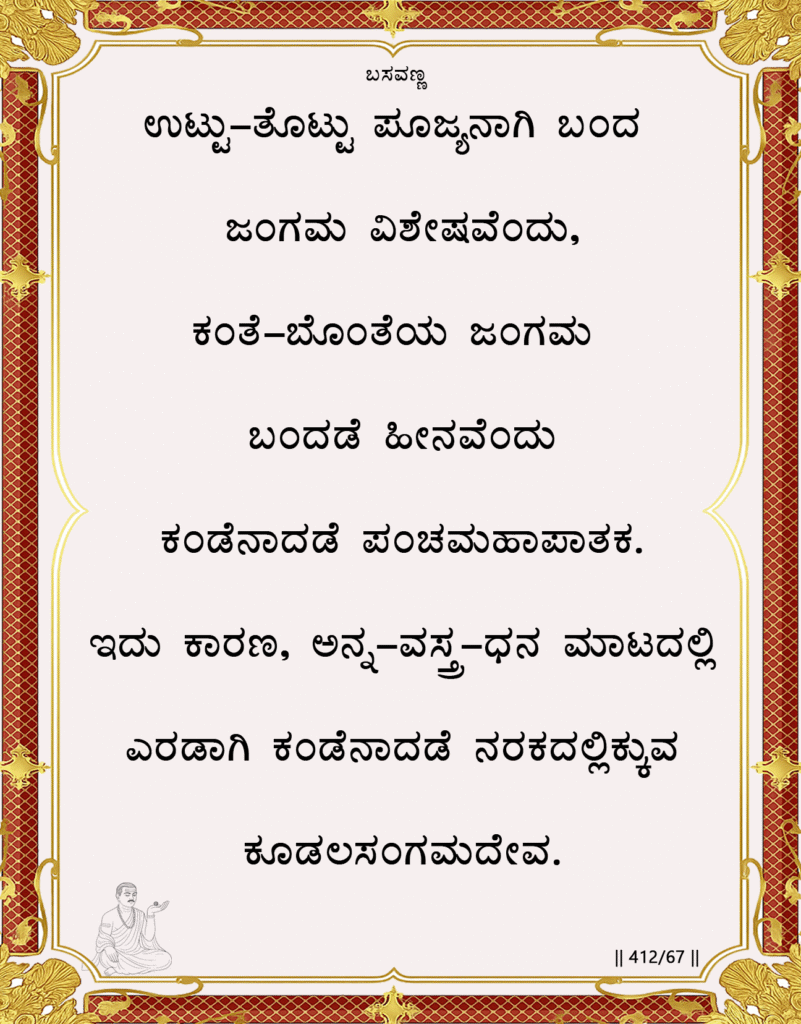
If a jangama arrives wrapped in silk,
you bow and call him holy.
If another comes in tattered cloth,
you turn away and call him low.
To see difference where none exists
that is the true fall.
For when the eyes divide
between rich and poor, fine and rough,
even food and clothing
become a path toward ruin.
O Koodalasangamadeva,
grant me the vision
that sees One in all.
Basavanna condemns the tendency to judge spiritual worth based on outward appearance honoring a well dressed jangama and despising a poorly clad one. Such discrimination, he warns, is a profound spiritual error. True devotion requires the vision that perceives the same divinity in every form, regardless of wealth or clothing.
Spiritual Context
Core Spiritual Principle: Spiritual vision (divya drishti) is the ability to perceive the unchanging divine essence (Linga) within the ever changing human form (Jangama). Judging based on external appearances is a failure of this vision and constitutes a fundamental spiritual error.
Cosmic Reality Perspective: In the non dual reality, the One Consciousness (Linga) voluntarily takes on all forms, from the silken robe to the tattered cloth, as a play of its own infinite expression (lila). To privilege one form over another is to be deluded by the display and to miss the Actor entirely. It is to worship the costume instead of the Divine Being wearing it.
Historical Reality (Anubhava Mantapa Context): This Vachana continues Basavanna’s radical social revolution. It attacks the deeply ingrained habit of associating spiritual authority with material wealth and high social status. In a society where clothing explicitly signaled caste and class, Basavanna declares that the Jangama the moving embodiment of God could be anyone, especially the poor and the humble. This empowered the masses and held a mirror to the hypocrisy of the elite, who performed piety while being blinded by their own privilege.
Interpretation
1. “If a jangama arrives wrapped in silk, you bow and call him holy. If another comes in tattered cloth, you turn away and call him low.” Basavanna first exposes the common, hypocritical behavior. The same sacred principle (Jangama) is revered or rejected based on its temporary, material covering. This reveals that the worshipper is not seeing the Jangama at all, but only the appearance.
2. “To see difference where none exists that is the true fall.” This is the core doctrinal statement. The “fall” is not a moral lapse but an epistemological one a failure to perceive reality correctly. The “difference” between the silk clad and the rag clad Jangama is an illusion projected by the ignorant mind. Succumbing to this illusion is the true spiritual downfall.
3. “For when the eyes divide between rich and poor, fine and rough, even food and clothing become a path toward ruin.” This explains the dangerous consequence. When perception is divided, the most mundane aspects of life food and clothing, which should be simple aids to living become catalysts for spiritual degradation. They reinforce duality, strengthen the ego, and build walls between souls.
4. “O Koodalasangamadeva, grant me the vision that sees One in all.” The Vachana concludes with a prayer, not a prescription. Basavanna recognizes that this unified vision is not an intellectual conclusion but a grace bestowed perception. He asks for the divine gift (prasada) of eyes that can see the One Linga in every single Jangama.
Practical Implications: The seeker is guided to: Consciously practice looking beyond external appearances clothing, wealth, status in everyone they meet. Actively challenge their own biases and snap judgments based on how someone looks. Understand that the ultimate spiritual practice is to cultivate this unifying vision in every moment.
The Cosmic Reality
Anga (Human Dimension): The Anga is the seeker whose perception is being purified. Their spiritual work is to train their “eyes” to see past the dualities of silk and rags, to perceive the singular Jangama principle in all.
Linga (Divine Principle): The Linga is the “One in all” the immutable, divine essence that is the true substance of every Jangama, regardless of the external form.
Jangama (Dynamic Interaction): The Jangama is every human being, in every possible condition. They are the test for the Anga’s perception. The dynamic interaction is the sacred act of seeing and honoring the Linga in the Jangama, whether they are clad in silk or rags.
Shata Sthala
Primary Sthala: Bhakta Sthala. This Vachana addresses the most basic purification required of a devotee: the cleansing of their perception. A Bhakta must learn to see God in all forms as the first step toward genuine devotion.
Supporting Sthala: Aikya Sthala. The “vision that sees One in all” is not just the foundation but also the culmination. It is the perpetual state of consciousness of one who has realized union with the Divine.
Practical Integration
Arivu (Awareness Practices): The Seeing Meditation: Sit in a public place and observe people. With each person, silently affirm: “The same Linga is in this one. The same Linga is in that one.” Practice erasing the distinctions your mind creates.
Mindfulness of Judgment: Notice the instant, automatic judgments you make about people based on their appearance. Pause and consciously replace that judgment with the thought: “This is a Jangama, a form of the Divine.”
Achara (Personal Discipline): Treat everyone you interact with from a CEO to a street sweeper with the same fundamental respect, recognizing the common divine core.
Kayaka (Sacred Action): In your work, do not be swayed by a person’s title or attire. Judge ideas and actions on their merit, and treat all colleagues as equal manifestations of the divine.
Dasoha (Communal Offering): Actively welcome and honor those who are often overlooked or marginalized in society. Make your community a place where the “rag clad Jangama” feels as revered as the “silk clad” one.
Modern Application
“The Culture of Surface and Stereotype.” In an age dominated by branding, social media aesthetics, and instant judgments, we are more conditioned than ever to evaluate people based on their appearance, fashion, and visible status symbols. This leads to prejudice, “lookism,” and deep social fragmentation.
This Vachana is an urgent antidote to our superficial culture. It liberates us from the tyranny of appearance, both our judgment of others and our anxiety about our own. It provides a profound basis for genuine human connection, allowing us to meet others at the level of soul rather than status. It is a call to develop “X ray vision” for the divine, seeing through the external costume to the sacred life within.
Essence
The eye that admires the silk and scorns the rag
is an eye that is blind to the truth.
It sees the robe, but misses the God;
it reads the cover, but not the book.
Give me, O Lord, the sight that is simple and pure:
to see Your one face in the rich and the poor.
This Vachana presents a spiritual epistemology where the value of perception is determined by its ability to penetrate illusion (maya) and apprehend the underlying unity (Jangama). Its multidimensional impact is to make social justice, psychological clarity, and theological truth inseparable. It positions the Jangama as the ultimate litmus test for spiritual awareness: if you cannot see the Divine in the humblest human form, you have not truly seen it at all. The “true fall” is thus a descent into a fragmented, illusory reality, while the path of ascent is the cultivation of a gaze that unifies all apparent duality.
Do not be fooled by the costume. The clothes, the car, the job title these are temporary disguises. Beneath them all is the same sacred life, the same consciousness, the same essential humanity. The greatest wisdom is to see this same one life shining in the eyes of every person you meet. When you learn to see this way, you will find God everywhere, and the world will become a temple of endless, equal sanctity.

Views: 18