Poetic Rendering
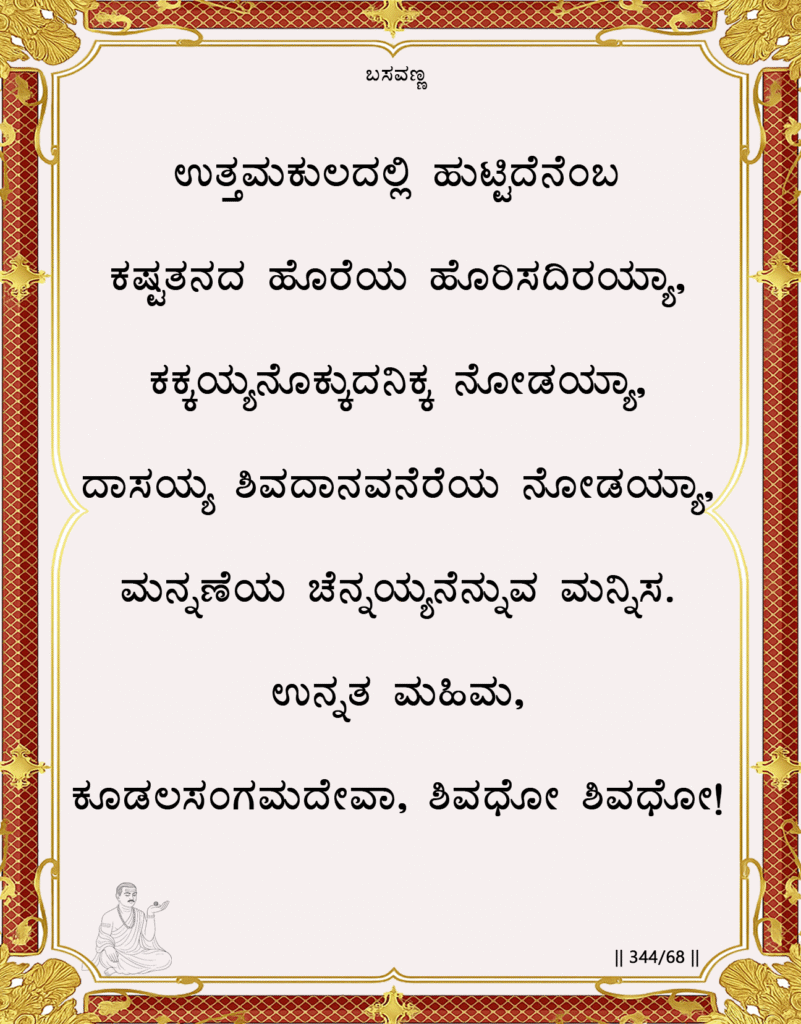
Do not fault me, O Lord,
for this noble birth I did not choose.
You have placed me among Your saints
Kakkayya, Channayya, Dasayya
and what weight has lineage before such light?
Will Kakkayya not share his hard won truth?
Will Channayya not reveal
the seasoned path of realization he has walked?
Will Dasayya not offer the buttermilk
from which the butter of wisdom is churned?
Break this pride of birth, O Kudalasangamadeva;
scatter it to the winds
for in the company of the true ones,
only lived experience carries worth.
Basavanna says that noble birth has no spiritual value. The true wealth lies in the lived experience of humble devotees like Kakkayya, Channayya, and Dasayya, who freely share the path to realization. He prays that any pride of lineage be destroyed, for only genuine spiritual insight matters.
Spiritual Context
Core Spiritual Principle: Spiritual authority is derived solely from direct experience (anubhava) and realization, not from social status, birth, or inherited privilege. The ego’s attachment to lineage is a primary obstruction to receiving true wisdom.
Cosmic Reality Perspective: The Divine (Linga) is the source of all consciousness and does not recognize man made hierarchies. In the eyes of the Absolute, a soul is valued by its purity, devotion, and wisdom, not by its familial origins. The cosmos operates on the law of karma and grace, not on the laws of caste.
Historical Reality (Anubhava Mantapa Context): Basavanna, a Brahmin by birth and a minister by profession, consciously rejects his own social privileges in this Vachana. He elevates saints from humble backgrounds Kakkayya (a potter), Channayya (a cobbler), and Dasayya (an outcaste) as his true teachers. This is a radical act that dismantles the entire caste based structure of spiritual authority and establishes the Anubhava Mantapa as a true meritocracy of the spirit.
Interpretation
1. “Do not fault me, O Lord, for this noble birth I did not choose.” Basavanna begins with a poignant disclaimer. He acknowledges that his high birth is an accident, a karmic circumstance for which he is not inherently responsible, but he is acutely aware that it can be a source of spiritual pride.
2. “You have placed me among Your saints Kakkayya, Channayya, Dasayya and what weight has lineage before such light?” This is the pivotal realization. He contrasts the artificial “weight” of lineage with the authentic “light” of realized beings from the lowest castes. In their presence, his noble birth becomes utterly irrelevant, even burdensome.
3. “Will Kakkayya not share his hard won truth? Will Channayya not reveal the seasoned path…? Will Dasayya not offer the buttermilk…?” He lists the specific, experiential wisdom each humble saint possesses. “Hard won truth,” “seasoned path,” and the “buttermilk” of wisdom are metaphors for spiritual insights earned through sincere practice and grace, which are unavailable through mere birthright.
4. “Break this pride of birth, O Kudalasangamadeva; scatter it to the winds ” This is a passionate prayer for active grace. He does not trust his own ability to rid himself of this deep seated social conditioning and asks the Divine to violently uproot it.
5. “for in the company of the true ones, only lived experience carries worth.” The concluding statement establishes the new spiritual currency. In the Sangha of the Sharanas, the only valid “lineage” is the lineage of direct, lived spiritual experience (anubhava parampara).
Practical Implications: The seeker is guided to: Actively seek wisdom from those who embody truth, regardless of their social standing. Consciously renounce pride in any accidental advantages like family, wealth, or education. Value personal spiritual practice and experience above all inherited beliefs or status.
The Cosmic Reality
Anga (Human Dimension): The Anga is Basavanna himself a high born individual consciously working to shed the egoic identity attached to his birth. His role is to be a humble student before the enlightened Jangamas, regardless of their social background.
Linga (Divine Principle): The Linga is the ultimate source of grace that can “break” and “scatter” the pride of the ego. It is the impartial judge that values only the quality of the heart.
Jangama (Dynamic Interaction): The Jangama are the saints like Kakkayya, Channayya, and Dasayya. They are the living embodiment of the principle that spiritual worth transcends birth. The dynamic interaction is Basavanna’s humble learning from them, a relationship that visibly enacts the death of the old social order.
Shata Sthala
Primary Sthala: Bhakta Sthala. This Vachana exemplifies the foundational work of a devotee: the cultivation of humility (vinaya) and the tearing down of the ego’s fortresses, which is the prerequisite for receiving true knowledge.
Supporting Sthala: Maheshwara Sthala. The intense inner renunciation (vairagya) of this stage includes the renunciation of social identity and pride. The prayer to “break this pride” is the essence of the Maheshwara’s purgative fire.
Practical Integration
Arivu (Awareness Practices): Contemplation on Humility: Reflect on the things you take pride in (skills, background, achievements). See them as gifts or circumstances, not as your essential self. Offer this pride to the Divine to be “scattered.”
Learning from All: Practice seeing every person, especially those from humble backgrounds, as a potential teacher who can reveal an aspect of truth you may lack.
Achara (Personal Discipline): Consciously interact with and show respect to people from all walks of life, breaking habitual patterns of social deference and prejudice.
Kayaka (Sacred Action): Perform your work without attachment to the status it confers. Let the quality of your work be your offering, not the title on your door.
Dasoha (Communal Offering): Foster a community where everyone is valued for their character and wisdom, not their pedigree. Ensure that leadership is based on spiritual maturity, not social status.
Modern Application
“The Meritocracy Myth and Credentialism.” Modern society, while ostensibly moving beyond caste, has created new hierarchies based on educational pedigree, professional titles, and wealth. People often derive their self worth from these external markers, leading to arrogance, inequality, and a dismissal of wisdom that comes from outside formal institutions or from humble sources.
This Vachana liberates us from the tyranny of credentials and social climbing. It teaches that true wisdom and authority come from authentic experience and realization, which can be found in the most unexpected places. It encourages us to value the wisdom of the elderly, the simplicity of the humble, and the insights of those who work with their hands, creating a more holistic and truly egalitarian understanding of human value.
Essence
The crown I inherited is a crown of thorns.
The palace of my birth, a prison of scorn.
I would trade it all for the dust on the feet
of the cobbler saint, the outcaste wise,
whose whispered truth makes kingdoms seem
like toys for children, empty dreams.
This Vachana performs a metaphysical inversion of value. It severs the illusory connection between spiritual merit (adhikara) and social accident (jati). Its multidimensional impact is to establish a spiritual ontology where being (sat) is defined by consciousness, not by social form. It positions the Jangama as the critical destabilizing force in the seeker’s psyche the living, breathing proof that the ego’s most cherished identities are utterly irrelevant in the court of the Divine. The prayer for the destruction of pride is, in fact, a prayer for the annihilation of the false self (ahamkara), which is the ultimate goal of the path.
Your resume, your family name, your bank account these are costumes you wear, not who you are. Do not let them become a source of pride that blinds you to the profound wisdom and inherent worth of every human being. True nobility is not inherited; it is earned through a humble heart, a seeking mind, and a life lived with integrity and love. The greatest souls are often disguised in the most ordinary lives. Learn to see them.

Views: 5