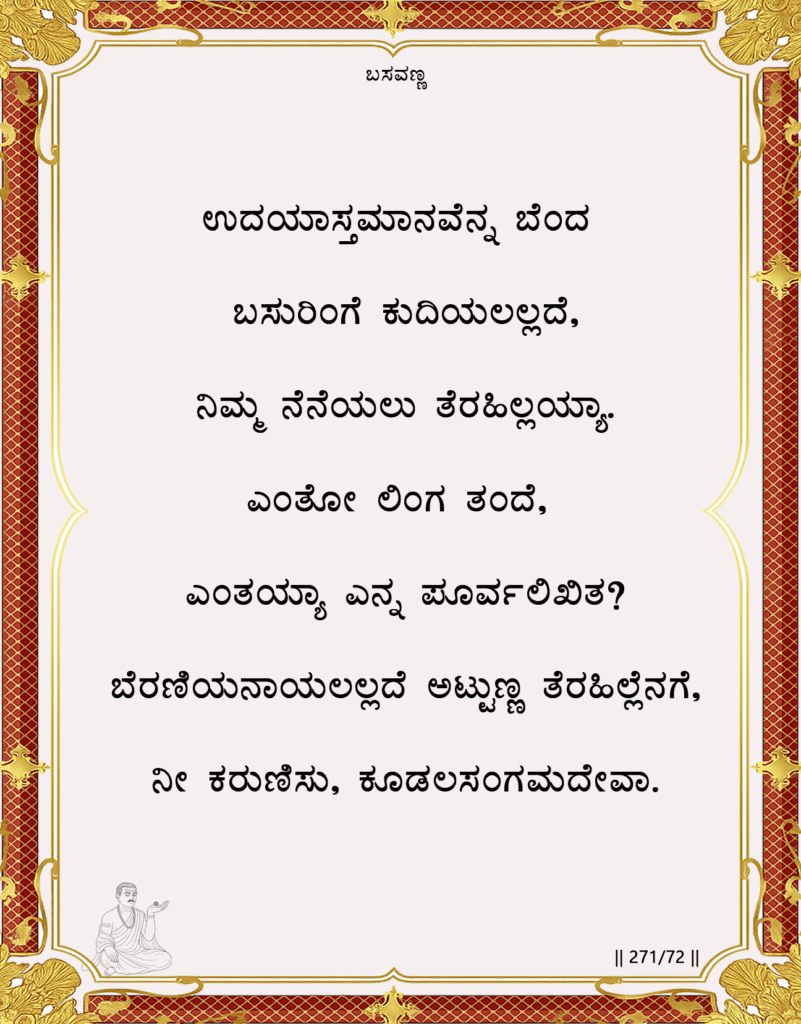
Poetic Rendering

At dawn, pressed by hunger,
I cook, I churn, I swallow
whatever comes to hand
where is the time to remember You?
O Linga, Father
is this the fate You have written for me?
Like a cow dung ember
that flares but cannot warm,
my offerings fall short, insufficient.
Have mercy on me,
O Kudalasangamadeva
breathe meaning into this meagre life.
Basavanna laments that the demands of daily survival leave him with little time for spiritual remembrance. He questions whether this helpless condition is his destined path. Using the image of a weak flame from a cow dung cake, he admits that his efforts feel inadequate. He finally pleads for divine grace to give depth and meaning to his otherwise constrained existence.
Spiritual Context
Core Spiritual Principle: The path of devotion is not separate from the struggles of earthly existence. True spirituality must encompass moments of despair, helplessness, and the feeling of inadequacy, transforming them into a sincere cry for grace.
Cosmic Reality Perspective: The Divine (Linga) is not only the transcendent goal but also the immanent witness to human suffering and limitation. It is the “Father” who hears the cries of his struggling child. The universe’s divine law includes the reality of karma and earthly toil, but grace can infuse this very struggle with sacred purpose.
Historical Reality (Anubhava Mantapa Context): This Vachana grounds the Lingayat path in the reality of the common householder. It is not a path only for ascetics but for those who must cook, churn, and labor for their survival. Basavanna gives voice to the universal anxiety of the working devotee who feels they are failing their spiritual duties due to life’s pressures. This validates the spiritual worth of every honest life and makes the path accessible to all.
Interpretation
1. “At dawn, pressed by hunger, I cook, I churn, I swallow… where is the time to remember You?” The Vachana opens with a vivid depiction of samsara the endless cycle of worldly needs and duties. The “dawn” symbolizes not just a time of day, but the constant pressure of primal needs that seem to eclipse higher spiritual aspirations.
2. “O Linga, Father is this the fate You have written for me?” This is a cry of existential confusion. It is not a rebellion but a heartfelt question from a child to a parent. It reflects the devotee’s struggle to understand the divine will within the confines of a difficult human life.
3. “Like a cow dung ember that flares but cannot warm, my offerings fall short, insufficient.” This is a profound metaphor of felt inadequacy. A cow dung ember gives light and smoke but lacks sustained, penetrating heat. Similarly, the seeker feels their prayers and efforts are fleeting, superficial, and lack the transformative “warmth” of true devotion. They see their life itself as an “offering” that is meager.
4. “Have mercy on me, O Kudalasangamadeva breathe meaning into this meagre life.” The culmination is a pure prayer for grace. The seeker has reached the limit of their own capacity. They cannot, by their own effort, find the time or generate the “heat” of perfect devotion. The only solution is for the Divine to actively “breathe meaning” into their efforts. This is a surrender that invites the Linga to transform the very nature of the struggle, making the cooking and churning themselves into acts of remembrance.
Practical Implications: The seeker is guided to: Honestly bring their struggles and feelings of spiritual failure to the Divine in prayer. Understand that grace is not a reward for perfect practice but a gift that meets us in our imperfection. Offer their daily chores and struggles themselves as a form of worship when formal prayer feels impossible.
The Cosmic Reality
Anga (Human Dimension): The Anga is the exhausted, struggling householder. Their role is not to be a perfect yogi, but to be an honest devotee who turns their helplessness into a sincere plea.
Linga (Divine Principle): The Linga is the compassionate “Father” and the source of mercy. It is the power that can transmute the “meagre” into the “meaningful” by its mere glance of grace.
Jangama (Dynamic Interaction): The Jangama is the act of crying out. It is the dynamic process of turning the mundane struggle into a sacred dialogue. The Jangama is the relationship of dependence that is established when the Anga surrenders its own effort and calls for help.
Shata Sthala
Primary Sthala: Bhakta Sthala. This Vachana epitomizes the stage of the devotee who is intensely aware of their own shortcomings and whose primary practice is heartfelt prayer and surrender.
Supporting Sthala: Prasadi Sthala. The plea for grace is the very gateway to this stage. The “breath of meaning” that the seeker asks for is the descent of grace (prasada) that transforms perception and infuses life with divine significance.
Practical Integration
Arivu (Awareness Practices): Prayer of Helplessness: Use this Vachana as a personal prayer when feeling overwhelmed. Verbally or mentally express your feeling of inadequacy to the Divine, asking for your efforts to be blessed and made sufficient.
Mindfulness in Chores: While performing daily tasks like cooking or cleaning, consciously offer the action to Kudalasangamadeva, asking that the act itself become a remembrance.
Achara (Personal Discipline): Maintain a simple, consistent spiritual practice, however short, even on busy days. The discipline is in the turning towards God, even if only for a moment.
Kayaka (Sacred Action): Re frame your daily work as your primary spiritual offering. See your labor to feed yourself and your family as a sacred duty (svadharma) that is itself a form of worship when offered with the right intention.
Dasoha (Communal Offering): Share your struggles with trusted fellow seekers. Normalize the conversation about the difficulty of balancing spiritual and worldly life, creating a supportive community that relies on collective grace.
Modern Application
“The Burnout Culture and Spiritual Guilt.” In the modern high pressure, productivity obsessed world, individuals are constantly overwhelmed by professional and personal demands. This leads to burnout and a profound sense of guilt for “failing” to maintain a spiritual practice, meditate, or find meaning, which can cause them to abandon the path altogether.
The Liberative Application: This Vachana is a healing balm for the modern soul. It liberates one from the guilt of not being a “perfect” seeker. It teaches that God is found not in spite of our struggles, but within them. It offers a spirituality for the overwhelmed a path where crying out “I cannot do this!” becomes a powerful prayer that invites the transformative grace that can make our busy, “meagre” lives profoundly meaningful.
Essence
The world’s hunger is a loud, constant cry.
My own hunger, a taskmaster with a whip.
Between the cooking pot and the empty belly,
where does the soul find its space to pray?
My life is a damp ember, Lord, a flicker without flame.
You are the wind. Breathe on me.
Make this smoke into an offering You can accept.
This Vachana presents a spirituality of imperfection. It maps the metaphysical truth that the human condition is one of inherent limitation (dukha), and that the bridge across this limitation is not superior personal effort, but grace (prasada). Its multidimensional impact is to make the entire human experience including failure, exhaustion, and doubt a valid part of the devotional relationship. It positions the Jangama as the principle of compassionate response, the assurance that the Divine hears the cry of the struggling heart and meets it not with judgment, but with the life giving “breath” that transforms struggle into sacred service.
You do not have to be a saint to call upon God. You can come exactly as you are overwhelmed, tired, and feeling like a failure. Your feeling of inadequacy is not a barrier to grace; it is the very ground upon which grace can act. When you have nothing else to offer, offer your struggle. When you have no time to pray, let your sigh be your prayer. The Divine is not waiting for you to become perfect; it is waiting for you to ask for help in becoming whole.

Views: 6