
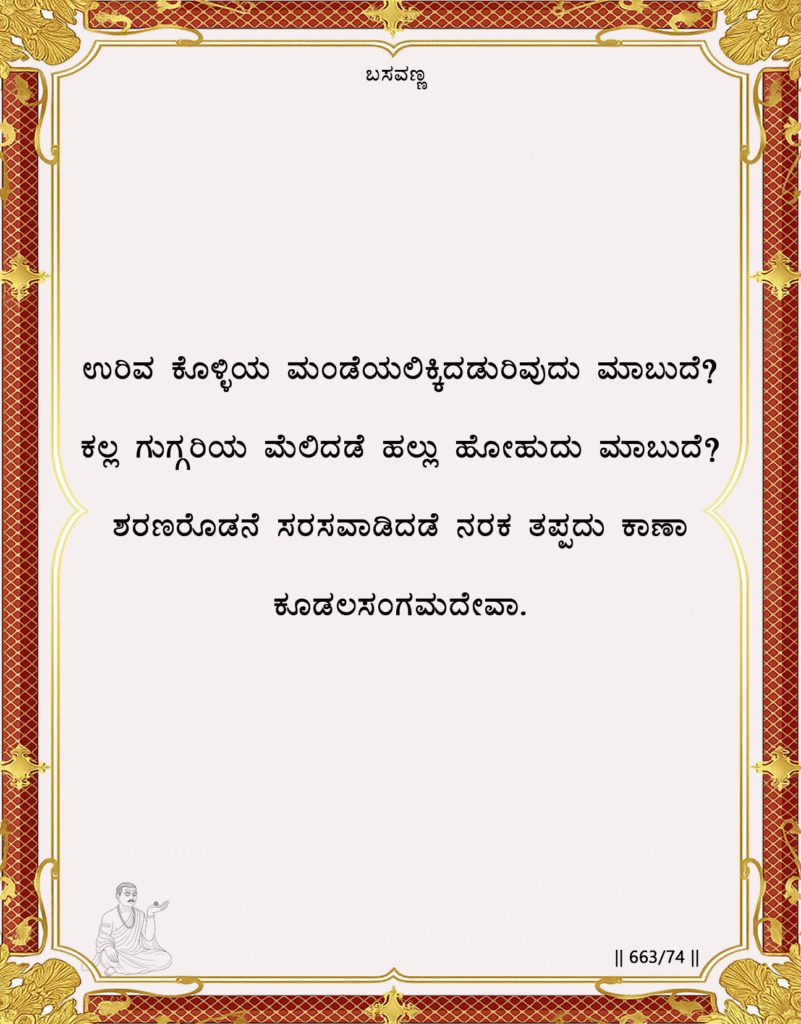
Poetic Rendering
Can one place glowing embers on the head
and hope to escape the burn?
Can one chew grain mixed with stones
and not shatter the jaw?
So too
those who mock or scorn the sharanas
turn away from truth itself,
and in that very moment
fall into their own hell.
For the sharanas are living fire,
the steadfast stone of truth,
O Kudalasangamadeva.
Basavanna teaches that mocking the sharanas is not merely disrespect it is a self inflicted fall from truth. Just as embers burn instantly and stones break the teeth at once, those who deride divine beings immediately create their own inner hell. The moment one turns against the sharanas, one collapses into spiritual ruin.
Spiritual Context
Core Spiritual Principle: The Sharanas (realized beings) are not merely holy individuals; they are living embodiments of the Divine Truth (Linga). To disrespect them is to actively reject the Truth they embody, and this rejection carries immediate and severe spiritual consequences, as it is a violation of cosmic law.
Cosmic Reality Perspective: The universe operates on immutable laws (Rta). Just as the physical law of gravity causes a fall, a spiritual law governs the consequences of one’s relationship with the sacred. The Sharana is a conduit of divine consciousness. Attacking the conduit does not harm the source but severs the attacker’s own connection to it, creating an immediate state of inner alienation and suffering a self created “hell.”
Historical Reality (Anubhava Mantapa Context): In the volatile social environment of 12th century Karnataka, the Sharanas faced ridicule and persecution from orthodox quarters. This Vachana is a powerful declaration and a warning. It serves to protect the community by instilling a deep sense of the sacredness of its members. It also empowers the Sharanas, affirming that their spiritual stature is not a matter of opinion but an objective reality, and that cosmic justice operates in their defense.
Interpretation
1. “Can one place glowing embers on the head and hope to escape the burn?” The first analogy uses the law of thermodynamics. Fire burns; it is its nature. The consequence is immediate and physical. This represents the jnana shakti (power of knowledge) of the Sharana. Their consciousness is a fire of truth that instantly burns the ignorance of those who attack it, not as punishment, but as a natural consequence.
2. “Can one chew grain mixed with stones and not shatter the jaw?” The second analogy uses a law of mechanics. A hard object breaks a softer one upon impact. This represents the dharma shakti (power of righteousness) of the Sharana. They are the unyielding “stone of truth.” To “chew” on them with the “teeth” of a malicious mind is to inevitably shatter one’s own mental and spiritual faculties.
3. “those who mock or scorn the sharanas turn away from truth itself, and in that very moment fall into their own hell.” This is the core doctrinal statement. The “fall” is not a future punishment in an afterlife. It is an immediate, existential event. The act of mocking is itself the turning away. The “hell” is the inner state of being divorced from truth, a condition of self inflicted spiritual darkness and suffering that begins the instant the disrespectful thought or word arises.
4. “For the sharanas are living fire, the steadfast stone of truth…” This confirms that the Sharanas are not passive victims but active spiritual principles. They are the very forces of divine law in human form. To engage with them negatively is to engage directly with these inviolable laws.
Practical Implications: The seeker is guided to: Cultivate utmost reverence for all spiritual beings and seekers, recognizing them as potential vessels of the divine. Understand that criticism and gossip about spiritual figures are not harmless opinions but acts that cause direct spiritual harm to the one who engages in them. Guard one’s speech and thoughts, ensuring they are always aligned with respect and humility towards the sacred.
The Cosmic Reality
Anga (Human Dimension): The Anga is the individual whose mind is the “head” being burned or the “jaw” being shattered. Their spiritual well being depends entirely on their attitude towards the Jangama. Reverence allows for the flow of grace; disrespect triggers an immediate karmic backlash.
Linga (Divine Principle): The Linga is the fundamental, unchanging Truth. It is the source of the “fire” and the substance of the “stone.”
Jangama (Dynamic Interaction): The Jangama is the Sharana, the “living fire” and “steadfast stone.” The dynamic interaction is the law of consequence itself: the seeker’s attitude towards the Jangama determines their own spiritual state. The Jangama is the litmus test for the Anga’s alignment with truth.
Shata Sthala
Primary Sthala: Bhakta Sthala. This Vachana lays the essential foundation for a devotee: the cultivation of Guru Bhakti and Sanga Bhakti devotion to the teacher and the holy company. Without this reverence, progress on the path is impossible, as one is constantly violating the fundamental law of the spiritual ecosystem.
Supporting Sthala: The principle extends to all stages. Even for a Sharana, disrespecting another Sharana would be a violation of the self same truth they embody.
Practical Integration
Arivu (Awareness Practices): Contemplation on Reverence: Meditate on the importance of the Guru and the Sangha. Reflect on the idea that your progress is directly linked to your reverence for the path and its exemplars.
Mindfulness of Speech and Thought: Vigilantly monitor your inner dialogue about spiritual teachers and fellow seekers. If a critical or mocking thought arises, see it as a “glowing ember” and let it go before it burns you.
Achara (Personal Discipline): Make a vow to never speak ill of any spiritual figure or fellow seeker. Cultivate the discipline of seeing the divine potential in everyone.
Kayaka (Sacred Action):In your workplace and social life, practice this principle by respecting those in positions of authority and knowledge, understanding that disrespect creates immediate negative consequences for your own peace and clarity.
Dasoha (Communal Offering): Actively protect the sanctity of your spiritual community. Gently discourage gossip and criticism, and help create an environment of mutual respect and reverence.
Modern Application
“The Culture of Cynicism and Deconstruction.” Modern society, particularly online, encourages criticism, cynicism, and the “tearing down” of public figures, including spiritual teachers. This habit, when applied to the spiritual realm, is extremely damaging to the seeker’s own consciousness, fostering judgment and closing the heart.
The Liberative Application: This Vachana provides a crucial ethical and psychological safeguard. It liberates the seeker from the toxic habit of spiritual criticism and gossip. It teaches that cultivating a respectful and reverent mind is not for the benefit of the teacher, but for the protection and progress of the seeker’s own soul. It fosters a mindset of humility and learning, which is essential for any genuine growth.
Essence
Spit at the sun, you wet your own face.
Kick the mountain, you break your own foot.
The truth that the saints embody is a fire and a stone.
To mock them is to choose, with clear eyes,
to be burned, to be broken,
to build your own prison of scorn and live in it alone.
This Vachana establishes a spiritual law of cause and effect that is as immediate and non negotiable as physical laws. It maps the metaphysical connection between the individual’s attitude and their spiritual state. Its multidimensional impact is to create a protected spiritual ecosystem (Sangha) where reverence is the currency of safety and progress. It positions the Jangama as the central, active node in this ecosystem the point where the abstract divine law becomes tangible and interactive. Disrespecting the Jangama is not a social faux pas; it is a direct rebellion against the architecture of reality itself, with instantaneous consequences.
Be careful where you direct your disrespect. Mocking what is sacred, true, or profoundly good does not diminish the sacred; it diminishes you. It immediately poisons your own mind and separates you from the very sources of light and wisdom you need. Cultivate reverence. It is not a sign of weakness but the master key that unlocks the door to higher understanding and inner peace.

Views: 9