

Summary
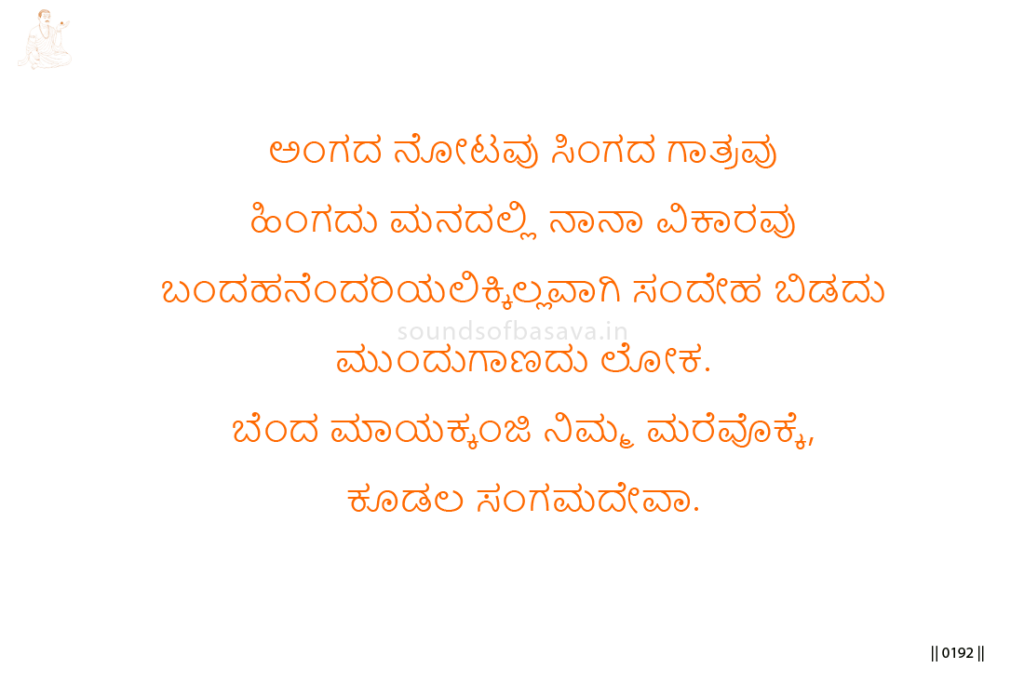
In this vachana, Basavanna speaks of the Linga held in the palm, small in measure, yet the mind remains filled with many distortions.
The difficulty is not distance from the Linga. The difficulty is lack of clear recognition while the Linga is already near.
Basavanna says that he does not know why he has come, doubt does not leave, and no path is seen ahead. Hardened by Māyā, he forgets Kudalasangama Deva.
Imagery & Symbolic Relevance
The first image is the Linga in the palm. Its small form shows nearness and direct presence, not absence.
The second image is the mind filled with many distortions. The Linga is near, but the mind does not remain clear before it.
The third image is not knowing why one has come. Purpose itself has become obscured.
The fourth image is doubt that does not leave. Doubt prevents steady recognition and forward movement.
The fifth image is the path not seen ahead. The seeker stands near the Linga, yet direction remains unclear.
The final image is forgetfulness through hardened Māyā. Māyā does not merely distract; it makes Basavanna forget Kudalasangama Deva.
Together, these images show obstructed nearness. The Linga is close, but distortion, doubt, pathlessness, and Māyā prevent recognition.
Lingayoga
In Lingayoga, this vachana shows that holding the Linga is not enough if the mind remains distorted.
The palm-held Linga gives the field of practice. The obstacle lies in the mind that cannot see rightly before what is already present.
Doubt and forgetfulness must be treated as serious obstructions. When Māyā hardens, even nearness does not become recognition.
The practical movement here is recovery of remembrance. Basavanna sees that the Linga is near, yet he asks from within the pain of forgetting Kudalasangama Deva.
Editorial Commentary
This vachana should be read as a confession of nearness without clarity. Basavanna does not say that Kudalasangama Deva is far away. He shows the more painful condition: the Linga is near, yet the mind’s distortion and Māyā prevent recognition.
Related Vachana
Supporting Vachana
Bhakta Sthala Vachana 1 — The Hidden Fire
Bhakta Sthala Vachana 1 supports this vachana by showing Kudalasangama Deva as already hidden within the seeker, like fire in water, taste in sap, fragrance in dew, and maidenly love. Vachana 42 carries this hidden nearness into Maheshwara Sthala, where the Linga is held close, yet the mind’s distortions and doubt prevent clear recognition.
Advancing Vachana
Prasadi Sthala Vachana 630 — When Remembrance Dies
Prasadi Sthala Vachana 630 advances this movement by showing the consequence of forgetfulness. In Vachana 42, hardened Māyā makes Basavanna forget Kudalasangama Deva. In Vachana 630, forgetting Kudalasangama Deva is named as death itself.
