Poetic Rendering

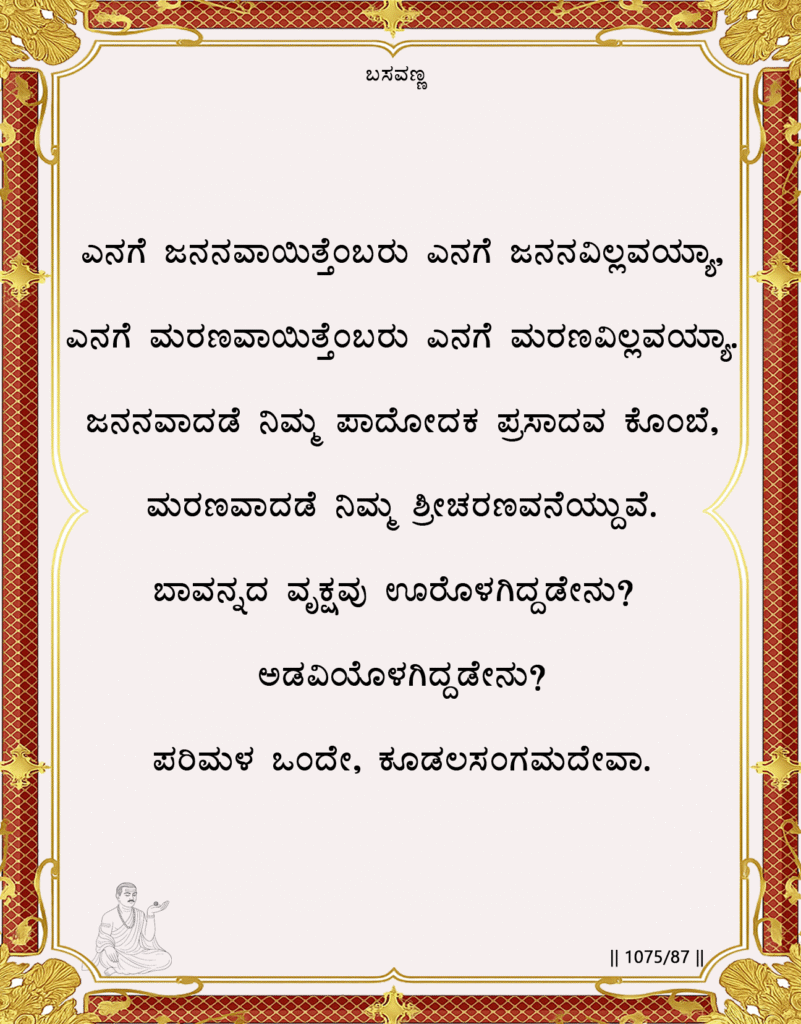
Some say I am born,
some say I die
but in birth I drink
the water of Your sacred feet,
and in death I fall
to rest upon them.
What matters where a tree grows
in forest or in village?
Its fragrance is the same.
So too the scent of my life
is only You,
O Koodalasangamadeva.
This vachana dissolves the fear and confusion surrounding birth and death. Basavanna shows that both events are merely different movements within the same divine presence. Because the devotee remains always anchored in the Lord at His feet in life and death these opposites lose their meaning. Like a tree whose fragrance remains unchanged regardless of where it grows, the essence of the sharana remains constant through all conditions. The true self is untouched, birthless, and deathless, unified in the eternal fragrance of God.
Spiritual Context
Core Spiritual Principle: For the realized being, the great dualities of existence birth and death are mere changes of state within the unchanging divine reality. The essential identity of the soul, its “fragrance,” remains constant and one with God.
Cosmic Reality Perspective: From the perspective of the Absolute (Linga), there is no creation or destruction, only transformation. The individual soul (jiva) is an eternal, immutable spark of this consciousness. What is called “birth” is the spark taking on a particular form; what is called “death” is the shedding of that form. The substance (consciousness) remains unchanged. The Linga is the eternal ground upon which this play of form occurs.
Historical Reality (Anubhava Mantapa Context): This Vachana provides the ultimate freedom from existential fear. In a society where rituals surrounding birth and death were often controlled by priestly classes to instill fear and dependency, Basavanna offers a revolutionary insight: the enlightened Sharana is beyond the jurisdiction of these cosmic events. This empowered the common devotee, freeing them from psychological bondage to the cycle of life and death and the authority of those who claimed to mediate it.
Interpretation
1. “Some say I am born, some say I die ” Basavanna begins by acknowledging the conventional, dualistic perspective. He does not deny the appearance of birth and death but questions the reality assigned to them.
2. “but in birth I drink the water of Your sacred feet, and in death I fall to rest upon them.” This is the core re framing. He redefines both events not as beginnings and endings, but as different modes of connection to the same divine source (the “sacred feet”).
Birth: Is not the start of a separate existence but the opportunity to “drink” or consciously partake of divine grace. Death: Is not an annihilation but a “falling to rest” upon the same divine ground a return, not an end.
3. “What matters where a tree grows in forest or in village? Its fragrance is the same.” This powerful analogy shifts the focus from the external circumstance to the internal, essential nature. The “tree” is the individual soul. The “forest” and “village” represent different lifetimes, circumstances, or states of existence (life/death). The “fragrance” is the essential nature of the soul, which is divine consciousness. This remains unchanged.
4. “So too the scent of my life is only You, O Koodalasangamadeva.” The final, triumphant declaration. The seeker’s fundamental identity is not the body mind that is born and dies, but the divine “scent” that permeates it the Linga itself. The sense of a separate self has been entirely replaced by the recognition of God as one’s own true essence.
Practical Implications: The seeker is guided to: Cultivate the awareness of being the unchanging witness to the changing states of the body and mind. Overcome the fear of death by realizing one’s true identity as the deathless consciousness. See all of life’s changes as occurring within the divine, not as events that happen to a separate self.
The Cosmic Reality
Anga (Human Dimension): The Anga is the “fragrance” the essential, conscious core of the individual that is one with the Divine and remains unchanged through all apparent transformations.
Linga (Divine Principle): The Linga is the source and substance of the “fragrance.” It is the “sacred feet,” the eternal ground of being.
Jangama (Dynamic Interaction): The Jangama is the constant, unwavering relationship of the fragrance to its source. It is the truth that whether the soul is “drinking” (in life) or “resting” (in death), its connection to the Linga is unbroken.
Shata Sthala
Primary Sthala: Aikya Sthala. This Vachana expresses the stabilized consciousness of union, where the soul knows itself to be non different from the Divine, and thus transcendent to the cycles of birth and death.
Supporting Sthala: Pranalingi Sthala is the stage of realizing the “inner Linga,” which is the precursor to this understanding that the inner essence is eternal and divine.
Practical Integration
Arivu (Awareness Practices): Fragrance Meditation: Meditate on your essential self as a divine fragrance, untouched by the circumstances of your life or body. Feel this fragrance as eternal and one with God.
Contemplation on Impermanence: Observe the constant change in the body, thoughts, and world. Use this observation to reinforce the understanding that you are the unchanging awareness behind it all.
Achara (Personal Discipline): Live with the freedom that comes from knowing your true self is immortal. Let this understanding remove anxiety and inspire fearlessness in your actions.
Kayaka (Sacred Action): Perform your duties without attachment, knowing that the true actor is the divine consciousness within, which is beyond the results and the lifespan of the action.
Dasoha (Communal Offering): Comfort those who fear death by sharing this vision of the eternal soul. Help build a community that understands life and death as sacred transitions within the divine play.
Modern Application
“Existential Anxiety and the Fear of Annihilation.” Modern secular culture, often devoid of a spiritual context for death, can lead to deep existential dread, a frantic attempt to deny aging, and a life lived in the shadow of meaninglessness.
The Liberative Application: This Vachana offers the ultimate liberation from the terror of non existence. It provides a rational, experiential, and profound basis for understanding that our core being is eternal. It allows one to live fully and fearlessly, embracing life without the paralyzing fear of its end, and to face death not as a termination but as a transition within the eternal.
Essence
They point at the body and say, “Here, he is born.”
They point at the ashes and say, “There, he has died.”
But the space between the pointing fingers
is where I have always lived.
I am the silence before the first cry,
I am the peace after the last breath.
I am the scent that the fire cannot burn away.
This Vachana presents a metaphysics of identity that transcends ontology (the philosophy of being). It asserts that the true Self (Atman) is not a being that is but is the very ground of Being (Linga) itself. Therefore, it is not subject to the categories of existence and non existence that define phenomenal reality. Its multidimensional impact is to resolve the fundamental human anxiety about mortality, revealing it to be based on a misidentification with the transient form. It positions the Jangama as the lived understanding of this truth a human life that moves through the world as the eternal, fragrant essence, utterly free from the tyranny of time and change.
You are not the story of your birth, your life, or your death. You are the timeless consciousness in which that story appears. Do not fear the closing of a chapter, for you are the book itself, and the reader, and the silent library that holds all stories. Your true essence is a divine fragrance that cannot be created or destroyed. Live in that knowing, and you will live without fear, and die without end.

Views: 11