

Summary
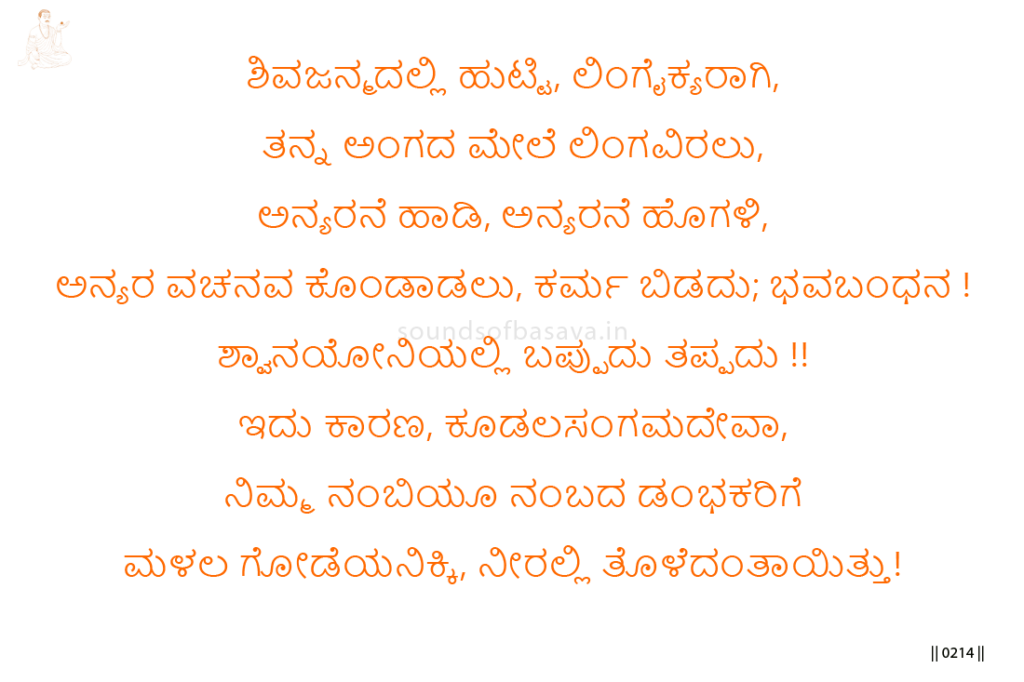
In this vachana, Basavanna warns against divided devotion after receiving the Linga. One may be born into Shiva’s way, receive the Linga, and bear it upon the body, yet still turn elsewhere in praise, following, and speech.
The problem is not the absence of the Linga. The Linga is present on the body. The failure lies in divided direction.
When praise and speech move elsewhere, karma does not leave and bhava-bondage remains. Basavanna says such a fall leads even to dog-birth. For those who say they trust Kudalasangama Deva yet do not truly trust, devotion becomes like a mud wall washed in water.
Imagery & Symbolic Relevance
The first image is birth into Shiva’s way. Basavanna begins with one who has entered the sacred path.
The second image is the Linga upon the body. The sign is close and visible, but outward bearing alone does not ensure fidelity.
The third image is praising another. Praise reveals where reverence is actually directed.
The fourth image is following another. Direction itself has shifted away from the path already received.
The fifth image is celebrating another’s word. Speech now takes delight elsewhere, and the person who bears the Linga becomes divided in utterance.
The sixth image is karma and bhava-bondage remaining. Basavanna makes the consequence clear: divided devotion does not release bondage.
The seventh image is dog-birth. It shows decline into an instinct-driven state when the path of the Linga is not lived.
The final image is the mud wall washed in water. A mud wall may appear to stand, but water breaks it down. In the same way, trust that is claimed but not lived cannot endure.
Together, these images show unstable devotion. The Linga is borne, but praise, following, and speech move elsewhere; therefore the structure collapses like a mud wall in water.
Lingayoga
The first image is birth into Shiva’s way. Basavanna begins with one who has entered the sacred path.
The second image is the Linga upon the body. The sign is close and visible, but outward bearing alone does not ensure fidelity.
The third image is praising another. Praise reveals where reverence is actually directed.
The fourth image is following another. Direction itself has shifted away from the path already received.
The fifth image is celebrating another’s word. Speech now takes delight elsewhere, and the person who bears the Linga becomes divided in utterance.
The sixth image is karma and bhava-bondage remaining. Basavanna makes the consequence clear: divided devotion does not release bondage.
The seventh image is dog-birth. It shows decline into an instinct-driven state when the path of the Linga is not lived.
The final image is the mud wall washed in water. A mud wall may appear to stand, but water breaks it down. In the same way, trust that is claimed but not lived cannot endure.
Together, these images show unstable devotion. The Linga is borne, but praise, following, and speech move elsewhere; therefore the structure collapses like a mud wall in water.
Editorial Commentary
This vachana should be read as a warning against divided fidelity. Basavanna does not question the Linga. He questions the one who bears it outwardly while turning elsewhere in praise, direction, and speech.
Related Vachana
Supporting Vachana
Bhakta Sthala Vachana 104 — The Divided Heart
Bhakta Sthala Vachana 104 supports this vachana by showing sacred practice weakened by inner division. Its image of the vessel washed outside but still impure within prepares the mud-wall image of Vachana 107. In both, outward form cannot sustain devotion when the inner condition remains divided.
Advancing Vachana
Prasadi Sthala Vachana 483 — The Grace That Burns Delusion
Prasadi Sthala Vachana 483 advances this movement by showing the release that Vachana 107 lacks. In Vachana 107, karma remains, bhava-bondage continues, and divided trust collapses like a mud wall. In Vachana 483, Kudalasangama Deva washes the stain of births, cuts the bonds of becoming, and burns the knots of delusion.
