

Summary
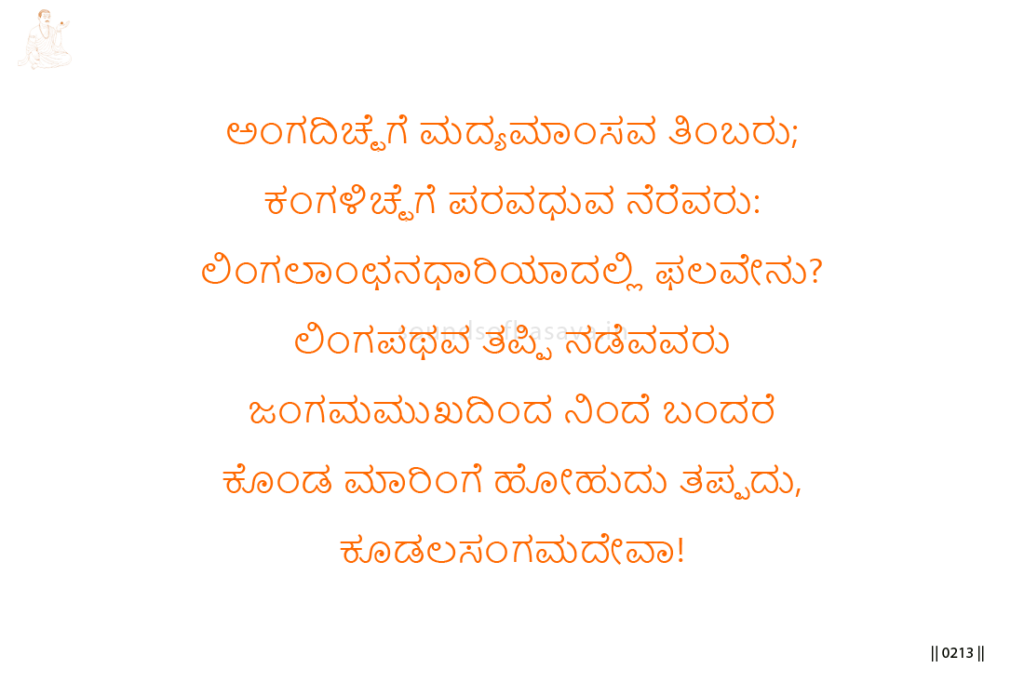
In this vachana, Basavanna exposes the contradiction between bearing the Linga-mark and straying from the Linga-path.
For the body’s desire, one turns toward liquor and meat. For the eyes’ desire, one goes toward another’s woman. The body and eyes still follow craving, even while the sacred mark is worn.
Basavanna then asks what fruit there is in carrying the Linga-mark if conduct has left the path. When rebuke comes from the mouth of the Jangama, it burns like falling into fire before Kudalasangama Deva.
Imagery & Symbolic Relevance
The first image is the body’s desire. The body becomes the field where craving shows itself.
The second image is liquor and meat. These show bodily appetite when it is allowed to govern conduct.
The third image is the desire of the eyes. Sight does not remain simple seeing; it moves toward what it wants.
The fourth image is going toward another’s woman. This shows desire crossing rightful limits and leaving the path.
The fifth image is the Linga-mark. The mark declares belonging to the Linga, but Basavanna asks what fruit it has if the wearer strays from the Linga-path.
The sixth image is the mouth of the Jangama. The Jangama speaks as living corrective presence. His word exposes what the outward mark cannot hide.
The final image is fire. The rebuke burns because it reveals the contradiction between sacred identity and actual conduct.
Together, these images show the failure of outward initiation without inward alignment. The Linga-mark must be lived through conduct, or the Jangama’s word becomes fire.
Lingayoga
In Lingayoga, this vachana tests whether the Linga-mark has entered conduct. Bearing the mark is not enough if the body and eyes still follow craving.
The Linga-path requires alignment of sign and life. When the mark is worn but the path is abandoned, devotion becomes divided.
The Jangama’s rebuke becomes necessary correction. It burns because it brings hidden contradiction into the open before Kudalasangama Deva.
Editorial Commentary
This vachana should be read as a warning against sacred identity without corresponding conduct. Basavanna does not reject the Linga-mark. He rejects the condition in which one wears it while bodily craving and eye-desire still govern life.
Related Vachana
Supporting Vachana
Bhakta Sthala Vachana 193 — The Living Altar
Bhakta Sthala Vachana 193 supports this vachana by showing that worship of the Linga must become living response to the Jangama. Vachana 106 carries this into sharper correction: one may wear the Linga-mark, but if one strays from the Linga-path, the Jangama’s word exposes the contradiction.
Advancing Vachana
Prasadi Sthala Vachana 260 — Not Washed but Made Pure
Prasadi Sthala Vachana 260 advances this movement by showing that surface cleansing cannot remove inner fault. Vachana 106 exposes the one whose Linga-mark remains outward while craving still rules conduct. Vachana 260 carries this into Prasadi Sthala, where hidden faults must be burned out, the self melted, and the seeker made pure through surrender to Kudalasangama Deva.
