

Summary
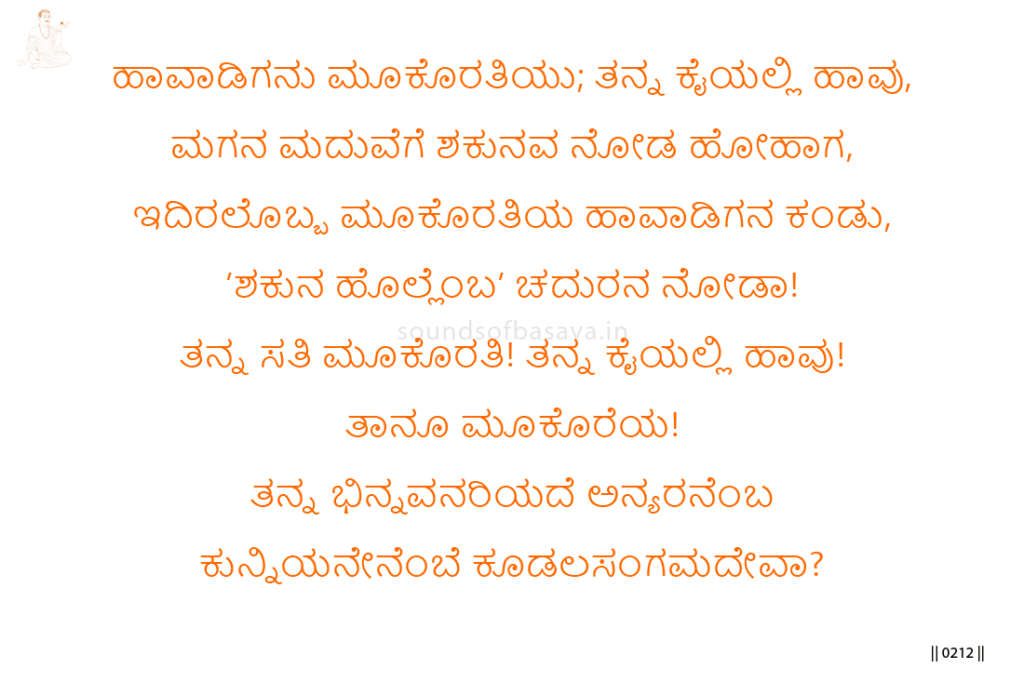
In this vachana, Basavanna exposes one who sees another’s defect but does not see his own. A snake-charmer goes to seek an omen for his son’s marriage and sees another snake-charmer with the same defect.
He calls that sight a bad omen, yet his own wife is noseless, a snake is in his own hand, and he himself is noseless. What he rejects outside already belongs to his own house, hand, and body.
Basavanna turns the judgment back upon the judge. Before Kudalasangama Deva, he asks what such a person should be called: one who does not know his own defect, yet names another as defective.
Imagery & Symbolic Relevance
The first image is the snake-charmer. He handles danger and signs, yet this familiarity does not give him self-knowledge.
The second image is the search for an omen. His attention moves outward, seeking a sign for his son’s marriage.
The third image is the other snake-charmer. He sees in another what he considers inauspicious.
The fourth image is his own household. His wife bears the same defect he rejects outside.
The fifth image is the snake in his own hand. The condition he judges is not distant; it is already with him.
The final image is the man himself. He is marked by the same defect and yet does not know himself.
Together, these images show self-deception. The man sees another, judges another, and names another defective, while failing to see his own condition.
Lingayoga
In Lingayoga, this vachana shows that practice must begin with self-seeing. Outward judgment has no worth if the seeker remains blind to himself.
The snake in the hand makes the warning direct. The danger is already being carried, yet the mind looks elsewhere.
The practical movement here is inward correction. Basavanna does not ask the seeker to read omens outside, but to know the defect within before Kudalasangama Deva.
Editorial Commentary
This vachana should be read as a correction of outward judgment. Basavanna is not merely telling a story about omens. He exposes the mind that condemns outside while remaining blind to its own condition.
Related Vachana
Supporting Vachana
Bhakta Sthala Vachana 108 — The Futility of the Unlived Truth
Bhakta Sthala Vachana 108 supports this vachana through the image of the blind person holding a mirror. A mirror is present, but the blind cannot use it for seeing. Vachana 105 carries the same condition into lived judgment: the snake-charmer can see another’s defect, but cannot see himself.
Advancing Vachana
Prasadi Sthala Vachana 630 — When Remembrance Dies
Prasadi Sthala Vachana 630 advances this movement by showing that wrong seeing and wrong speech are forms of inner death. Vachana 105 exposes a man who sees wrongly and judges from self-ignorance. Vachana 630 carries this into Prasadi Sthala, where sight, speech, and remembrance must remain turned toward Kudalasangama Deva.
