

Summary
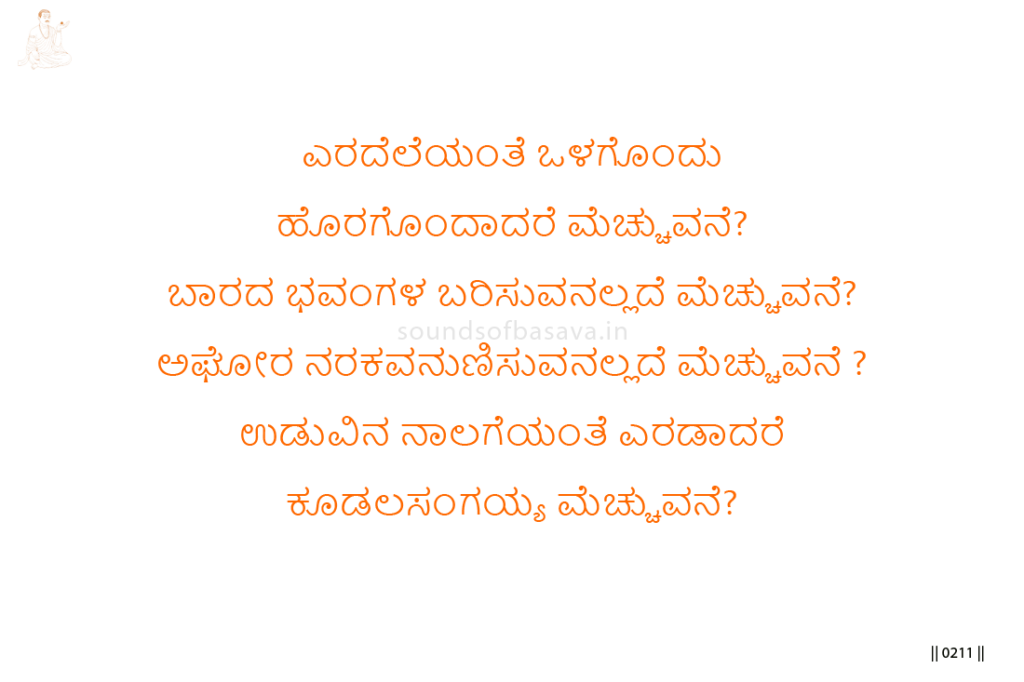
In this vachana, Basavanna asks whether Kudalasangama Deva will accept one thing within and another thing outside. The question exposes a life divided at its root.
He then asks whether fabricated worlds of becoming will be accepted, and whether the terrible hell one prepares for oneself will be accepted. Division does not remain harmless; it creates its own suffering.
The final image is the lizard’s forked tongue. If one becomes double in this way, how can Kudalasangama Deva approve? The vachana teaches that only an undivided being can stand in truth.
Imagery & Symbolic Relevance
The first image is inner and outer difference. What is held within does not agree with what is shown outside. This is the basic division Basavanna rejects.
The second image is the double leaf. It suggests a form that has two faces, one side turned one way and another side turned differently. Basavanna uses it to show a divided self.
The third image is fabricated worlds of becoming. The mind creates false states, imagined standing, and unreal constructions. These do not free the seeker; they bind him more deeply.
The fourth image is terrible hell. Basavanna shows that divided living prepares its own suffering. The hell is produced by the fragmentation one continues to live.
The final image is the lizard’s forked tongue. This is the sharpest image in the vachana. A forked tongue speaks from one source in two directions, just as the divided person shows one thing and holds another.
Together, these images show the danger of doubleness. Inner and outer must not split, speech must not become forked, and imagined spiritual standing must not replace truth.
Lingayoga
In Lingayoga, this vachana tests alignment between inner state, outer conduct, and speech. Practice cannot mature where the self remains divided.
The lizard’s forked tongue shows the danger of double expression. Speech must arise from the same truth that is lived within.
The practical movement here is indivisibility. Basavanna brings the divided condition before Kudalasangama Deva and shows that what is double cannot unite with truth.
Editorial Commentary
This vachana should be read as a warning against divided being. Basavanna does not treat duplicity as a minor fault of speech. When inner state, outer appearance, and spoken word do not agree, the whole person becomes split.
Related Vachana
Supporting Vachana
Bhakta Sthala Vachana 803 — Words Become the Mirror of the Soul
Bhakta Sthala Vachana 803 supports this vachana by teaching that speech must be pure, luminous, and acceptable to the Linga, but that speech has no value if conduct does not move within it. Vachana 102 carries this into a sharper warning: speech like the lizard’s forked tongue cannot stand before Kudalasangama Deva.
Advancing Vachana
Prasadi Sthala Vachana 630 — When Remembrance Dies
Prasadi Sthala Vachana 630 advances this movement by naming wrong seeing, wrong speech, and forgotten remembrance as death. Vachana 102 exposes inner-outer division and forked speech. Vachana 630 carries this into Prasadi Sthala, where the tongue that speaks wrongly and the remembrance that forgets Kudalasangama Deva mark the loss of spiritual life itself.
