

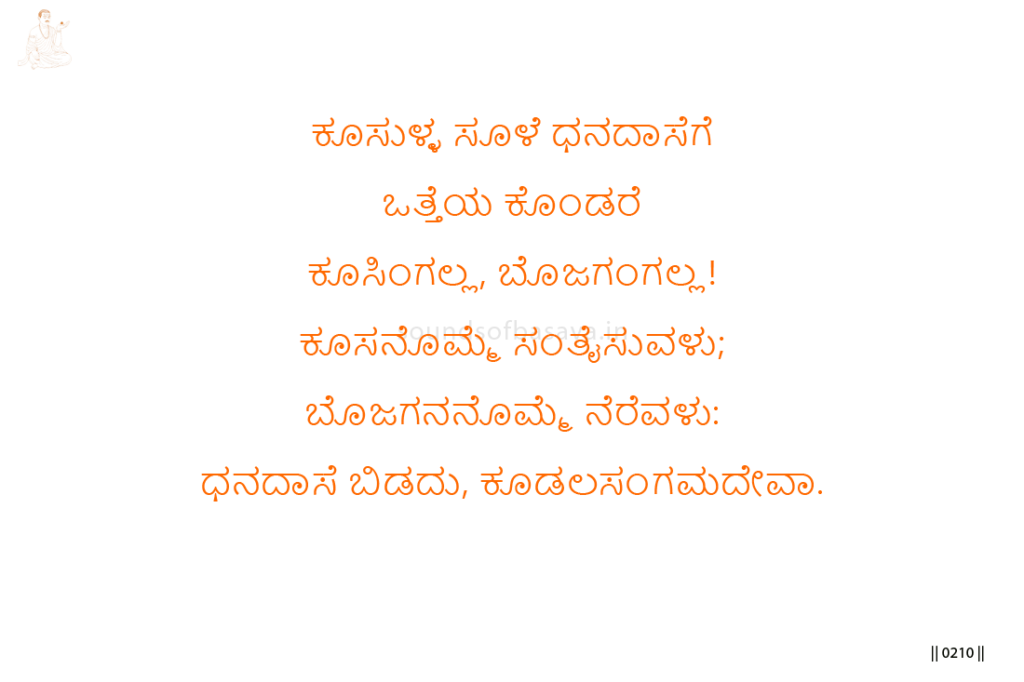
Summary
In this vachana, Basavanna exposes a relationship governed by hidden gain. The courtesan may turn toward the child at one moment and toward the lover at another, but the desire for wealth does not leave.
The outer movement appears relational, yet the inward motive remains fixed on gain. The child and the lover are not the center; wealth is.
Basavanna brings this before Kudalasangama Deva as a warning against devotion ruled by hidden motive. When desire for gain remains beneath the act, devotion becomes transaction.
Imagery & Symbolic Relevance
The first image is the courtesan. She represents outward closeness without inward fidelity.
The second image is the child. The child receives attention, but the attention does not remove the deeper pull of wealth.
The third image is the lover. The lover too may be attended, but the hidden motive remains unchanged.
The fourth image is desire for wealth. This is the center of the vachana. It does not leave, even while relationship appears to move in different directions.
The final image is devotion before Kudalasangama Deva. Basavanna shows that sacred action becomes false when gain remains its hidden aim.
Together, these images expose divided motive. One may appear to love, serve, or turn toward another, but if wealth remains the inner aim, the relationship is not whole.
Lingayoga
In Lingayoga, this vachana tests the motive behind practice. The outer act may appear devotional, but the inward aim must be examined.
If the seeker approaches Kudalasangama Deva for gain, the movement remains divided. The Divine is treated as a means, not as the final refuge.
The practical movement here is purification of intention. Devotion must be freed from hidden commerce before it can become surrender.
Editorial Commentary
This vachana should be read as a test of motive. Basavanna does not focus on outward relation alone. He exposes the desire that remains beneath it. Where gain is still sought, devotion has not yet become whole.
Related Vachana
Supporting Vachana
Bhakta Sthala Vachana 223 — Purity in Earning, Purity in Giving
Bhakta Sthala Vachana 223 supports this vachana by teaching that wealth cannot become sacred if its source is impure. Vachana 101 carries the concern inward: even when the outward act appears devotional, hidden desire for gain makes it transactional.
Advancing Vachana
Prasadi Sthala Vachana 507 — Free of All Wanting
Prasadi Sthala Vachana 507 advances this movement by showing purity only when wanting and return-seeking have ended. Vachana 101 exposes devotion corrupted by wealth-desire. Vachana 507 carries this into Prasadi Sthala, where worship becomes pure only when the doer is free of expectation before Kudalasangama Deva.
