Poetic Rendering
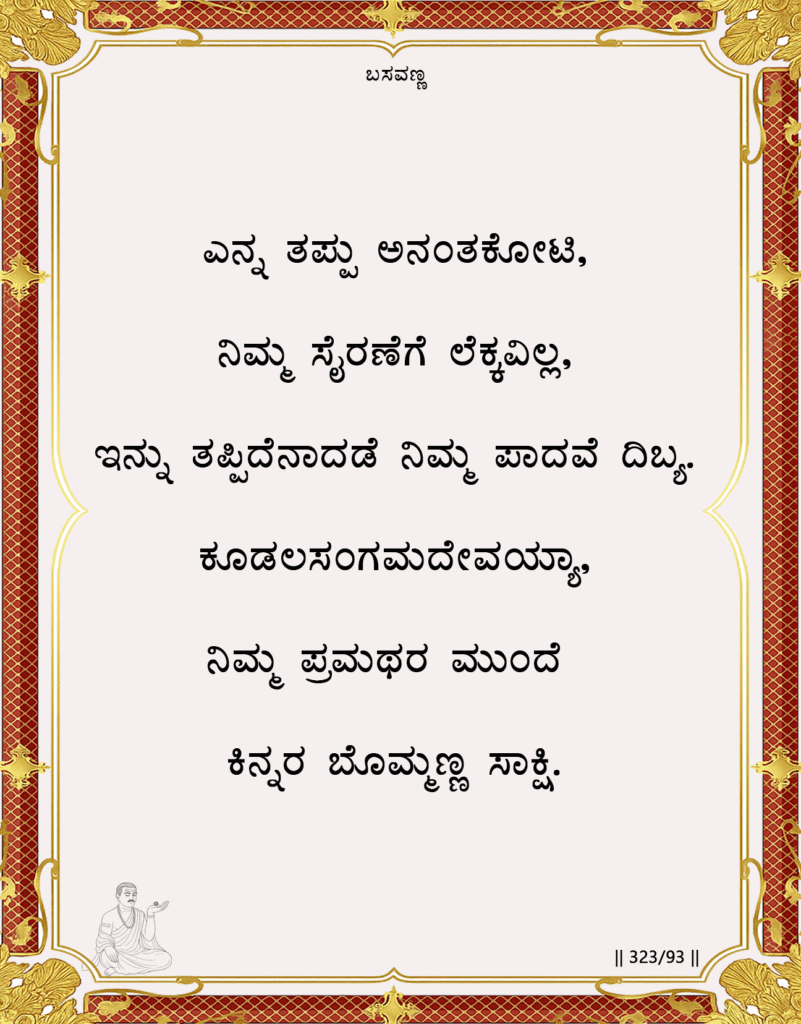
My sins are without number,
but Your compassion cannot be measured.
And if I stumble yet again,
let Your feet alone be my judge.
Let all the worlds bear witness
I come as Kinnari Bommanna came,
with nothing but surrender in my hands,
O Koodalasangamadeva.
Basavanna admits that human faults are endless, yet divine grace is limitless. Instead of hiding his shortcomings, he places himself entirely at the feet of the Lord, trusting that only divine compassion can free him. By invoking Kinnari Bommannaknown for total surrenderhe affirms that the true spiritual path is not perfection but reliance on the overflowing mercy of Koodalasangamadeva.
Spiritual Context
Core Spiritual Principle: The foundation of the spiritual path is not the ego’s effort to become perfect, but its humble admission of fallibility and its wholehearted surrender to Divine Grace (Prasada). Liberation is a gift received, not a prize won.
Cosmic Reality Perspective: In the non-dual view, the sense of being a separate, sinful individual is part of the illusion (Maya). The Linga (Divine Principle) is pure, unattached compassion. By taking refuge, the seeker aligns with this compassionate reality, allowing it to dissolve the illusion of separation and the karmic baggage (papa) that sustains it.
Historical Reality (Anubhava Mantapa Context): This Vachana democratizes spirituality. It asserts that the path is open not only to the pure and the learned but to every fallible human being. It challenges religious systems that emphasize punitive morality, replacing them with a theology of compassionate refuge. The reference to Kinnari Bommanna, a figure from a lower social stratum known for his devotion, reinforces this radical inclusivity.
Interpretation
1. “My sins are without number, but Your compassion cannot be measured.”: This establishes the fundamental equation of the path. The finite, however large, is always infinitesimal before the Infinite. By openly stating his flaws, Basavanna does not wallow in guilt but places his limitations in the context of a limitless solution.
2. “And if I stumble yet again, let Your feet alone be my judge.”: This is the essence of surrender (Sharanagati). He preemptively renounces the judgment of society, religious authorities, and his own condemning mind. The Divine’s judgment is sought because in this tradition, the Divine’s nature is compassion; to be judged by God is to be healed by grace.
3. “I come as Kinnari Bommanna came, with nothing but surrender in my hands.”: Kinnari Bommanna is the archetype of the devotee who had nothing to offer but his humble, unwavering devotion. This is the ultimate Dasohathe offering of one’s own poverty of spirit. The “empty hands” of surrender are the most potent offering, as they are completely receptive to the gift of grace.
The Cosmic Reality
Anga (Human Dimension): The Anga is consciously imperfect and vulnerable. It is the “stumbling” self, aware of its karmic debts and its inability to save itself through mere willpower. This conscious imperfection, when offered, becomes the very gateway for grace.
Linga (Divine Principle): The Linga is “Koodalasangamadeva,” the Lord who is the confluence of all dualities. Its primary attribute here is Karuna (compassion)a love that is not conditional upon the worthiness of the recipient but is its very nature.
Jangama (Dynamic Interaction): The Jangama is the dynamic of refuge. It is the flow from a state of sin-consciousness to a state of grace-consciousness. The act of surrendering at the Lord’s feet completes the circuit, allowing the Linga’s compassionate energy to purify, uphold, and transform the Anga. The Jangama is the grace itself in action.
Shata Sthala
Primary Sthala: Bhakta Sthala. This Vachana redefines the devotee stage. A true Bhakta is not one who is free from sin, but one who, aware of their sins, knows exactly where to take them: to the feet of the Lord. The core quality of the Bhakta is this trusting surrender.
Supporting Sthala: Prasadi Sthala. The entire Vachana is a prayer for and an affirmation of Prasada (Grace). The Bhakta’s surrender is the condition that allows the Prasadi statea life lived under the influence of divine graceto manifest.
Practical Integration
Arivu (Awareness Practices): Practice self-awareness without self-condemnation. When you notice a fault or failure, instead of spiraling into guilt, consciously offer it up with the prayer: “I place this at Your feet. Let Your compassion be my purification.” Use the name of the Linga as a mantra to shift focus from the problem to the solution.
Achara (Personal Discipline): The primary discipline here is the discipline of surrender. This means consciously refraining from the inner torture of guilt and the outer performance of false piety. It is the discipline of ruthless honesty before the Divine, coupled with radical trust.
Kayaka (Sacred Action): Perform your duty as an offering, not as a means to prove your worth. Work done in the spirit of surrender is free from the anxiety of success and the fear of failure, as the results are also offered to the Divine.
Dasoha (Communal Offering): By embodying this vulnerable surrender, one creates a compassionate community. It gives others permission to be imperfect and to seek refuge, breaking down the barriers of hypocrisy and judgment. Your shared humanity becomes the offering.
Modern Application
Perfectionism, Performative Wellness, and the Anxiety of Not Being Enough. Modern culture, fueled by social media and achievement-oriented values, creates immense pressure to present a flawless, successful, and morally upright image. This leads to crippling anxiety, inauthenticity, and a deep sense of shame when one inevitably fails to meet these impossible standards.
This Vachana is an antidote to the tyranny of perfectionism. It liberates the individual from the need to “have it all together.” It teaches that wholeness is found not in hiding our brokenness but in offering it to a loving and compassionate Source. This replaces the anxiety of performance with the peace of being accepted, and the burden of self-justification with the freedom of grace.
Essence
My account of wrongs is deep and wide,
Your ocean of mercy, my only tide.
I’ll stumble, fall, and lose my way,
But to Your feet, I’ll always stray.
With empty hands and head bowed low,
This is the only truth I know.
This Vachana presents a profound metaphysics of karmic dissolution through grace. It operates on the understanding that the cycle of karma (action and reaction) is binding precisely because the ego claims ownership of both the “sin” and the “merit.” The act of total surrender performs a metaphysical sleight-of-hand:
1. The Transfer of Ownership: By saying, “My sins are without number… let Your feet alone be my judge,” Basavanna transfers the karmic account from the individual ego (Anga) to the Divine (Linga). The Linga, being eternal and untouched by karma, does not “punish” the sin but absorbs and dissolves it in its infinite, compassionate consciousness. The “judgment” of the Divine is not a verdict but a transformation.
2. The Alchemy of Compassion: The “immeasurable compassion” is not just a feeling; it is a active, transformative force. When the flawed Anga places itself in direct contact with the Linga through surrender, the Linga’s compassion acts as a solvent on the solidified karma (papa), breaking its binding power and freeing the consciousness of the devotee.
3. The Jangama as Kinnari Bommanna Consciousness: The Jangama is embodied here as the “Kinnari Bommanna” state of beinga consciousness that has relinquished all claims to personal achievement, social status, and spiritual attainment. This state of zero egoic resistance allows for the maximum conductance of grace. It is the ultimate prapatti (surrender) in which the seeker’s only “action” is to remain open and receptive, allowing the Linga’s transformative power to work unimpeded.
The universal message is that our inherent flaws and failures are not barriers to wholeness, but the very raw materials for it, provided we place them in the context of a love and compassion greater than ourselves. The path to peace is not self-perfection, but self-surrender. It is the courageous and humble acknowledgment that we cannot save ourselves, coupled with the faithful trust that there is a benevolent, compassionate force in the universe that can and will, if we allow it, transform our very brokenness into the foundation of our freedom.

Views: 5