
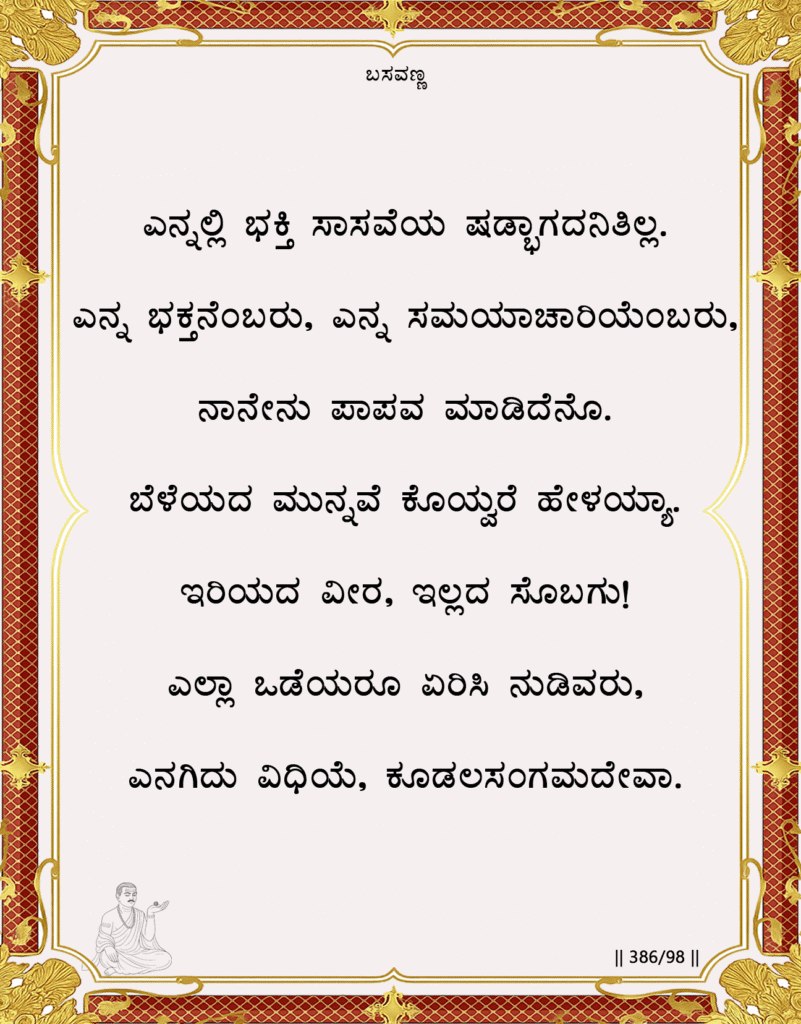
Poetic Rendering

My devotion is smaller than a mustard seed,
yet they call me saint, they call me timeless one.
Lord, what fault of mine invites such praise?
Can fruit be plucked before it ripens?
Can the untested warrior be hailed as victorious?
Even kings and elders honor me, lifting me high
but I am unripe, unseasoned, unproven.
Is this the destiny You have written for me,
O Koodalasangamadeva?
Basavanna expresses deep humility: though his devotion feels small and unripe, the world places him on a pedestal. He rejects premature praise, comparing it to harvesting fruit before it matures or hailing a warrior who has not fought. The vachana teaches that spiritual ripening is an inner process guided by divine timingnot by human recognition. Basavanna surrenders even praise and honor at the feet of Koodalasangamadeva.
Spiritual Context
Core Spiritual Principle: Genuine spirituality is measured by inner sincerity, not external acclaim. The seeker must be more vigilant against the seduction of premature honor than against the sting of blame, for honor can permanently arrest development by inflating the ego.
Cosmic Reality Perspective: From the non-dual view, the ego is a temporal construct that exists in a state of becoming. To assign it the label of a perfected “saint” is to freeze this process, creating a false, static entity that blocks the fluid, continuous unfolding of consciousness into the Linga. True being is a verb, not a noun.
Historical Reality (Anubhava Mantapa Context): As the leader of a revolutionary movement, Basavanna was surrounded by devotees who revered him. This Vachana is a public dismantling of his own guru status, a radical act that prevents the formation of a personality cult and keeps the community’s focus on the divine goal, not the human teacher.
Interpretation
1. “My devotion is smaller than a mustard seed…”: This is not false modesty but a profound self-assessment. The closer one gets to the divine light, the more one sees the shadows of one own imperfections. The “mustard seed” is an image of infinite potential, but in its current state, it is tiny and undeveloped.
2. “Lord, what fault of mine invites such praise?”: This is a critical inquiry. He questions what subtle egoic vibration or spiritual flaw within him is attracting this misplaced adoration, treating the praise itself as a symptom of a hidden disease to be rooted out.
3. “Can fruit be plucked before it ripens?”: The “fruit” is the soul’s maturity, its readiness for union. Plucking it prematurely (through acclaim) severs it from the vine of grace, halting its development. It may look like a fruit but lacks the sweetness of true realization.
4. “Is this the destiny You have written for me?”: The final question is not one of complaint but of deep surrender. He offers the entire confusing situation the dissonance between his inner reality and his outer reputation back to the Linga, trusting that even this test is part of his divine curriculum.
The Cosmic Reality
Anga (Human Dimension): The Anga is in a state of conscious paradox. It is externally honored but internally feels “unproven.” This inner truth is its saving grace, protecting it from the poison of the outer falsehood. Its strength is its willingness to confess its weakness.
Linga (Divine Principle): The Linga is the ultimate standard of ripeness and the source of all true testing. It is the “sun” that ripens the fruit and the “battlefield” that proves the warrior. The Linga’s will is the only destiny that matters.
Jangama (Dynamic Interaction): The Jangama is the process of navigating this paradox. It is the dynamic of using the discomfort of false praise as a catalyst for deeper surrender. By continually questioning and offering his situation to Koodalasangamadeva, Basavanna ensures that the Jangama relationship remains authentic, using the world’s error to fuel his own truth.
Shata Sthala
Primary Sthala: Bhakta Sthala. This Vachana defines the essence of a true devotee: one who prioritizes the truth of their inner state over all external validation. The Bhakta’s love for the Lord is expressed here as a fierce protection of the relationship’s integrity from the corruption of ego.
Supporting Sthala: Maheshwara Sthala. The intense desire for inner purity and the terror of being spiritually “unripe” or impure is the driving force behind the Maheshwara’s discipline. This Vachana shows that this concern for purity extends to one’s spiritual reputation.
Practical Integration
Arivu (Awareness Practices): Practice “label dis-identification.” When a thought arises like “I am a good practitioner,” immediately counter it with, “This is a thought about a limited self. My true nature is vast and one with Koodalasangamadeva.” Use praise as a bell of mindfulness to return to the source.
Achara (Personal Discipline): Cultivate a discipline of “spiritual anonymity.” Actively deflect praise. If someone compliments your spiritual qualities, sincerely attribute them to the grace of your Guru or the Divine. Avoid roles and titles that create a persona.
Kayaka (Sacred Action): Let your work be silent and selfless. The focus should be on the quality of the action as an offering, not on the reputation it builds. The “unripe fruit” does its work of growing without seeking attention.
Dasoha (Communal Offering): The greatest Dasoha here is to model authentic humility. By openly confessing your own sense of being “unproven,” you give others permission to be on the path, not to have arrived. This creates a community of honest seekers, not competing saints.
Modern Application
The “Influencer” Spirituality and Premature Guru Syndrome. In the modern spiritual marketplace, there is immense pressure to present oneself as an enlightened, perfected being to gain followers, sell courses, and build a brand. This creates inauthenticity, spiritual bypassing, and communities built on the shaky foundation of a leader’s inflated image.
This Vachana is a powerful antidote to spiritual consumerism. It liberates both teachers and students from the tyranny of perfection. It encourages a culture where the path is more valued than the destination, where teachers are honest guides who are also on the journey, and where the only brand is the relentless pursuit of truth, however messy that may be.
Essence
They see a harvest, I feel the green.
They crown a king, I know the unseen
struggle within, the untested fight.
This praise feels like the deepest night.
O Lord of Truth, if this is Your test,
In this bitter honor, let me find rest.
1. The Energetic Mismatch and Its Dangers: When the social field projects an energy of “sainthood” onto an individual whose inner energy is still that of a “seeker,” it creates a destructive resonance. The individual’s subtle body is forced to vibrate at a frequency it has not organically attained. This can lead to a spiritual “imposter syndrome” that is actually a healthy psychic protection mechanism, or worse, a fracturing of the psyche as it tries to live up to the false projection.
2. The Linga as the Sole Arbiter of Ripeness: The process of ripening is an alchemical reaction between the individual’s latent potential (bija) and the grace of the Linga. It cannot be rushed by social consensus. The “mustard seed” of devotion must be allowed its own sacred timeline to unfold. Basavanna’s lament is a plea for this organic process to be respected and protected from the corrosive influence of human impatience and projection.
3. Jangama as the Dynamic of Authentic Positioning: The functioning Jangama here is the seeker’s active effort to remain in their correct metaphysical position. By continually confessing his unripeness and questioning the situation, Basavanna is dynamically realigning himself with his true inner state. This is not humility as a virtue, but humility as a metaphysical necessitya conscious refusal to occupy a karmic and energetic space that he has not yet grown to fill. This honest positioning is what keeps the channel for true grace clear and uncorrupted, ensuring that his eventual maturity, when it comes, will be genuine and not a hollow performance.
Do not accept an identity that you have not earned through your own inner experience. The world is quick to label you, but your freedom depends on knowing your own truth, however small or unripe it may feel. The most dangerous prison is the one built from the gifts of other people’s admiration. True growth requires the courage to remain in the vulnerable, honest space of “not knowing” and “not yet,” trusting that your ripening will come in its own perfect time, under the sun of a grace that does not rush.

Views: 2