

Summary
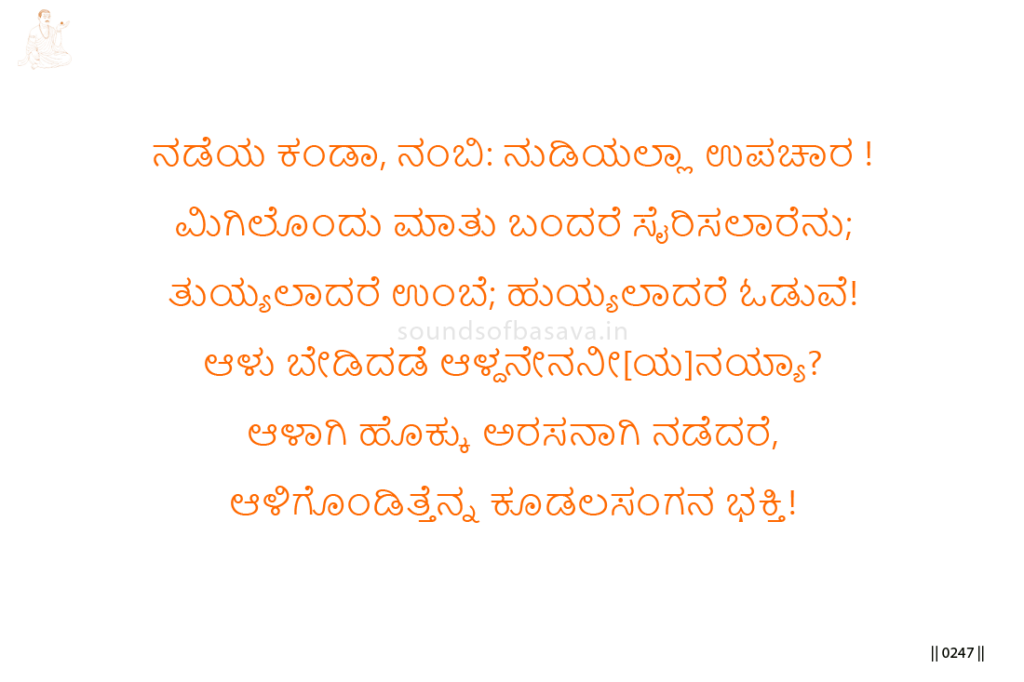
In this vachana, Basavanna exposes devotion that appears proper from outside. The conduct looks trustworthy, and the speech is full of courtesy.
Yet when one extra word comes, the seeker cannot bear it. If honoured, he accepts. If challenged, he runs. The outer form of devotion is present, but inward steadiness is absent.
Basavanna then gives the central contrast: one enters as a servant but behaves like a king. Such conduct destroys Kudalasangama’s bhakti. Devotion cannot remain true when servant-conduct is only a posture and inwardly the seeker seeks mastery.
Imagery & Symbolic Relevance
The first image is conduct that appears trustworthy. What is seen outside gives the impression of devotion.
The second image is courteous speech. Words are proper and polished, but courtesy alone does not prove inward surrender.
The third image is the unbearable extra word. A single challenging word exposes the weakness hidden beneath devotional appearance.
The fourth image is accepting honour. When treated favourably, the seeker remains and receives.
The fifth image is fleeing under pressure. When challenged or corrected, the seeker cannot stand firm.
The sixth image is entering as servant. This is the proper form of devotion. The seeker must come in humility and readiness to serve.
The final image is behaving as king. This is the inward contradiction. The seeker takes the place of a servant outwardly, but acts from self-importance inwardly.
Together, these images expose performative devotion. Conduct, courtesy, and appearance may seem devotional, but if the seeker cannot bear correction and behaves like a master after entering as servant, bhakti is lost.
Lingayoga
In Lingayoga, this vachana tests whether humility has become real. The seeker must not merely appear as servant; servant-conduct must enter the inner state.
Speech, gesture, and outward behaviour are not enough. The test comes when honour is removed or correction appears.
The practical movement here is inward servanthood. Basavanna asks the seeker to stop using devotion as appearance and to become truly low, steady, and service-ready before Kudalasangama Deva.
Editorial Commentary
This vachana should be read as a warning against devotional role-playing. Basavanna does not reject courtesy or reverent conduct. He rejects the condition in which courtesy hides self-importance, and one who entered as servant begins to behave like a king.
Related Vachana
Supporting Vachana
Bhakta Sthala Vachana 245 — The Mirror of Authenticity
Bhakta Sthala Vachana 245 supports this vachana by showing the true seeker approaching the devotee-assembly with covered speech, humility, servant-conduct, and inward attention. Vachana 254 shows the opposite danger: one may appear courteous and devotional, yet fail when corrected and behave like a master after entering as servant.
Advancing Vachana
Prasadi Sthala Vachana 777 — The Offering That Is Not Giving
Prasadi Sthala Vachana 777 advances this movement by exposing the subtle claim that remains even in offering. Vachana 254 shows the performer who appears as servant but acts as king. Vachana 777 carries this into Prasadi Sthala, where the claim of the one who offers must dissolve, and sacred action becomes true only when the performer no longer stands apart before Kudalasangama Deva.
