

Summary
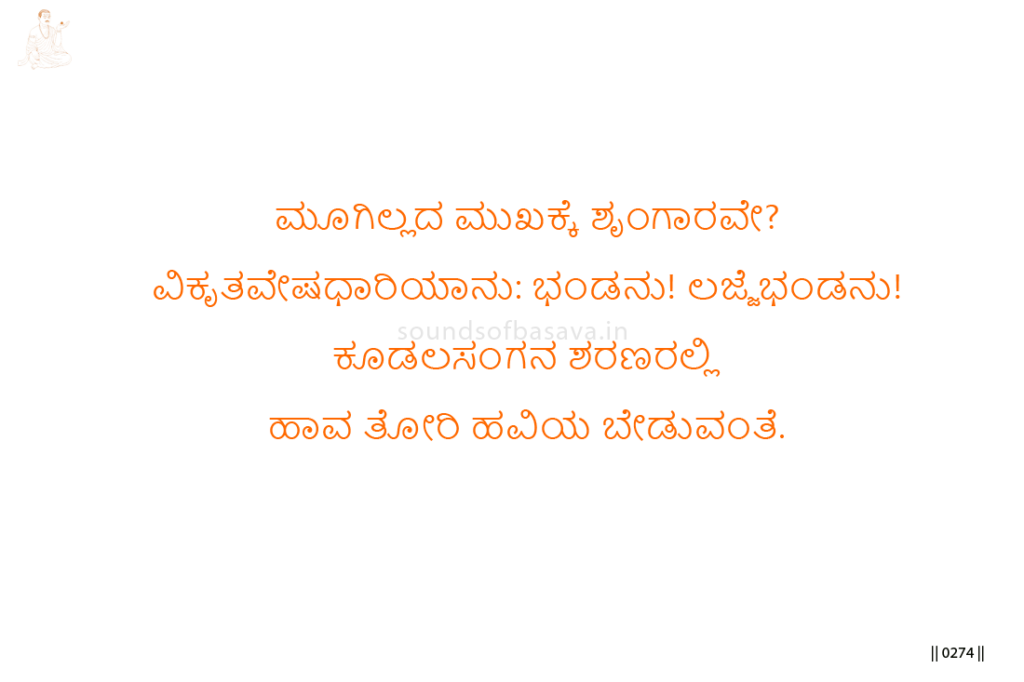
In this vachana, Basavanna asks what adornment can do for a face without a nose. Ornament cannot restore what is absent.
He then names his own condition sharply: he is one who wears a distorted appearance, a bhaṇḍa, a shameless pretender.
The final image brings the confession before Kudalasangama’s Sharanas. He is like one who shows a snake while begging for rice. The teaching is clear: frightening display and needy asking cannot stand together as true devotion.
Imagery & Symbolic Relevance
The first image is adornment for a noseless face. Ornament is meant to beautify what is present, but when the proper feature is absent, decoration becomes futile.
The second image is distorted appearance. Basavanna does not call this merely an incomplete form. He names it as vikṛta-veṣa, a disfigured or distorted appearance.
The third image is the bhaṇḍa. This is the pretender, the one whose appearance does not match inner truth.
The fourth image is the shameless bhaṇḍa. The fault has become more severe because the pretender continues without shame.
The final image is showing a snake while begging for rice among Kudalasangama’s Sharanas. The snake creates fear and contradiction, while begging seeks nourishment. The image exposes a divided condition: one displays what repels, yet asks to be fed.
Together, these images show the futility of spiritual appearance without inward fitness. A noseless face cannot be made whole by ornament. A distorted appearance cannot become devotion by display. A snake-charmer’s display cannot become rightful nourishment before the Sharanas.
Lingayoga
In Lingayoga, this vachana tests whether the seeker’s appearance has become truthful. Sacred form, posture, or devotional identity cannot replace inner fitness.
The seeker must not stand before the Sharanas with a distorted appearance and still seek the fruit of devotion. What is displayed must agree with what is inwardly true.
The practical movement here is shame that leads to correction. Basavanna does not defend his appearance. He exposes it before Kudalasangama’s Sharanas.
Editorial Commentary
This vachana should be read as a continuation of Basavanna’s critique of spiritual decoration. The issue is not ornament itself, but ornament placed where the essential condition is missing.
The snake-and-rice image is especially important. The snake charmer, showing the snake seeks attention, fear, or authority, yet at the same time begs for nourishment. Basavanna uses this contradiction to expose false devotional standing before the Sharanas.
The shame here is not social embarrassment. It is the shame of seeing that one’s spiritual appearance has become a distorted costume. Before the Sharanas, such appearance cannot survive as truth.
Related Vachana
Supporting Vachana
Bhakta Sthala Vachana 1241 — The Exposure of Hollow Devotion
Bhakta Sthala Vachana 1241 supports this vachana by stripping away false spiritual identity. There, Basavanna says he is not Bhakta, not Yukta, not Mukta, but a deceiver wearing the garb of devotion. Vachana 332 carries the same exposure into Maheshwara Sthala: the seeker stands as a distorted pretender before Kudalasangama’s Sharanas, like one showing a snake while begging for rice.
Advancing Vachana
Prasadi Sthala Vachana 882 — The Grace of the Company of the True
Prasadi Sthala Vachana 882 advances this movement by showing the corrective form of Sharana-company. Vachana 332 exposes false standing among the Sharanas. Vachana 882 carries this into Prasadi Sthala, where the company of the true and noble leads one to the Mahānubhāvas, and through that company one comes to know Guru, Linga, Jangama, Prasada, and oneself before Kudalasangama Deva.
