

Summary
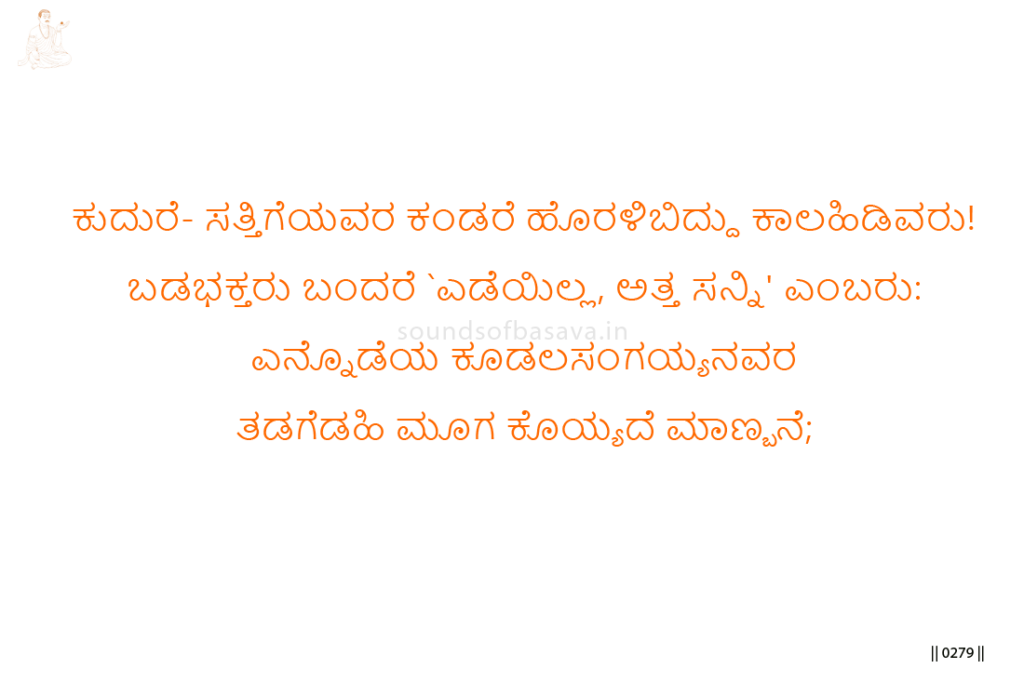
In this vachana, Basavanna exposes false social measure. When people of horse and umbrella arrive, people fall forward and hold their feet. Visible status receives immediate honor.
But when poor bhaktas arrive, they are told, “There is no place; move aside.” The one who bears devotion without wealth is not received.
Basavanna then invokes Kudalasangayya’s people. Such false valuation will not go unshamed before them. The teaching is clear: honoring status while rejecting poor bhaktas is a spiritual disgrace.
Imagery & Symbolic Relevance
The first image is horse and umbrella. These are signs of worldly position, authority, and visible importance.
The second image is falling and holding the feet. Reverence is quickly given to those who arrive with status.
The third image is the poor bhakta. This figure arrives without outward power, wealth, or visible prestige.
The fourth image is the refusal, “There is no place; move aside.” The poor bhakta is not merely ignored; he is pushed away.
The final image is nose-cutting before Kudalasangayya’s people. This is an image of shame and exposure. The false measure that honors status and rejects devotion cannot stand before the Sharanas of Kudalasangama.
Together, these images show a reversal of true value. Worldly signs are honored, while living devotion is dismissed. Basavanna exposes this as a failure of perception.
Lingayoga
In Lingayoga, this vachana tests how the seeker recognizes sacred presence. Devotion must not be measured by wealth, dress, power, or social standing.
If the eye honors horse and umbrella but refuses the poor bhakta, it has not learned to see. The same awareness that turns toward Linga must also receive the living devotee without social division.
The practical movement here is correction of value. Basavanna asks the seeker to see the bhakta by devotion, not by visible status.
Editorial Commentary
This vachana should be read as a sharp correction of social reverence. Basavanna does not merely criticize wealth; he criticizes the eye that bows to wealth while refusing devotion.
The poor bhakta is central. His poverty is not the problem; the problem is the failure of others to recognize the sacred worth present without ornament or power.
The closing image of nose-cutting is severe because the fault is severe. To reject the poor bhakta while honoring status is not a small social mistake. It is a shameful failure before Kudalasangama’s people, who measure by devotion rather than outward rank.
Related Vachana
Supporting Vachana
Bhakta Sthala Vachana 412 — The Eyes That See One
Vachana 412 supports this teaching by warning that Jangama must not be divided by outer condition. The eye may honor what is clothed, ordered, wealthy, and dignified, while lowering what appears poor, rough, simple, or unnoticed. Vachana 414 carries this Bhakta-stage correction into Maheshwara Sthala: those with horse and umbrella are honored, while poor bhaktas are refused space. Both vachanas reject reverence governed by outward status instead of living devotion before Kudalasangama Deva.
Advancing Vachana
Prasadi Sthala Vachana 741 — The Depth Within
Vachana 741 advances this teaching by showing that Kudalasangama Deva does not respond according to outer arrangement alone. Food was prepared by Siriyala’s son, and the house of the Chola had greatness, yet Kudalasangama Deva ate in Chennayya’s house. Vachana 414 exposes the false social measure that honors visible rank and rejects poor bhaktas. Vachana 741 carries this into Prasadi Sthala by showing that the true measure lies deeper than outward power, wealth, preparation, or status.
