

Summary
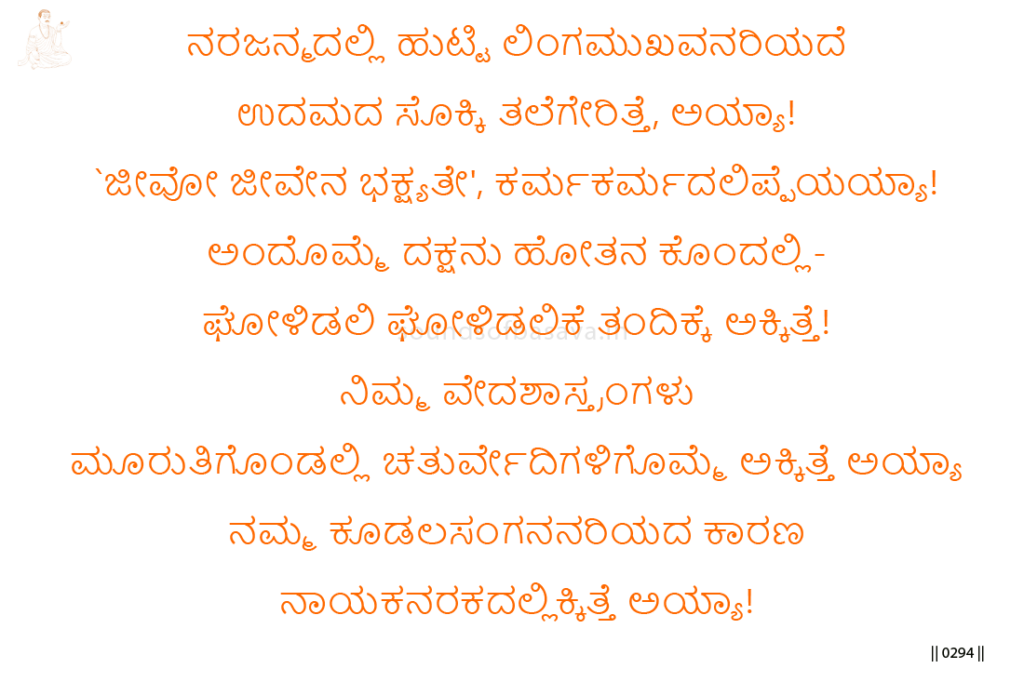
In this vachana, Basavanna laments human birth wasted without knowing the faces of Linga. Human birth alone does not become sacred if the seeker fails to recognize the presence and measure of Linga.
Instead of such recognition, pride rises to the head. The person then justifies action by saying, “Life feeds on life,” and by placing act upon act under the name of karma.
Basavanna invokes Daksha’s sacrifice to expose this blindness. When killing was done in the name of sacrifice, did the Veda cry out? Did the Shastras take form and stop the act? Not knowing Kudalasangama Deva, such a person enters a hell of his own making.
Imagery & Symbolic Relevance
The first image is human birth. It is not presented as fulfillment by itself, but as an opportunity to know Linga.
The second image is Liṅga-mukha, the faces or aspects of Linga. To be born human and still not know these faces is to miss the sacred measure that should guide life.
The third image is pride rising to the head. When Linga is not known, human birth becomes swollen by self-importance rather than shaped by recognition.
The fourth image is the saying, “Life feeds on life.” Basavanna exposes the danger of using such a saying to excuse action without spiritual discernment.
The fifth image is karma upon karma. Karma becomes another covering when it is used to justify action rather than awaken responsibility.
The sixth image is Daksha’s sacrifice. It stands as an example of killing performed under ritual authority.
The seventh image is the silence of Veda and Shastra. Basavanna asks whether scripture itself cried out or took form to stop such action. The question shows that scripture cannot protect the one who acts without knowing Kudalasangama Deva.
The final image is naraka. Hell is shown as the consequence of pride, misrecognition, ritualized action, and failure to know Kudalasangama Deva.
Together, these images show the danger of human birth without recognition. When Linga is not known, pride rises, sayings become excuses, karma becomes covering, scripture becomes powerless, and action creates its own hell.
Lingayoga
In Lingayoga, this vachana tests whether the seeker has moved beyond outward birth, inherited saying, and ritual justification.
The Linga must not remain unknown while the person lives by pride, karma-excuse, and scriptural cover. Practice must bring the seeker into direct recognition before Kudalasangama Deva.
The practical movement here is from justification to knowing. Basavanna asks the seeker to stop hiding behind saying, karma, ritual, or scripture, and to know Kudalasangama Deva directly.
Editorial Commentary
This vachana should be read as a warning against spiritual blindness within human birth. Basavanna does not reject Veda, Shastra, karma, or ritual as words. He rejects the condition in which they are used without knowing Kudalasangama Deva.
The Daksha image gives the warning its severity. If Linga is not known, even religiously framed action can become blind action, and that blindness becomes self-made hell.
Related Vachana
Supporting Vachana
Bhakta Sthala Vachana 599 — The Heart’s Measure
Vachana 599 supports this teaching by asking what use there is in reading the Vedas, hearing the Shastras, performing japa, practicing tapas, or doing any spiritual act if Kudalasangama Deva has not touched the heart. Vachana 584 carries this Bhakta-stage correction into Maheshwara Sthala: Veda and Shastra cannot save action that proceeds without knowing Kudalasangama Deva. Both vachanas test sacred learning and religious practice by inward recognition, not by outward authority alone.
Advancing Vachana
Prasadi Sthala Vachana 630 — When Remembrance Dies
Vachana 630 advances this teaching by showing that wrong seeing, wrong speech, and forgotten remembrance become a destructive condition. Vachana 584 shows the danger of not knowing Kudalasangama Deva and entering self-made hell through pride, excuse, and blind action. Vachana 630 carries this into Prasadi Sthala by showing the inner form of that fall: when sight, speech, and remembrance lose their relation to Kudalasangama Deva, spiritual life itself becomes damaged.
