

Summary
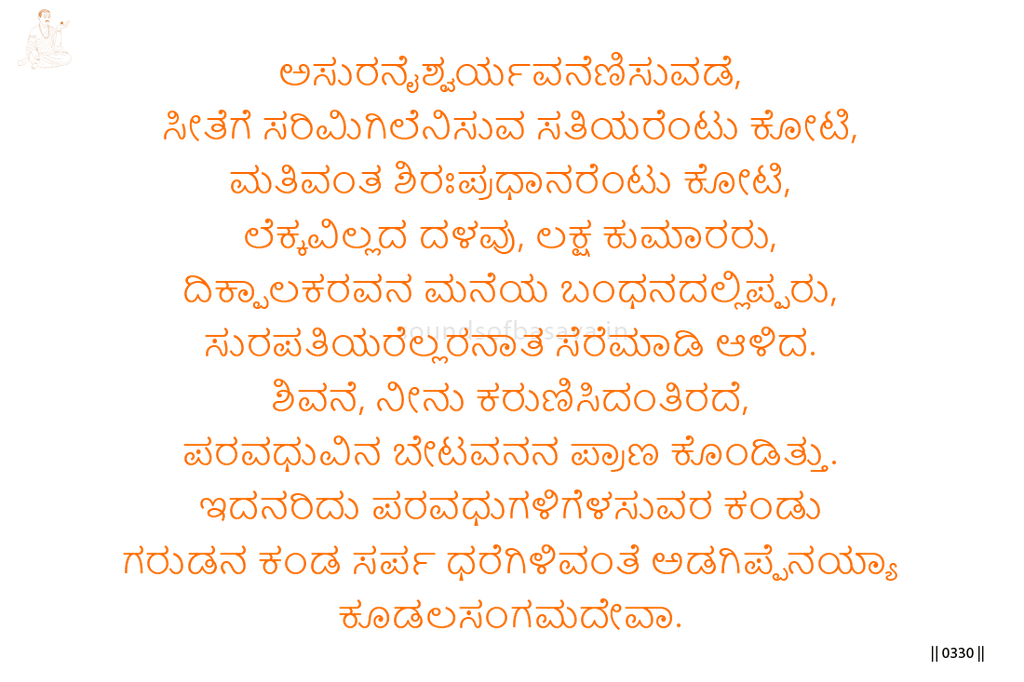
In this vachana, Basavanna recalls the vast greatness of Ravana: asura-like wealth, countless women said to rival Sita, wise ministers, immense armies, many sons, power over the guardians of the directions, and dominion over the lords of heaven.
Yet none of this protected him. Because he pursued another’s wife, his life was lost when Shiva’s grace did not stand with him.
Before Kudalasangama Deva, Basavanna draws the lesson personally. Knowing this, when he sees those who pursue another’s wife, he withdraws from them as a serpent withdraws at the sight of Garuda.
Imagery & Symbolic Relevance
Ravana’s wealth is the first image of worldly greatness. Basavanna begins by showing that the person in question lacked nothing in outer power.
The countless women, ministers, armies, and sons expand the image of abundance. Ravana possessed pleasure, counsel, military force, and lineage, yet none of these could save him.
The guardians of the directions and the lords of heaven show the height of his authority. His power extended beyond ordinary kingship. Still, such power could not stand against the consequence of wrongful desire.
The phrase “hunter of another’s wife” gives the vachana its central warning. Ravana’s fall is tied not to weakness, poverty, or lack of strength, but to the crossing of a rightful boundary.
The serpent and Garuda image completes the teaching. A serpent does not remain before Garuda; it withdraws at once. Basavanna uses this image to show how sharply the seeker must avoid the company of those who normalize such desire.
Together, the images show the collapse of greatness when conduct loses restraint. Wealth, power, counsel, armies, sons, and celestial authority cannot protect one who stands outside grace.
Lingayoga
In Lingayoga, this vachana teaches ethical vigilance. Spiritual life is not protected by power, learning, status, or achievement if conduct is corrupted by desire.
The seeker must recognize danger before it becomes inward entanglement. Basavanna’s response is not debate, closeness, or tolerance of the fault; it is immediate withdrawal.
Before Kudalasangama Deva, greatness without restraint collapses. The path is guarded by discernment, rightful conduct, and dependence on grace.
Editorial Commentary
This vachana should not be read as a general condemnation of greatness, power, or household life. Basavanna’s warning is specific: Ravana’s immense greatness could not protect him once he pursued another’s wife.
The serpent-Garuda image shows practical discernment. The seeker protects the path by avoiding the field where such desire is treated lightly. This is vigilance, not hatred.
Related Vachana
Supporting Vachana
Bhakta Sthala Vachana 109 — The Milk of True Devotion
Vachana 109 supports this teaching by showing that relationship without love and devotion without steadfastness become hollow. There, a wife without love for her husband and a devotee without steadiness in the Linga are compared to a cow that gives no milk and leaves the calf unfed.
Vachana 1028 carries this concern into Maheshwara Sthala through Ravana’s fall. When desire violates rightful relationship, even immense power and greatness cannot preserve the person before Kudalasangama Deva.
Advancing Vachana
Prasadi Sthala Vachana 1066 — When Grace Withdraws
Vachana 1066 advances this teaching by extending the same principle beyond Ravana to other figures of vast worldly greatness. Jewels, elephants, women, children, chariots, cities, relatives, horses, warriors, and tribute-paying kings are all named as signs of power; yet when Kudalasangama Deva’s grace withdraws, even such greatness cannot protect.
Vachana 1028 shows Ravana’s fall through wrongful desire and the absence of protecting grace. Vachana 1066 carries this into Prasadi Sthala by making the teaching broader and sharper: outer greatness is never final shelter. Grace alone decides whether power stands or falls before Kudalasangama Deva.
