

Summary
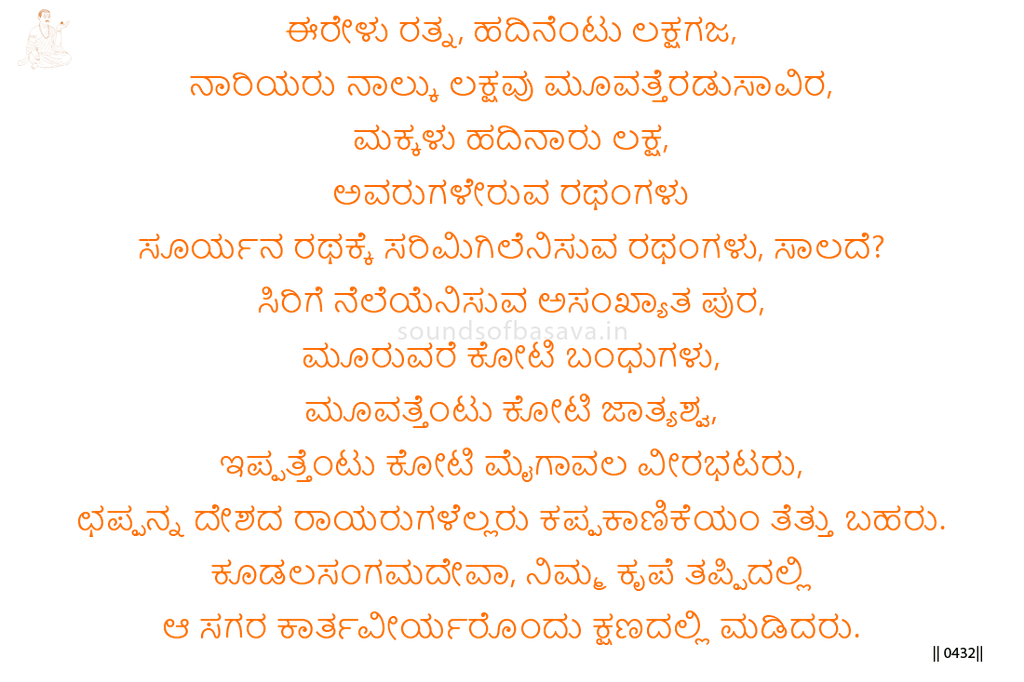
In this vachana, Basavanna places before us the full display of royal power: jewels, elephants, women, children, chariots, cities, relatives, horses, warriors, and tribute-paying kings.
After naming these signs of greatness, he asks whether all this was still not enough. The question shows that no accumulation of wealth, family, army, kingdom, or fame can give final protection.
The closing line gives the teaching. When Kudalasangama Deva’s grace departed, even Sagara the Great and Kartavirya Arjuna perished in a single moment.
The meaning is direct: outer greatness cannot stand when grace is absent.
Imagery & Symbolic Relevance
The catalogue is the central image of the vachana. Basavanna does not mention one possession or one form of power. He piles up every recognized sign of royal strength.
Jewels represent treasure. Elephants, horses, chariots, and warriors represent military force. Women, children, and relatives represent household, lineage, and social support. Cities and tribute-paying kings represent dominion.
The chariots compared with the chariot of the sun raise this greatness to an extraordinary scale. Basavanna deliberately makes the power appear vast, almost beyond ordinary measure.
The repeated question “Was this not enough?” exposes the limitation of all these supports. If grace is absent, even such abundance cannot protect.
The final contrast is sharp. On one side stand countless treasures, armies, relatives, cities, and kings. On the other side stands the withdrawal of Kudalasangama Deva’s grace. Grace alone decides the outcome.
Sagara the Great and Kartavirya Arjuna are used as examples of mighty rulers. Their fall is not narrated for history’s sake. Basavanna invokes them to show that even the greatest worldly power cannot survive when grace is lost.
Lingayoga
In Lingayoga, this vachana teaches that possession is not protection.
The seeker may have wealth, family, position, and strength, but none of these can replace Kudalasangama Deva’s grace.
For Prasadi Sthala, the teaching is clear. Grace is not one support among many. Without grace, even vast power becomes helpless.
Editorial Commentary
The list should remain concrete because its force lies in accumulation. Basavanna first makes worldly greatness appear complete, then overturns it in the final line.
Sagara the Great and Kartavirya Arjuna should be named clearly. Sagara is remembered for vast power and lineage; Kartavirya Arjuna for extraordinary might and sovereignty. Basavanna uses them as archetypes of worldly greatness made powerless by the loss of grace.
The final sentence should govern the whole explanation: when Kudalasangama Deva’s grace departed, they perished in a single moment.
Related Vachana
Supporting Vachana
Maheshwara Sthala Vachana 1028 — The Fall of Ravana’s Greatness
Maheshwara Vachana 1028 supports this vachana by using Ravana as another example of immense power that could not protect him when grace was absent.
In Vachana 1066, Sagara the Great and Kartavirya Arjuna fall despite royal abundance. In Maheshwara Vachana 1028, Ravana’s greatness also fails. Both vachanas teach that greatness without grace cannot endure.
Advancing Vachana
Pranalingi Sthala Vachana 691 — The One-Pointed Alignment
Pranalingi Vachana 691 advances this teaching by moving from outer possession to inner steadiness.
In Vachana 1066, outer power fails when grace departs. In Vachana 691, even bodily harm and loss of possessions do not matter if mind, chitta, and buddhi remain one and do not separate. Thus the Prasadi warning against dependence on outer power advances into Pranalingi as one-pointed alignment before Kudalasangama Deva.
