

Summary
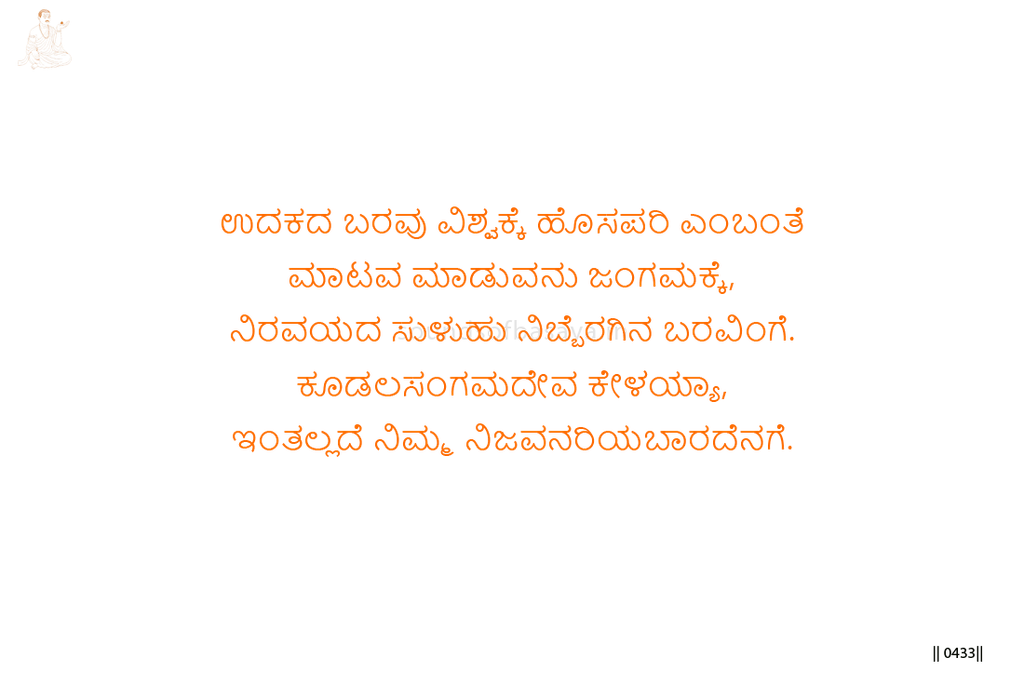
In this vachana, Basavanna speaks of making Lingayoga known to Jangama as a new understanding for the world.
The image is water. Just as thirst is answered by water, the thirst of Jangama-society must be answered by a fresh and life-giving understanding. This is not ordinary giving. It is the bringing forth of a new spiritual current.
Basavanna says that this new water must be made known to Jangama so that the stainless, all-pervading truth may prevail.
He then calls upon Kudalasangama Deva to listen. Without this intent, the Lord would not have made this truth known.
The teaching is clear: Lingayoga is not to remain hidden as private knowledge. It must flow into the living Jangama-society as new water, bringing clarity, renewal, and recognition of Kudalasangama Deva’s truth.
Imagery & Symbolic Relevance
The first image is thirst. Basavanna sees a condition in the world that needs water. This thirst is not physical alone. It points to the need for true understanding.
The second image is new water. Water gives life, removes dryness, and restores movement. Here it represents the new understanding of Lingayoga that must reach Jangama.
Jangama is not treated as a single person receiving a gift. Jangama stands for the living society in which the truth must move and become known.
The phrase concerning the stainless and all-pervading truth is central. Basavanna is not speaking of a partial teaching or sectarian claim. He speaks of the truth that is pure, pervasive, and meant to prevail.
The final appeal to Kudalasangama Deva gives the vachana its force. Basavanna says, in effect: “Hear me; without this intent, You would not have revealed this truth.” The revealing itself is therefore part of Kudalasangama Deva’s purpose.
Lingayoga
In Lingayoga, this vachana teaches that realization must not remain closed within the individual.
What is known through grace must become life-giving for Jangama-society. The new water is the living understanding that quenches spiritual thirst and brings the stainless truth into public life.
For Prasadi Sthala, the point is receiving and transmitting rightly. What is received from Kudalasangama Deva must flow outward without being reduced to possession, display, or private claim.
Editorial Commentary
This vachana should not be read mainly as ordinary charity or material offering. The water image is larger. It speaks of a new understanding that must answer the thirst of the world.
“Jangama” should be read here as living society, not merely as an individual receiver.
The final line should be kept close to the corrected meaning: without this intent, Kudalasangama Deva would not have made the truth known.
Related Vachana
Supporting Vachana
Maheshwara Sthala Vachana 421 — Water the Root, and the Tree Blossoms
Maheshwara Vachana 421 supports this vachana through the water image and the centrality of Jangama. There, watering the root allows the tree to flourish, and Jangama is shown as the living mouth of Linga. In Vachana 1067, the new water of Lingayoga must reach Jangama-society. Both vachanas show that spiritual nourishment must be directed to the living root.
Advancing Vachana
Pranalingi Sthala Vachana 1016 — The Fulness of Pranalinga
Pranalingi Vachana 1016 advances this teaching by showing that knowledge becomes complete only as Anubhava. In Vachana 1067, Basavanna speaks of Lingayoga being made known as new water for Jangama. In Vachana 1016, this knowing matures into lived realization: Arivu is fulfilled by Anubhava, Achara becomes life-breath, and the greatness of Pranalinga is revealed through Guru’s grace before Kudalasangama Deva.
