

Summary
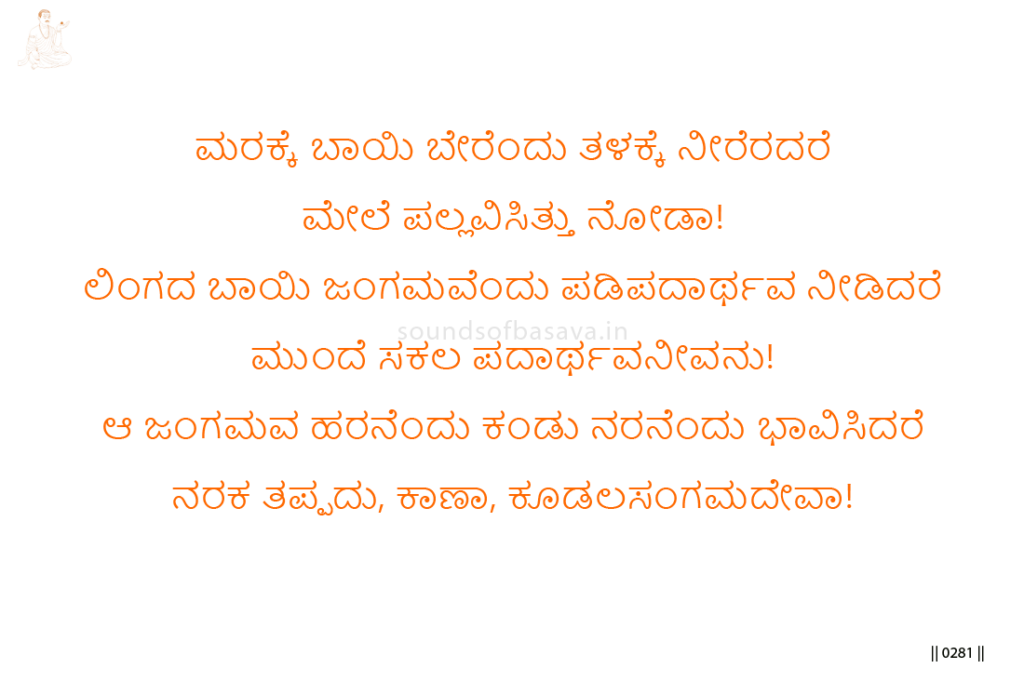
In this vachana, Basavanna gives the image of watering the root of a tree. When water is poured at the root, the tree blossoms above.
He then applies this directly to Linga and Jangama. Jangama is the mouth of Linga. When food or substance is offered there, all meanings and fulfilments arise.
The final warning is severe. If one sees that Jangama as Hara, the path is clear. But if one thinks of Jangama as mere human, naraka cannot be avoided. The teaching is clear: the living Jangama must be recognized as the mouth of Linga, not reduced to ordinary human form.
Imagery & Symbolic Relevance
The first image is the root of the tree. The root is hidden below, but it is the place where nourishment must be given.
The second image is watering the root. Water placed at the root rises through the tree and produces visible growth above.
The third image is the blossoming of the tree. The flower appears above, but its cause lies in the nourishment given below.
The fourth image is Jangama as the mouth of Linga. Basavanna gives a precise relation: the Jangama is the living point through which offering reaches Linga.
The fifth image is giving food or substance. The offering is not lost. When rightly offered to Jangama as Linga’s mouth, it bears full meaning.
The final image is seeing Jangama as Hara or as mere human. This is the decisive test. Sacred recognition leads to fulfilment; reduction to ordinary human seeing leads to fall.
Together, these images show the law of right offering. Water must reach the root; offering must reach the living mouth of Linga. If Jangama is seen as Hara, the offering flowers. If Jangama is seen as mere human, the path is broken.
Lingayoga
In Lingayoga, this vachana tests whether the seeker understands the living relation between Linga and Jangama. Linga is not to be honored in isolation while Jangama is reduced to ordinary human status.
The seeker must know where offering becomes alive. Just as the tree is nourished at the root, Linga-worship becomes complete when Jangama is recognized as Linga’s mouth.
The practical movement here is right recognition joined to right offering. Basavanna asks the seeker to see Jangama as Hara and to offer without divided perception.
Editorial Commentary
This vachana should be read as a teaching on the correct channel of sacred nourishment. Basavanna does not give a vague image of growth. He gives a precise spiritual economy: water at the root becomes blossom above; offering to Jangama as Linga’s mouth becomes full spiritual fulfilment.
The phrase “mouth of Linga” is important for the reader. A mouth receives nourishment into the living body. In the same way, Jangama is the living receiving-point of Linga. To offer there is not mere charity or social service; it is participation in the living relation between Linga and Jangama.
The warning against seeing Jangama as mere human is equally important. Basavanna is not denying the human form of Jangama. He is warning against reducing Jangama to that form alone. When sacred presence is seen only as ordinary personhood, the eye of devotion has failed.
The root image clarifies the whole vachana. One may admire flowers, leaves, and branches, but the tree is nourished at the root. Likewise, one may speak of Linga, but the offering must reach the living Jangama-mouth. Without that recognition, devotion remains misdirected.
Related Vachana
Supporting Vachana
Bhakta Sthala Vachana 677 — The Five Pillars of Integrity
Bhakta Sthala Vachana 677 supports this vachana by teaching that the Sharana must know Linga and Jangama as one and hold Prasada as certain. Vachana 421 carries that principle into Maheshwara Sthala through the image of the root and the mouth of Linga. What Bhakta Vachana 677 states as firmness, Vachana 421 shows as right offering: Jangama must be seen as the living mouth of Linga.
Advancing Vachana
Prasadi Sthala Vachana 777 — The Offering That Is Not Giving
Prasadi Sthala Vachana 777 advances this movement by showing the fulfilled state of offering. Vachana 421 teaches that food or substance offered to Jangama, the mouth of Linga, bears full meaning. Vachana 777 carries this into Prasadi Sthala, where true offering is no longer a separate act of giving, but living participation: what is received from Jangama returns as Prasada before Kudalasangama Deva.
