

Summary
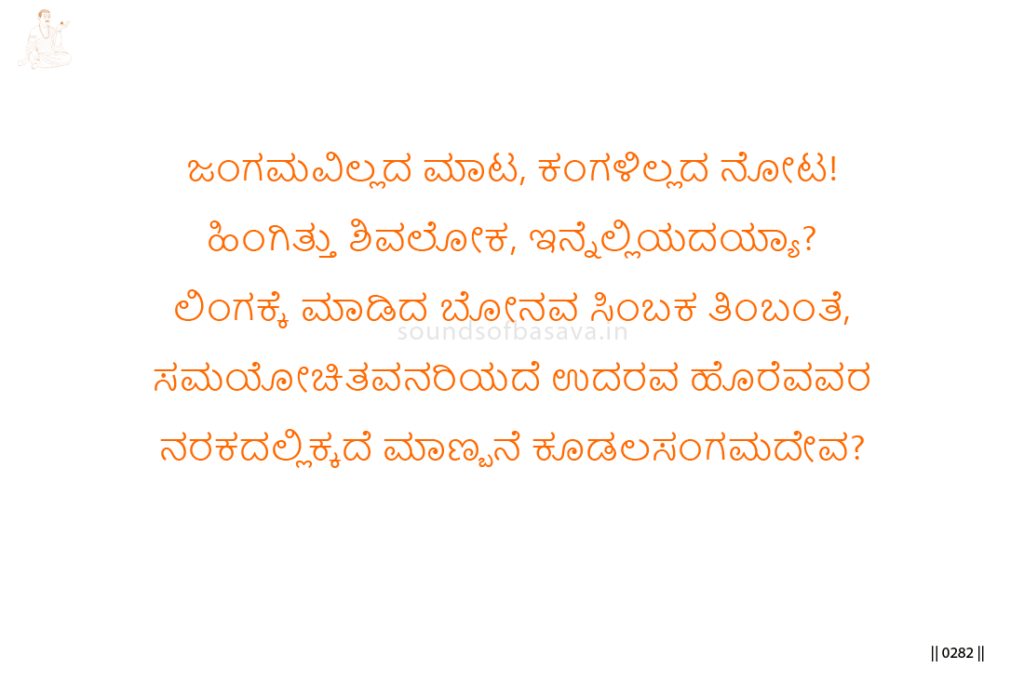
In this vachana, Basavanna teaches that without Jangama, the form is not complete. Jangama here must be understood as living totality: all life forms, the moving field through which the shape of the cosmos becomes present.
He compares this absence to sight without eyes. Where there is no true seeing, Śivaloka cannot be found. The collapse is not elsewhere; it happens in the seeker’s own divided perception.
He then turns to Linga-offering. The Linga held in the hand is the mark of totality, but if what is offered to Linga is used by the offerer himself, the sacred act is reversed. One who does not understand completeness and speaks only partially enters a hell of his own making before Kudalasangama Deva.
Imagery & Symbolic Relevance
The first image is form without Jangama. Without Jangama, the living movement of existence is absent. The shape of the whole cannot be formed when life is excluded.
The second image is sight without eyes. Looking is not enough. Without the eye of recognition, perception remains blind.
The third image is Śivaloka. Śivaloka is not treated as a distant place to be reached while living in divided sight. If Jangama is not recognized, Śivaloka collapses in the seeker’s own understanding.
The fourth image is Linga held in the hand. The Ishtalinga is the mark of totality, the sign through which the seeker is meant to remember the whole.
The fifth image is the offering made to Linga. The offering is meant to move toward surrender, not return to self-use.
The sixth image is the offerer using the offering himself. This is the central reversal. What was made for Linga is taken back into the one who offered it.
The seventh image is not knowing completeness. The seeker sees only partially. He separates Linga from Jangama, mark from totality, offering from surrender, and life from sacred presence.
The final image is entering naraka. This is not merely punishment from outside. It is the hell created by partial seeing, self-use, and broken understanding.
Together, these images show the danger of incomplete recognition. Without Jangama, the living whole is not seen. Without true sight, Śivaloka is lost. Without completeness, Linga-offering becomes self-consumption.
Lingayoga
In Lingayoga, this vachana tests whether the seeker understands the inseparability of Linga and Jangama. The Linga held in the hand is not an isolated object. It is the mark of totality.
Jangama is the living field of that totality. To exclude Jangama is to reduce Linga to a sign without the living whole it signifies.
The practical movement here is from partial worship to complete recognition. The seeker must not offer to Linga and then turn the offering back toward himself. Offering must become surrender into the whole, not self-use disguised as worship.
Editorial Commentary
This vachana should be read as a warning against partial spirituality. Basavanna is not rejecting Linga worship. He is correcting the condition in which Linga is honored as a mark while Jangama, the living totality, is not recognized.
The image of sight without eyes clarifies the problem. One may look at the Linga, speak of worship, and perform offering, yet still lack the eye that sees the whole. In that condition, Śivaloka is not elsewhere; it is lost through the seeker’s own blindness.
The offering image is severe because it exposes reversal. What is given to Linga should not return as personal use. When the offerer uses the offering himself, surrender collapses into self-consumption.
The final warning about naraka follows from this. Hell is not only a future consequence. It begins when the seeker divides Linga from Jangama, totality from life, and offering from surrender. Such partial seeing becomes its own fall before Kudalasangama Deva.
Related Vachana
Supporting Vachana
Bhakta Sthala Vachana 677 — The Five Pillars of Integrity
Bhakta Sthala Vachana 677 supports this vachana by teaching that the Sharana must know Linga and Jangama as one. Vachana 427 carries that principle into Maheshwara Sthala: without Jangama, the living totality is not formed, and Linga worship becomes partial. Both vachanas insist that Linga cannot be understood apart from Jangama.
Advancing Vachana
Prasadi Sthala Vachana 777 — The Offering That Is Not Giving
Prasadi Sthala Vachana 777 advances this movement by showing the mature correction of offering. Vachana 427 warns that what is offered to Linga must not be taken back by the offerer for self-use. Vachana 777 carries this into Prasadi Sthala, where offering is no longer private possession or return-seeking, but living participation in Prasada before Kudalasangama Deva.
