Poetic Rendering

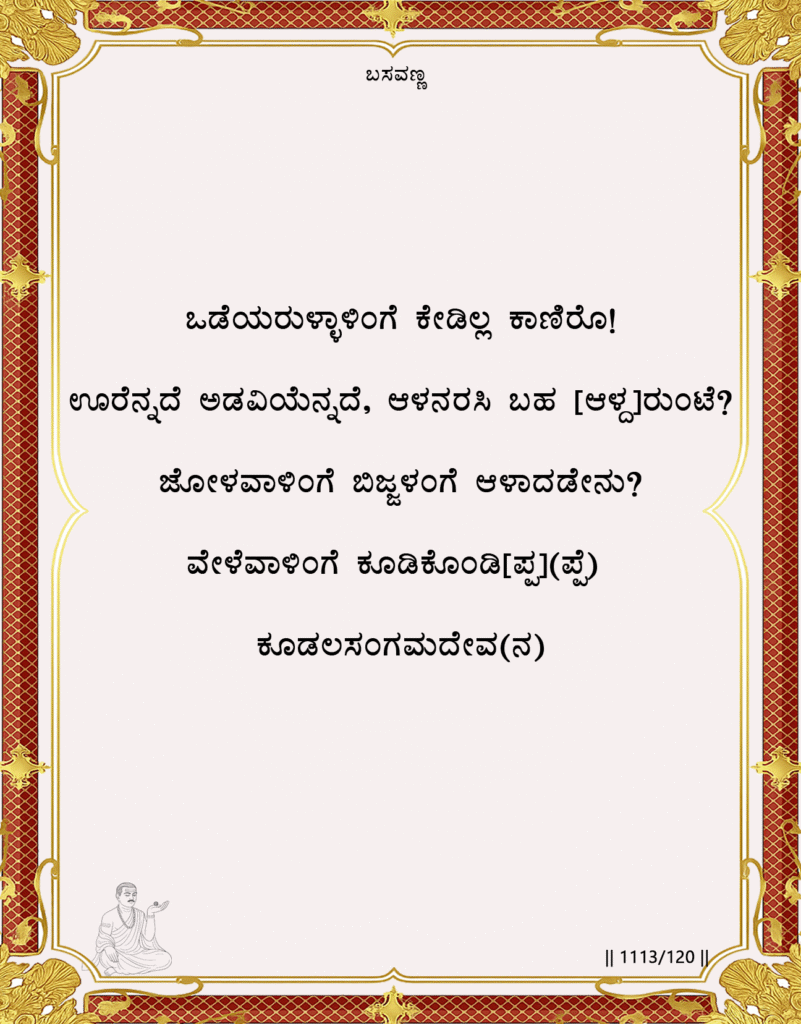
A woman who has her lord is never truly poor
what does it matter if he lives in palace or forest?
Her refuge is in him, not in the place.
And I, who serve the earthly king for my livelihood
yes, I must account for every coin I draw
from mighty King Bijjala’s treasury.
But tell me
when the Great Reckoning comes,
are not the king who commands
and the accountant who obeys,
both servants of the One Eternal Master?
When the final ledger of truth is opened,
when worldly crowns crumble into dust
only You remain,
O Koodalasangamadeva.
Basavanna uses his own role as royal treasurer to teach a profound truth: worldly authority, wealth, and duty are temporary, but one’s ultimate accountability is to the Divine alone. Just as a woman’s security rests not in her surroundings but in her connection to her lord, Basavanna’s true refuge is not the earthly king he serves but the Eternal Sovereign, Kudalasangamadeva. This vachana affirms that while one must perform worldly duties with integrity, all earthly roles including kingship it selfare subordinate to the final truth of God. In the ultimate ledger of life, only divine allegiance endures.
Spiritual Context
Core Spiritual Principle: Transcendent Immanence in Action. The Divine is not separate from the world but is its ultimate context and purpose. One can engage in secular affairs with sacred consciousness by performing them as a service to the true Sovereign (Raja-Aradhana). This transforms duty (kartavya) into worship (puja).
Cosmic Reality Perspective: From the non-dual view, the entire cosmos is the administration (shasan) of Shiva. King Bijjala’s kingdom is a temporary, localized expression of this cosmic sovereignty. Basavanna, by keeping accounts for the king, is symbolically participating in the divine order. His realization is that he serves the King of Kings through serving the earthly king.
Historical Reality (Anubhava Mantapa Context): This is Basavanna’s public theology of responsible engagement. As the chief officer of a secular kingdom, he models how a Lingayoga practitioner holds power: with scrupulous honesty, without corruption, and without identifying with the power itself. It legitimizes the path of the householder (grihastha) as equal to that of the renunciant, provided the inner refuge remains absolute.
Interpretation
Her refuge is in him, not in the place.” Establishes the principle of inner security (abhaya) derived from relationship, not circumstance. The soul’s refuge in the Linga makes one invulnerable to the dualities of fortune/misfortune.
I must account for every coin…” Affirms the necessity of aparigraha (non-misappropriation) and extreme integrity in one’s given role. Spiritual practice begins with ethical conduct in one’s station.
Both servants of the One Eternal Master?” This is the leveling insight that dissolves ego. It exposes the relativity of all social power and creates a profound humility and solidarity. The king’s command and the accountant’s obedience are two forms of the same service.
When worldly crowns crumble into dust only You remain.” This finalizes the hierarchy of reality. All worldly structures are perishable constructs. Consciousness of the Imperishable is the only permanent attainment.
The Cosmic Reality
Anga (Human Dimension): The Anga is a responsible functionary within a temporary system. It performs its duty impeccably as an offering, knowing the system itself is ephemeral.
Linga (Divine Principle): The Linga is the foundational Treasury, the source of all wealth and authority. It is the King whom all kings unconsciously reflect.
Jangama (Dynamic Interaction): Jangama is the wisdom-in-action that performs the worldly function while seeing it as a sacred ritual. It is the balance sheet where every debit and credit is entered as a transaction of consciousness with the Divine.
Shatsthala
Primary Sthala: Sharana. The entire vachana demonstrates the stabilized state of a Sharana. One who has taken refuge is fearless in stating the truth of divine sovereignty, even from within the heart of worldly power. Their identity is secure, allowing them to serve without subservience and command without arrogance.
Supporting Sthala: Aikya. The perspective that equates the king and the servant can only fully dawn from the unifying vision of Aikya. While the vachana is spoken from the posture of a Sharana, its profound insight points toward and is supported by the culminative Aikya under standing that in the eyes of the One, all distinctions of role and status merge.
Practical Integration
Arivu (Awareness Practices): Practice seeing your daily work as a yajna (sacrifice) offered to the Divine. With each task, mentally offer it: “This action is for You, the true Master of all outcomes.”
Achara (Personal Discipline): Uphold impeccable professional ethics. Let your “ledger” be clean in all dealings. This practical integrity is the foundation for the spiritual claim of serving a higher Master.
Kayaka (Sacred Action): Consciously frame your job as kayaka. Whether you lead or follow, perform your role with the awareness that you are contributing to a divine order that transcends your immediate workplace.
Dasoha (Communal Offering): Use your position and resources to foster justice and equity, understanding that you are a steward of the Divine’s wealth. Manage resources time, money, influence as an offering for the welfare of all, the true “subjects” of the Eternal King.
Modern Application
“The Anxiety of Hierarchical Identity.” We derive self-worth from job titles, social status, and wealth, leading to arrogance in success and despair in failure. We are either tyrannized by bosses or intoxicated by power, with no psychological sanctuary beyond the corporate or social ladder.
This vachana grants liberation within the system. It allows one to work with excellence and ambition without being owned by the results. By knowing you ultimately serve a purpose larger than your company or career, you gain the freedom to act with integrity, respect all colleagues as fellow servants of life, and find peace regardless of promotion or demotion.
Essence
For her lord’s love, no hut is mean.
For his king’s coin, his count is clean.
But when the final roll is read,
the crowns of power, like leaves, are shed.
One Master’s service, deep and true,
is all the ledger honors. You.
The Deeper Pattern: This vachana describes Holographic Sovereignty. In a hologram, every fragment contains the information of the whole. Here, every role (king, accountant, spouse) contains a reflection of the primary relationship: servant-to-Sovereign (Jiva-to-Shiva). Basavanna’s genius is to recognize this holographic principle within the system itself. He doesn’t reject the king’s authority; he sees it as a partial, fractal expression of the Divine authority. By fulfilling his duty perfectly within that fractal, he is simultaneously serving the whole. His accountability to Bijjala is a training ground for his ultimate accountability to the Source.
In Simple Terms: Imagine a large corporation (the cosmos). There’s the CEO (Shiva), department heads (various powers/deities), and managers like you. You have a demanding boss (King Bijjala/your worldly role). You can either resent your boss and job, or you can understand that you, your boss, and your department are all part of the same corporation, ultimately working (however imperfectly) for the CEO’s vision. By doing your specific job with excellence and integrity, you are directly contributing to the highest purpose of the whole company. Basavanna chooses the latter view, which transforms stress into sacred service.
The Human Truth: This speaks to our need for dignity within structure and our fear of being merely a cog in a machine. The vachana affirms that you are not just a cog; you are a conscious participant in a cosmic enterprise. Your work has meaning when you see it as service to something infinite. It resolves the tension between duty and freedom by making duty the very expression of your deepest freedom to act in alignment with the ultimate Truth.

Views: 19