Poetic Rendering

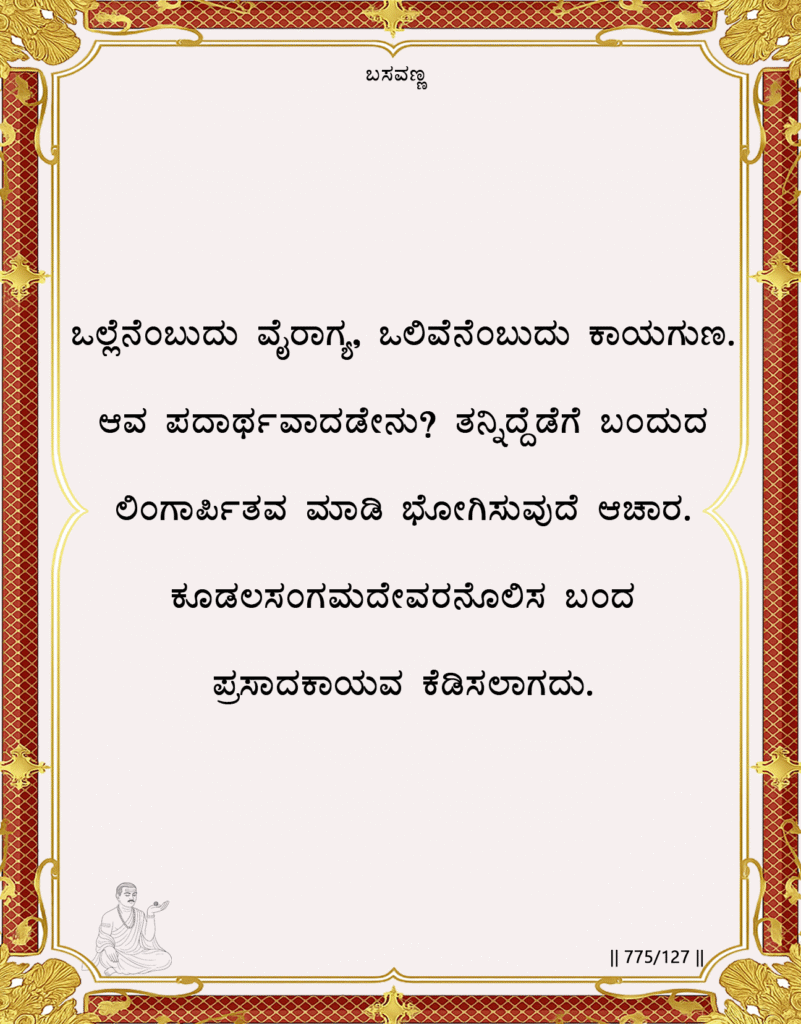
Detachment alone is the highest good.
The moment one says, “I will attain,”
the body whispers its pride.
What then is the right use of this self?
Whatever life brings
receive it as coming from the Liṅga,
offer it back as worship,
and partake of it as sacred prasāda.
For this very body,
bestowed by Koodalasangamadeva,
and bearing within it the jīva destined
to blossom into the primordial Liṅga,
can never be defiled.
Basavanna reveals that true renunciation is not the rejection of the world but the shedding of ego. Even the desire for spiritual attainment becomes a subtle arrogance when claimed by the body-bound mind. The path, he says, is to consecrate life itself: whatever comes to us must be received as divine prasāda and returned as devotion. The body is not an obstacle but a sacred vessel given by the Divine, capable of realizing its own inseparable connection with the Liṅga. When life is lived as worship, nothing can taint the one who walks in this awareness.
Spiritual Context
Core Spiritual Principle: The final obstacle to liberation is the ego’s appropriation of the spiritual quest itself. True detachment (vairagya) is not from objects, but from the sense of personal doership. The path is to live in a continuous, conscious loop of receiving life as grace and offering action as worship, thus dissolving the doer in the flow of divine activity.
Cosmic Reality Perspective: The Linga is the sole cause and substance of all manifestation. The body, the world, and all experiences are modulations of this divine consciousness. To see them as separate and potentially defiling is ignorance. To receive them as prasada (consecrated offering) and offer them back is to recognize their true nature, a process that reveals the Anga itself to be none other than the Linga.
Historical Reality (Anubhava Mantapa Context): This Vachana is a cornerstone of the Shivayoga path for householders. It refutes ascetic practices that reject the body and the world. It provides a tantric-like framework for total immersion in life as the means of liberation, making every shoemaker, weaver, and king a potential yogi through the sanctification of their daily experience.
Expanded Interpretation
1. “The moment one says, ‘I will attain,’ the body whispers its pride.”: This identifies the subtlest trap. The seeking mind creates a future goal (“attainment”) and a present seeker (“I”). This very division is the ego’s fortress. The “body” here symbolizes the entire apparatus of individual, separate existence.
2. “receive it as coming from the Liṅga, offer it back as worship, and partake of it as sacred prasāda.”: This is the functional algorithm for non-dual living. It creates a sacred circuit:
Input (Receiving): All experience is seen as a direct gift from the Divine (Linga).
Process (Offering): One’s responsework, thought, feelingis offered back to the source.
Output (Partaking): The result is consumed not as personal achievement or failure, but as blessed nourishment (prasada). This loop annihilates the ego, which thrives on claiming credit or assigning blame.
3. “this very body… can never be defiled.”: This is the triumphant conclusion. Defilement is a concept applied by a mind that sees itself as separate from the source. When the body is recognized as a manifestation of the Linga itself (“bestowed by Koodalasangamadeva”) and its essential purpose is the flowering of that same Linga-consciousness (“the jīva destined to blossom into the primordial Liṅga”), the idea of defilement becomes absurd. The vessel is made of the same substance as the nectar it carries.
The Cosmic Reality
Anga (Human Dimension): The Anga is the sacred vessel. Its purpose is not to become divine but to recognize its inherent divinity through the process of consecration. It is the field where the Linga consciously knows itself.
Linga (Divine Principle): The Linga is the source, the substance, and the ultimate consumer of the offering. The entire process of life is the Linga offering itself to itself through the medium of the Anga.
Jangama (Dynamic Interaction): The Jangama is the continuous cycle of receiving, offering, and partaking. It is the living worship, the dynamic love affair between the Divine and its own manifestation. It is not a relationship between two, but the joyous self-recognition of the One.
Shata sthala
Primary Sthala: Bhakta Sthala. This Vachana is the ultimate manual for this stage. It defines Kayaka not as a type of work, but as a quality of consciousness brought to all action and experience.
Supporting Sthala: Prasadi Sthala. The entire process described is the operation of grace (Prasada). Life itself is the grace, and the ability to perceive it as such is the highest grace.
Practical Integration
Arivu (Awareness Practices): Implement the “Prasada Loop” throughout your day. With every significant event (a meal, a meeting, a conflict, a success), pause and consciously perform the three steps inwardly:
1. “This comes from the Linga.” 2. “My response is an offering to the Linga.” 3. “I receive this outcome as Prasada.” This trains the mind in non-dual perception.
Achara (Personal Discipline): The core discipline is the eradication of the “I-attain” mentality. Replace goals like “I will become peaceful” with intentions like “I offer this moment to the Divine, whatever it contains.” Surrender the anxiety of achievement.
Kayaka (Sacred Action): Transform your work into this continuous flow. See the raw materials, your energy, and the challenges as “coming from the Linga.” Perform your tasks as an “offering.” Receive the finished product and the compensation as “prasada.” This makes any labor worship.
Dasoha (Communal Offering): Share this understanding. A community that practices this becomes a collective expression of the Jangamaa self-sustaining circuit of grace where everyone is simultaneously giving and receiving the divine in the form of service, support, and shared resources.
Modern Application
The Anxiety of Achievement and Burnout. Modern life, especially in the realms of career, wellness, and even spirituality, is driven by the “I will attain” paradigm. This leads to constant striving, stress, and the feeling that one is never enough. The body and mind become battlefields for achieving future goals.
This Vachana offers liberation from the tyranny of the self-improvement project. It replaces striving with sacred receiving. It cures burnout by transforming exhaustion into a form of offering. It allows one to engage passionately with the world without being broken by it, because the burden of being the “doer” and “attainer” has been lifted. Life becomes a playful, sacred dance rather than a grim test.
Essence
To say “I will” is but a stain,
A subtle, self-created chain.
But take what comes, and give it back,
And find yourself on sacred track.
For body, world, and all you see,
Are God alone, and always free.
1. The Ego as a Karmic Short-Circuit: The statement “I will attain” creates a karmic short-circuit. It posits a separate self (the attain-er) and a future state (the attained), generating a psychological time-loop that perpetuates suffering. The “Prasada Loop” is the antidote: it restores the natural, karmically neutral flow of energy from the Source (Linga) back to the Source, with the individual consciousness acting not as a resistor but as a conscious conductor. In this state, the Anga does not generate new karma but becomes a transparent medium for the Linga’s lila (divine play).
2. The Linga as the Total System: The teaching reveals the universe as a closed, divine system. Nothing enters the system from outside (all is “from the Linga”) and nothing leaves (all is “offered back”). The idea of defilement implies an external contaminant, which is impossible in this model. The body and its experiences are not in the system; they are the systemthe dynamic, ever-changing expressions of the Linga itself.
3. Jangama as the Divine Metabolism: The functioning Jangama is the metabolic process of the Divine Body. It is the perpetual cycle where the One “ingests” its own manifestation through the receptive heart of the Anga (“receives”), “digests” it through the fire of conscious offering (“offers back”), and assimilates it into its own blissful substance (“partakes as prasada”). The realized being is one in whom this metabolic process has become continuous and effortless. They no longer live in the world; the world lives through them as the Linga’s own self-sustaining nourishment. This is the state where the Anga, having fully realized itself as the Linga, experiences all Jangama (all relationship and action) as the joyous, unceasing celebration of its own infinite being.
Stop trying to become spiritual. Instead, start recognizing the spirituality of everything you already are and everything that already happens to you. Your life is not a problem to be solved; it is a ceremony to be lived. Receive each moment as a gift, offer your response as a prayer, and digest the results as a blessing. In this simple, profound practice, you will discover that you were never the seeker, but the very divinity you sought. The body you thought was a barrier is the temple, and the world you thought was an illusion is the continuous revelation of God.
Views: 13