
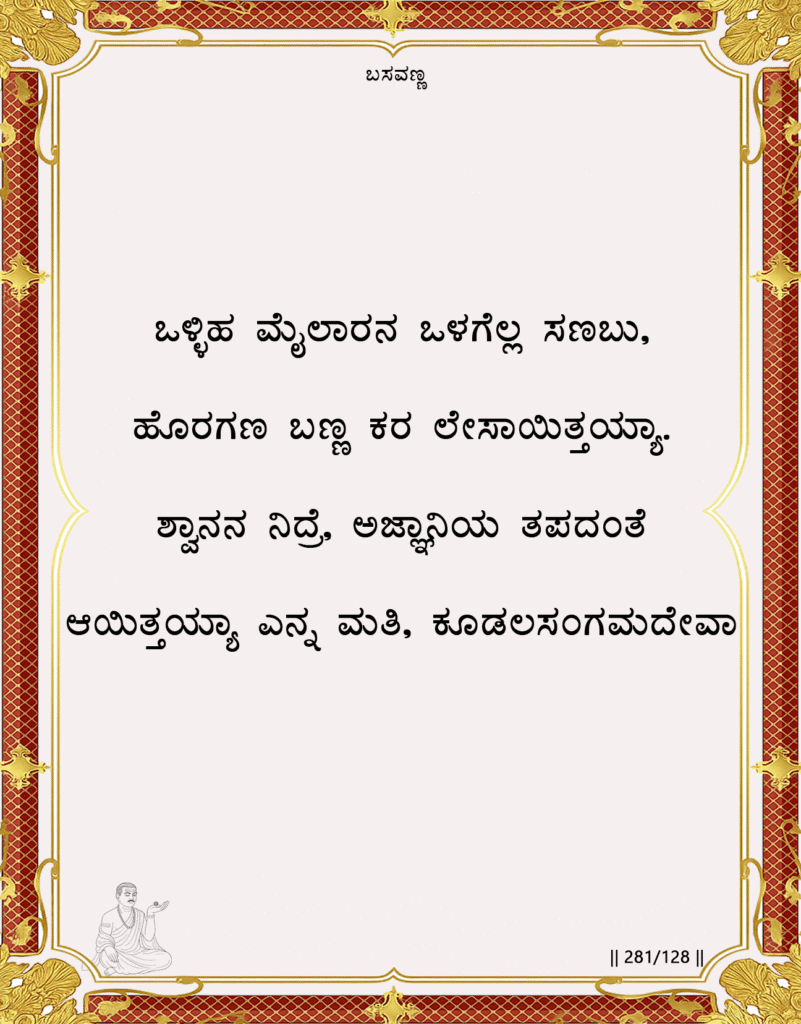
Poetic Rendering
Like the Mailara warrior’s figure
glittering in armor,
yet stuffed within with nothing but straw
so too is the state of this body.
And like a dog stretched out in sleep,
mimicking meditation without awareness,
my own practice has become hollow.
O Koodalasangamadeva,
this is what I have turned into.
Basavanna uses two piercing images: a warrior effigy filled with straw, and a dog lying in sleep that resembles meditation. Both point to the same truth the danger of spiritual emptiness disguised as devotion. One may appear disciplined, adorned, or outwardly pious, yet remain inwardly vacant, without awareness or sincerity. Basavanna laments his own state to teach humility: the real battle is not in looking spiritual but in living with genuine inner presence. Only through honest self-recognition can one turn again toward the Divine.
Spiritual Context
Core Spiritual Principle: The most insidious spiritual failure is not open transgression, but the unconscious performance of piety. True spirituality begins with the courageous confession of one’s own inner emptiness and mechanical practice. This honest self-assessment is more valuable than any impressive but unfeeling ritual.
Cosmic Reality Perspective: The Linga is pure Consciousness (Chit). A practice performed without awareness is, by definition, not an offering to Consciousness. It is an empty form, an object within consciousness, not a communion with consciousness. The “straw” represents the inert, unconscious substance of the ego, which can never know God.
Historical Reality (Anubhava Mantapa Context): This Vachana serves as a powerful check against spiritual pretense within the community. By publicly confessing his own potential for hollowness, Basavanna, the leader, creates a culture of radical honesty. It ensures that the Shivayoga path remains one of authentic experience (anubhava), not social performance.
Expanded Interpretation
1. “the Mailara warrior’s figure… stuffed within with nothing but straw”: The “warrior” represents the spiritual adeptthe one who appears to be fighting the battle against the ego. The “armor” is the external display of discipline, vows, and knowledge. The “straw” is the shocking truth: the absence of the true warrior, which is vigilant awareness. It is the ego pretending to be spiritual.
2. “a dog stretched out in sleep, mimicking meditation…”: This is an even more humbling image. The dog is not pretending; it is simply in a natural state that looks like meditation. This symbolizes the practitioner who, through habit and comfort, goes through the motions of practice. The body is still, but the mind is unconscious, “asleep” to the presence of the Divine. There is no volitional offering, only biological repose.
3. “this is what I have turned into.”: This confession is the climax and the saving grace. The moment one can sincerely utter this statement, the “straw” of unconsciousness is set on fire by the spark of self-awareness. The hollow warrior begins to fill with the substance of honest seeking.
The Cosmic Reality
Anga (Human Dimension): The Anga is the “warrior of straw.” Its task is to recognize this hollowness without despair and to use that recognition to invoke the true indweller the Linga itself.
Linga (Divine Principle): The Linga is the silent witness to this confession. It does not condemn the straw warrior but shines the light of awareness that reveals the straw for what it is. This revealing is itself an act of grace.
Jangama (Dynamic Interaction): The Jangama is the dynamic of honest self-confrontation. The act of speaking this truth to the Divine bridges the gap between the hollow form and the conscious reality. This vulnerable confession is the most authentic Jangama at this stagethe real connection being made.
Shatsthala
Primary Sthala: Bhakta Sthala. This Vachana is essential for the Bhakta. It prevents the devotee from becoming a hypocrite and ensures their devotion is rooted in the soil of self-awareness, not the sand of performance.
Supporting Sthala: Maheshwara Sthala. The burning desire to replace the “straw” with a genuine, purified substance is the driving force behind the inner purification of the Maheshwara stage.
Practical Integration
Arivu (Awareness Practices): Practice “Straw Inspection.” In your meditation or prayer, regularly ask: “Am I truly present, or am I just a straw warrior going through the motions? Is my mind asleep like a dog, merely mimicking the posture of awareness?” Do not fear the answer; welcome the clarity it brings.
Achara (Personal Discipline): Make honesty your primary discipline. If you find yourself speaking or acting in a way to appear more spiritual than you feel, inwardly confess it. It is better to be an honest worldling than a dishonest saint.
Kayaka (Sacred Action): Infuse your work with conscious intent. Before starting a task, set a clear intention for awareness. Are you working mechanically (like the sleeping dog) or with mindful presence? Let the quality of your attention be the real offering, not just the completed task.
Dasoha (Communal Offering): Create a community where it is safe to say, “I feel like a straw warrior today.” This level of shared vulnerability destroys spiritual pretense and builds a community based on mutual support in genuine growth, not mutual admiration for polished images.
Modern Application
Spiritual Branding and “Wellness” Performance. In the age of social media, there is immense pressure to present a curated spiritual image the perfect meditation corner, the enlightened quote, the serene posture. This can create a culture of “straw warriors,” where the external display is flawless, but the internal experience is one of anxiety, distraction, or emptiness.
This Vachana is the ultimate antidote to spiritual narcissism. It liberates you from the exhausting project of maintaining a spiritual image. It gives you permission to be a beginner, to be messy, to be honest about your dryness. It teaches that the path to God is paved not with perfect images, but with honest confessions. The first step toward filling the hollow self with divine presence is to admit that it is hollow.
Essence
In armor bright, a fearsome sight,
A warrior poised for holy fight.
But tap the chesta hollow sound,
Where straw, and not a soul, is found.
And like a dog in sleeping pose,
The mind that rests, but never knows.
1. The Phenomenology of the Straw Self: The “straw warrior” is a precise phenomenological description of the egoic state. The ego can mimic the attributes of spirituality (discipline, knowledge, compassion) but cannot replicate the substance, which is conscious presence itself. The straw represents the inert, conditioned content of the mind (samskaras) arranged in the shape of a seeker. It is a complex of thoughts about God, without the living presence of God.
2. The Linga as the Anti-Dote to Straw: The Linga, as pure Chit (consciousness), is the ontological opposite of “straw” (unconscious matter). The Vachana’s power lies in its act of confession. By holding the straw-self up to the light of the Linga, a fundamental incompatibility is revealed. The Linga’s nature is to illuminate, and in that light, the straw cannot maintain its pretense. The confession is the first act of allowing the Linga’s light to penetrate the hollow form.
3. Jangama as the Alchemy of Honesty: The functioning Jangama here is the transformative power of radical self-honesty. This is not a Jangama of blissful union, but of painful, necessary disclosure. It is the dynamic process where the unconscious self (the sleeping dog, the straw warrior) is offered to the conscious Divine. This offering, though it contains no “bliss,” is packed with the only substance the Divine truly desires: Truth. In the economy of spirit, this honest confession of emptiness has more weight than a dishonest performance of fullness. This Jangama is the sacred fire that will eventually burn away the straw, leaving the armor empty and ready to be filled not by a new self, but by the Linga itself. The warrior’s true battle is to cease being straw, and this confession is the first and most crucial victory.
Have the courage to tap on your own armor. If you hear a hollow sound, do not be ashamed. This honest recognition is the beginning of wisdom. The world is full of glittering warriors stuffed with strawdo not add to their number. It is better to be a humble, honest bundle of straw aware of its own condition, than a glorious warrior ignorant of his own emptiness. For God can fill the first with divine presence, but can do nothing with the second but wait for it to see itself. Your honesty is the crack in the armor through which the light gets in.

Views: 20