Poetic Rendering
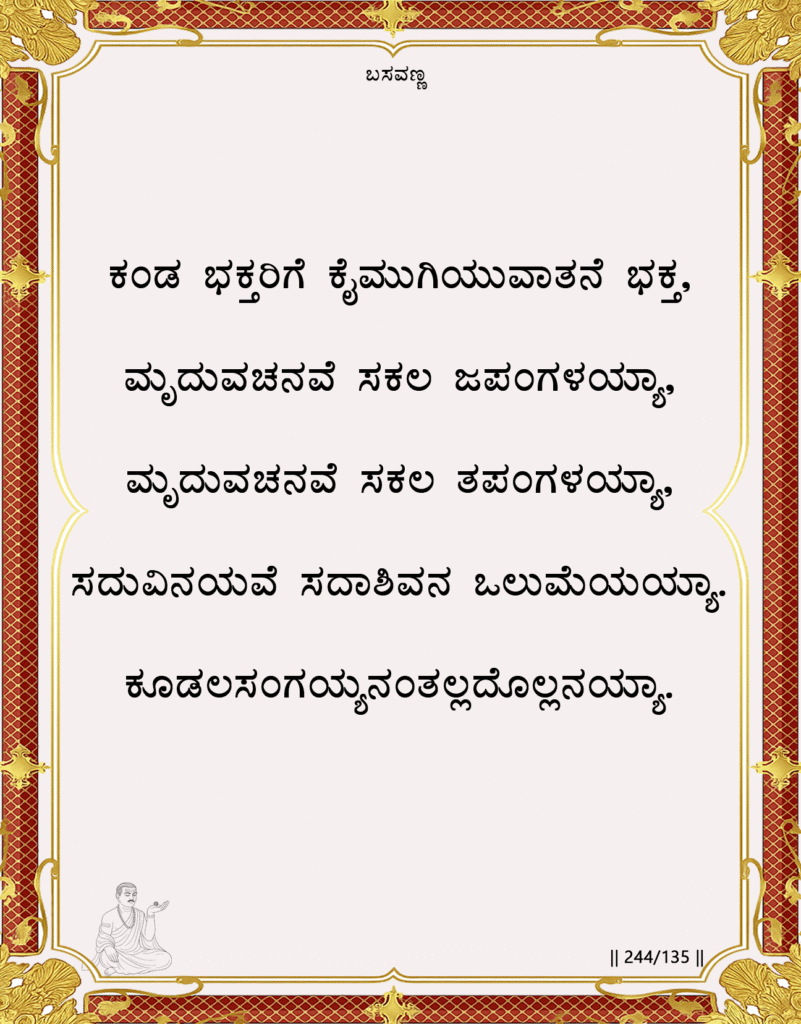
One who bows to the feet of devotees is the true bhakta.
Gentle speech is the highest of mantras,
gentle speech is the greatest of penances.
And a humble heart is the most beloved offering
to the Lord Sadashiva Himself.
What other worship is needed, O Koodalasangamadeva?
This vachana distills the essence of practical spirituality into three tangible virtues: reverence for the enlightened, gentle speech, and inner humility. Basavanna systematically replaces complex, external religious observances with simple, internal qualities that directly shape one’s character and interactions. He presents a path where devotion is not measured by ritual prowess but by the softness of one’s heart and the kindness of one’s words, asserting that these qualities are themselves the highest forms of worship most pleasing to the Divine.
Spiritual Context
Core Spiritual Principle: The essence of spirituality is not in external performance but in the cultivation of a humble heart, reverent demeanor, and gentle speech. These internal attributes constitute the most direct and potent form of worship.
Cosmic Reality Perspective: The non-dual truth (Linga/Sadashiva) is not reached through complex rites but is revealed in the quiet spaces where ego subsides. Gentle speech reflects a non-violent consciousness aligned with all existence, and a humble heart is a vessel empty enough to be filled by the Divine. These qualities are the natural expression of a self that is harmonized with the Linga.
Historical Reality (Anubhava Mantapa Context): This is a radical democratization of spiritual practice. Basavanna dismantles the monopoly of priestly ritual by declaring that the most profound worship is accessible to everyone, regardless of birth or learning, through the simple, everyday discipline of character.
Interpretation
“One who bows to the feet of devotees is the true bhakta.”: The first virtue is humility expressed as reverence. Bowing is a physical act that enforces the psychological dissolution of ego. It recognizes the Divine (Linga) present in the other (Jangama), making the act of reverence a direct spiritual technology.
“Gentle speech is the highest of mantras, the greatest of penances.”: This elevates everyday communication to the level of supreme spiritual practice. A “mantra” is a potent sound that transforms consciousness; here, gentle speech itself becomes that transformative force. “Penance” typically involves austerity; here, the constant restraint required to speak gently is redefined as the most meaningful tapas.
“A humble heart is the most beloved offering to Lord Sadashiva.”: The culmination is the internal state. The heart is the altar, and humility is the offering. This internal offering is declared more pleasing to God than any material oblation, as it represents the true surrender of the ego, the final obstacle to union.
Practical Implications: The seeker is guided to measure their spiritual progress not by mystical experiences, but by the genuineness of their humility, the kindness in their speech, and their capacity to see and honor the divine in others. The practice is moment-to-moment mindfulness in thought, word, and deed.
The Cosmic Reality
Anga (Human Dimension): The body that bows, the tongue that speaks, and the heart that feels. The Anga is not to be suppressed but to be perfected as an instrument of devotion through these three disciplines.
Linga (Divine Principle): Koodalasangamadeva as Sadashiva, the eternal, auspicious Lord who is the very embodiment of peace and benevolence. The qualities prescribed (gentleness, humility) are the human reflection of this divine nature.
Jangama (Dynamic Interaction): The living practice of these virtues. It is the dynamic relationship where the Anga, through its gentle and humble engagement with the world, continuously worships and connects with the Linga. Every kind word becomes a living mantra; every humble thought becomes a moving prayer.
Shatsthala
Primary Sthala: Bhakta. This Vachana is a perfect manual for the Bhakta stage. It outlines the core attitudesreverence, gentle speech, and humilitythat define a genuine devotee and form the bedrock for all higher stages.
Supporting Sthala: Maheshwara. The Maheshwara stage involves intense inner purification. The disciplines of controlling speech and cultivating humility are central to this purificatory process, making the Bhakta’s devotion stable and authentic.
Practical Integration
Arivu (Awareness Practices): Practice mindfulness of speech. Before speaking, pause to check the tone and intention. Practice “inner bowing” by mentally offering respect to everyone you meet, seeing them as a manifestation of the Jangama.
Achara (Personal Discipline): Make a vow (vrata) of Satya (truth) and Ahimsa (non-harm) in speech. Cultivate humility by consciously acknowledging your mistakes and learning from others, especially those you might have considered beneath you.
Kayaka (Sacred Action): Let your work be performed with a gentle and humble attitude. Use your speech in your profession to uplift, clarify, and heal, rather than to command, criticize, or boast.
Dasoha (Communal Offering): Offer the gift of kind words and a humble presence to your community. Be the person who de-escalates conflict with gentle speech and who strengthens the community through selfless cooperation.
Modern Application
The culture of assertiveness, aggressive communication (online and offline), narcissism, and the constant performance of a curated, superior self on social media.
This Vachana is an antidote to the ego-driven modern psyche. It posits that true strength lies in gentleness and that real self-worth is found in humility. It offers a path to profound inner peace and authentic connection by replacing the exhausting effort of self-promotion with the liberating practice of self-effacement and sincere regard for others.
Essence
A bowed head, a word of grace,
A heart that holds no hidden space.
These three, the truest rite and chant,
Are all that does the Beloved want.
The Deeper Pattern (The Subtle Body): This Vachana outlines a Spiritual Coherence Model. The egoic self is a state of internal noise and dissonance. The three practicesreverence, gentle speech, and humilityact as coherence-inducing operators. Bowing creates coherence between individual consciousnesses. Gentle speech creates coherence in the field of vibrational energy one emits. A humble heart creates internal coherence by silencing the chaotic feedback loop of the ego. Together, they tune the human system (Anga) to the fundamental frequency of the Linga, which is pure, silent, and all-encompassing benevolence.
In Simple Terms (The Gross Body): A spiritual life is like tuning a musical instrument. You don’t need a complex song to know it’s tuned; you just need to check that the strings are at the right tension and produce a clear, harmonious note when plucked. Reverence, gentle speech, and humility are those three tuning pegs. When they are correctly adjusted, your entire being resonates in harmony with the Divine.
The Human Truth (The Causal Body): The most powerful spiritual practice is to be kind. The most profound wisdom is to be humble. The deepest worship is to see the sacred in everyone you meet. Everything else is commentary.

Views: 17