
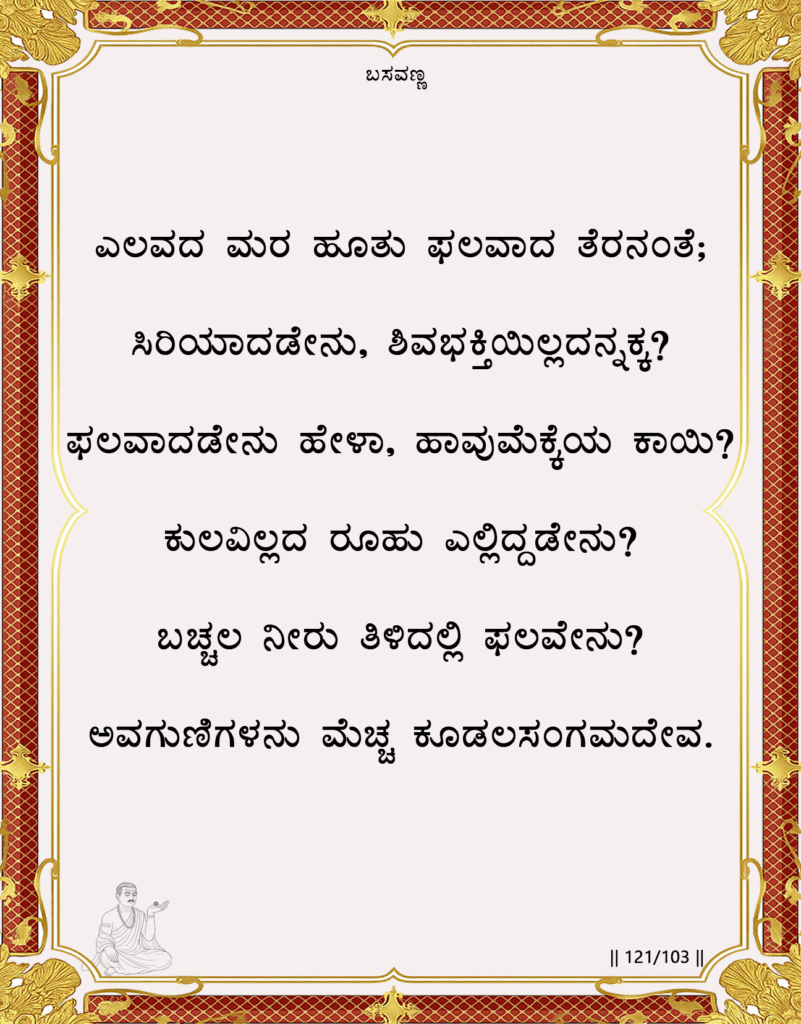
Poetic Rendering

What use is a tree thick with leaves
yet bearing no fruit?
What use is wealth
when devotion is absent?
What use is fruit
guarded and poisoned by serpents?
What use is lineage
when virtue does not flow within it?
What use is water
that looks clean yet is fouled beneath?
Such things do not delight,
nor are they worthy
in the sight of Koodalasangamadeva.
Basavanna teaches that outer abundanceleaves, wealth, status, or purityhas no meaning without inner worth. Fruit poisoned by snakes and water clean only on the surface symbolize lives that appear whole but lack devotion, integrity, and virtue. God values only what is true within; all external show without inner substance is empty before Koodalasangamadeva.
Spiritual Context
Core Spiritual Principle: The value of a life is determined by its inner spiritual fruit, not by its external adornments. Appearance without essence is not merely useless; it is a dangerous illusion that obstructs true growth.
Cosmic Reality Perspective: The Linga is pure, undivided Consciousness and Truth. Any disparity between one’s inner state and outer presentation is a form of duality and falsehood (Maya) that reinforces separation from the Divine. The path to unity requires integritythe state where the outer and inner are one.
Historical Reality (Anubhava Mantapa Context): This Vachana continues Basavanna’s social critique, targeting the Brahminical emphasis on ritual purity, caste lineage, and material offerings to temples, while ignoring the inner quality of the devotee. It establishes that in the new community, one’s spiritual integrity is the only true currency.
Interpretation
1. “a tree thick with leaves yet bearing no fruit?”: The “leaves” represent external religiousity, learning, and social respectability. Without the “fruit” of genuine spiritual realization (anubhava), these are merely for show, providing no nourishment to the soul.
2. “wealth when devotion is absent?”: This critiques a life dedicated to material accumulation (artha) without the orienting principle of devotion (bhakti). Such wealth becomes a burden, reinforcing ego and attachment.
3. “fruit guarded and poisoned by serpents?”: The “fruit” can represent even spiritual achievements or good deeds. If they are “guarded” by the serpent of ego (pride, possessiveness) or “poisoned” by hidden motives (desire for reward), they become toxic and binding rather than liberating.
4. “lineage when virtue does not flow within it?”: This is a direct challenge to caste hierarchy. A noble birth is worthless if it does not produce a noble character. True lineage is the lineage of virtue and devotion, not blood.
5. “water that looks clean yet is fouled beneath?”: This symbolizes a person who maintains an outer facade of purity and morality, but whose inner world is polluted by hidden prejudices, hatred, and deceit. This hypocrisy is the most insidious failure.
The Cosmic Reality
Anga (Human Dimension): The Anga is called to a state of integration. It must ensure that its outer life (leaves, wealth, status) is a direct expression of its inner reality (fruit, devotion, virtue). The Anga is the gardener of its own soul, responsible for producing authentic fruit.
Linga (Divine Principle): The Linga is “Koodalasangamadeva” as the ultimate touchstone of authenticity. It cannot be deceived by appearances and values only the sincere offering of a truthful heart. It is the standard of absolute integrity.
Jangama (Dynamic Interaction): The Jangama is the practice of constant self-audit. It is the dynamic process of examining one’s own “tree” to ensure the leaves of action are connected to the sap of devotion, and that the fruit of one’s life is wholesome, unguarded, and offered freely.
Shata Sthala
Primary Sthala: Bhakta Sthala. This Vachana defines the sincerity required of a true devotee. The Bhakta’s first duty is to weed out hypocrisy from their own heart, ensuring their devotion is not just a performance.
Supporting Sthala: Maheshwara Sthala. The inner “virtue” and “purity” that must flow within are the qualities of a purified individual, the Maheshwara, whose inner and outer being are a clean vessel for the Divine.
Practical Integration
Arivu (Awareness Practices): Practice “motivation check.” Before any significant action, especially spiritual practices, ask: “What is the true fruit I seek? Is this for inner growth, or for outer recognition?” Scrutinize the “serpents” of pride and hidden desire.
Achara (Personal Discipline): Cultivate integrity as the highest discipline. Let your words, actions, and inner feelings align. Avoid presenting a spiritual image that is not matched by your private conduct. Simplicity and authenticity should be your guiding principles.
Kayaka (Sacred Action): Let your work produce a tangible, positive “fruit” for others. Do not just do a job for a paycheck (leaves); ensure that your labor contributes to the well-being of the community (fruit). Reject work that is outwardly impressive but inwardly corrupting or harmful.
Dasoha (Communal Offering): Build a community that values character over credentials. Praise sincerity and humility over displays of wealth or piety. Create an environment where people feel safe to be authentic, shedding the pressure to maintain a false, “clean-looking” surface.
Modern Application
The Culture of Personal Branding and Virtue Signaling. In the age of social media, there is immense pressure to curate a perfect life a “tree thick with leaves” of success, wellness, and woke morality. This often masks a hollow core, a “fruit” poisoned by anxiety, comparison, and inauthenticity. We perform virtue without embodying it.
This Vachana is a call to radical authenticity. It liberates one from the exhausting performance of being “spiritual” or “successful.” It encourages a focus on inner cultivation producing the genuine fruit of compassion, integrity, and self-awareness regardless of how it appears to others. It teaches that a simple, fruitful life is of infinitely greater value in the eyes of the Divine than a spectacular, fruitless one.
Essence
A leafy tree with nothing sweet,
A wealthy soul in stark defeat.
A poisoned fruit, a tainted well,
A life of show, a hollow shell.
But God sees past the grand display,
To the true fruit the heart does lay.
1. The Energetic of Authentic Output: The “leaves” represent potential energy, while the “fruit” represents kinetic energy that nourishes. A life focused on leaves is a system of stored, stagnant potential (e.g., knowledge never applied, wealth never shared). A life focused on fruit is a system in dynamic exchange, transforming inner potential into outer nourishment for the self and the ecosystem (the community). The Linga, as the source of all life, values this dynamic, nourishing output.
2. The Toxicity of Misaligned Systems: The “poisoned fruit” and “fouled water” represent systems where the output is corrupted. This occurs when the transformative process (Jangama) is hijacked by a foreign agentthe ego. The ego acts as a toxin that converts pure energy (action, devotion) into a binding substance (karma, pride). A virtuous lineage that produces no virtue is a broken circuit; energy cannot flow through it.
3. Jangama as the Process of Bearing True Fruit: The functioning Jangama is the entire cycle of photosynthesis for the soul: drawing energy from the sun (Linga’s grace), converting it through the work of the leaves (spiritual practice and Kayaka), and producing a nourishing, selfless offering (the fruit of realized consciousness). This Vachana calls for a Jangama that is a closed, integrity-filled loop, where the inner state of the Anga is perfectly manifested in its outer expression, creating a life that is a worthy offering to the Linga because it is, itself, true, wholesome, and nourishing.
Your true legacy is not what you have, but what you give; not how you appear, but what you produce from the depths of your character. Cultivate your inner world with such integrity that its fruit your actions, your words, your very presence becomes a source of nourishment and truth in a world starved of authenticity. In the final reckoning, it is not the showy leaves but the humble, wholesome fruit that counts.

Views: 4