
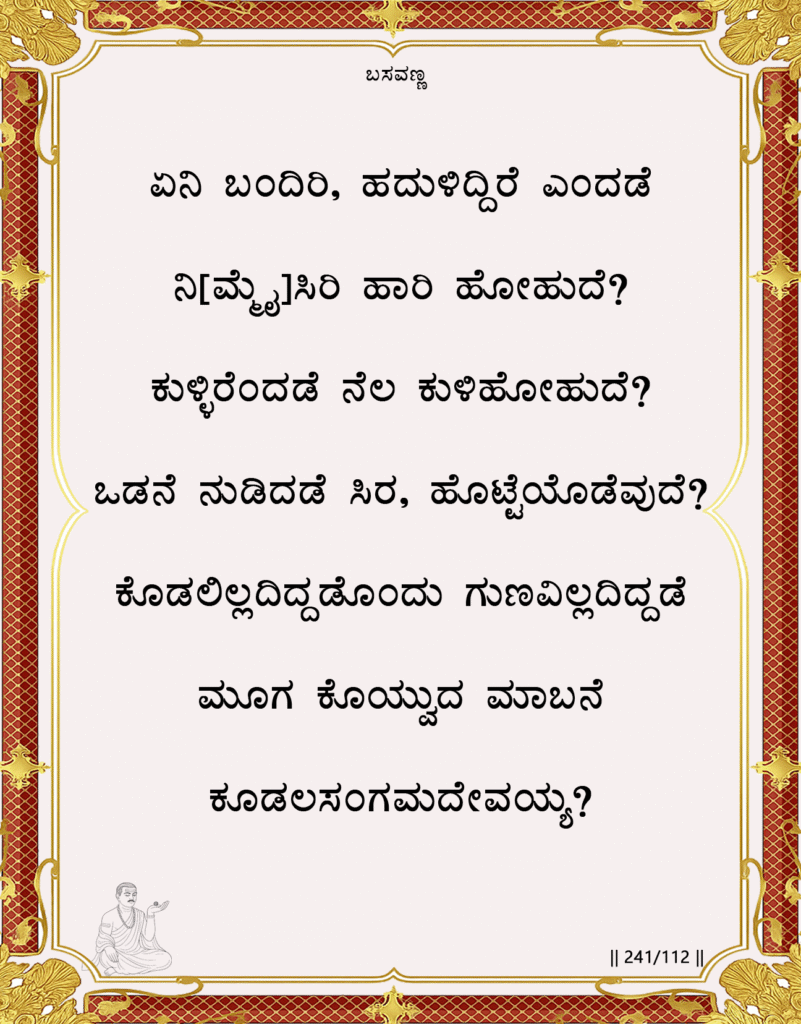
Poetic Rendering

“Welcome, come in”
if you greet a guest with joy,
does your wealth diminish?
If you say, “Please sit,”
does the earth crack beneath the weight?
If you speak kindly the moment they arrive,
will your head burst open?
You may or may not give from your store,
but if you withhold simple respect
if you fail in courtesy and human warmth
know this,
Koodalasangamadeva
will not pardon such a heart.
Basavanna turns everyday hospitality into a profound spiritual teaching. He mocks the ego’s stinginess by exposing how effortless kindness truly is greeting, offering a seat, speaking warmly cost nothing. The guest is the living Jangama, the moving form of the Divine, and honoring them is honoring the God who resides in everyone as the inner Linga. To refuse respect is to reject the Divine itself. Thus, Basavanna declares: true spirituality is measured not in ritual but in the humility, openness, and reverence with which we meet those who arrive at our door.
Spiritual Context
Core Spiritual Principle: The ultimate test of spirituality is not in secluded worship but in interpersonal conduct. Reverence for the Divine is meaningless if it does not translate into reverence for the human being before you. The guest is a test from God, and simple, respectful courtesy is a fundamental, non-negotiable form of worship.
Cosmic Reality Perspective: This Vachana embodies practical non-duality. If the Linga is the one consciousness in all, then every person is a mobile temple. The “guest” is not a separate entity but the Linga itself arriving at your door in a dynamic, human form (Jangama). To dishonor the guest is to dishonor the very principle you claim to worship.
Historical Reality (Anubhava Mantapa Context): This was a radical social ethic in a caste-ridden society where hospitality was often restricted by notions of purity and pollution. Basavanna democratizes divinity, stating that every guest, regardless of birth, deserves respect as God. This is the practical application of the Dasoha principle.
Interpretation
1. “does your wealth diminish?… does the earth crack?… will your head burst open?”: With these sarcastic, rhetorical questions, Basavanna exposes the absurdity of the ego’s吝啬 (stinginess). He highlights that the currency of basic human respecta smile, a kind word, a gesture of welcomeis infinite and costs the giver absolutely nothing. The only thing that is spent is the ego’s pride.
2. “You may or may not give from your store…”: This is a crucial distinction. Material charity (Dasoha of wealth) is a higher level offering and may depend on one’s capacity. However, the Dasoha of dignity is a fundamental, universal duty. One may be poor in wealth, but no one is poor in their capacity to be respectful.
3. “if you withhold simple respect… Koodalasangamadeva will not pardon such a heart.”: This is the stern, spiritual consequence. The failure to offer basic courtesy is not a minor social faux pas; it is a profound spiritual failure. It reveals a heart that has not understood the first thing about the nature of God, which is all-pervasive and resides in all. Such a heart, closed to the divinity in others, is by definition closed to the Divine itself.
The Cosmic Reality
Anga (Human Dimension): The Anga is the host, the householder. Their spiritual practice is to cultivate an open, generous, and reverent heart. Their home is their temple, and every guest is the deity.
Linga (Divine Principle): The Linga is the indwelling divine presence in the guest. It is the silent, sacred reality that awaits recognition through the host’s courtesy.
Jangama (Dynamic Interaction): The Jangama is twofold: it is the guest themselves, the “moving
Linga,” and it is the host’s act of welcoming. This interaction is the sacred meeting point where the divine in the host recognizes the divine in the guest. This is Kayaka as sacred service and Dasoha as the offering of respect.
Shatsthala
Primary Sthala: Sharana Sthala. This Vachana is a behavioral definition of a Sharana. A Sharana is one who has taken refuge in the truth that God is in all, and therefore treats all with the reverence due to God.
Supporting Sthala: Bhakta Sthala. The simple, heartfelt courtesy described is the natural expression of a true devotee’s love for God. If one truly loves the Lord, one cannot be rude to His manifestations.
Practical Integration
Arivu (Awareness Practices): Practice “Seeing the Jangama.” Throughout your day, with everyone you meet family, colleagues, strangers, service staff pause for a second and silently acknowledge: “This person is a form of Koodalasangamadeva.” Let this recognition inform your tone and manner.
Achara (Personal Discipline): Make respectful communication a core discipline. Eliminate contempt, sarcasm, and dismissiveness from your speech. Practice active listening. Offer your full attention when someone is speaking to you, as if you are listening to the Divine.
Kayaka (Sacred Action): Let your work be an extension of this hospitality. Whether you are a CEO, a cook, or a carpenter, treat your colleagues, clients, and customers as honored guests. Create an environment of warmth and respect.
Dasoha (Communal Offering): The most fundamental Dasoha is to create a welcoming community. Ensure that your spiritual or social group is inclusive and that newcomers are greeted with genuine warmth. The community itself should be a “home” where every member feels seen, heard, and respected as the divine being they are.
Modern Application
The Crisis of Incivility and Digital Dehumanization. Modern life, especially online, is characterized by quick judgments, anonymous rudeness, and a profound lack of basic civility. We often treat people as abstractions, avatars, or obstacles rather than as living, breathing embodiments of consciousness. This leads to a culture of disrespect, isolation, and social fragmentation.
This Vachana is a simple yet revolutionary guide for modern living. It liberates us from the transactional, often disrespectful nature of modern interactions. It teaches that every encounter is a sacred opportunity. By practicing this “hospitality of the heart,” we not only honor others but actively repair the fractured social fabric and reclaim our own humanity. It is a potent antidote to the alienation of the digital age.
Essence
A welcome costs no gold to give,
A respectful word, by which we live.
The guest who stands there at your door,
Is the God you say you’re searching for.
To turn them coldly from your gate,
Is a sin that heaven won’t abate.
1. The Jangama as the Divine Invitation: The guest is not a passive recipient of charity but an active, living invitation from the Divine. They are a divine catalyst placed at your door to test your realization. Your response reveals the depth of your understanding: do you see a separate person in need, or do you see the Linga itself asking for recognition?
2. The Economy of Grace: Basavanna contrasts the economy of material wealth, which can diminish, with the economy of grace, which is limitless. A kind word, a respectful gesturethese are forms of spiritual currency that increase in value when spent. The host who gives respect does not become poorer but richer in spiritual merit and inner joy. The only true poverty is the inability to give this respect.
3. Jangama as the Liturgy of Meeting: The functioning Jangama here is the entire liturgy of hospitality. The greeting (“Welcome”), the offering of a seat (“Please sit”), and the kind word are the sacred mantras and rituals of this liturgy. The “temple” is not a building but the momentary sacred space created between the host and the guest. In this liturgy, the host is the priest, the guest is the deity, and the simple acts of courtesy are the offerings. To fail in this is to fail in the most basic liturgical act of the path of Kayaka and Dasoha. It is to be a priest who refuses to worship the very God he serves.
The divine is not hiding in a temple or a text. It is standing at your doorstep, sitting next to you on the bus, and working in your office. You encounter God dozens of times a day in the form of other people. The simplest, most profound spiritual practice is to treat every single one of these encounters with the reverence, kindness, and respect that you would offer to God. If you cannot manage this, then all your prayers, rituals, and meditations are an empty performance. For God is not impressed by how you treat Him in solitude, but by how you treat Him in the disguise of your fellow human beings.

Views: 2