Poetic Rendering
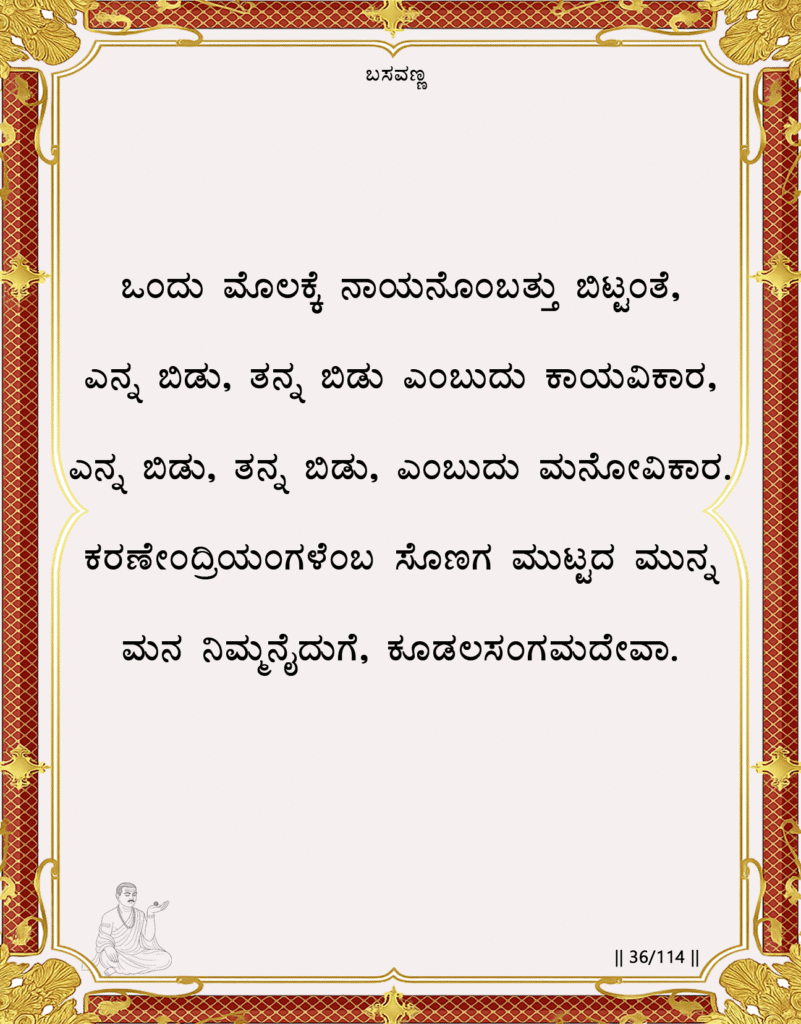
Like nine hounds let loose upon a single trembling hare,
the body cries, “Spare me,”
the mind cries, “Spare me,”
as the senses claw and pull from every side.
Before these ravenous dogs of desire
tear me apart and feast on my weakness,
O Koodalasangamadeva,
grip my awareness,
and make it cling to You alone.
Basavanna portrays the senses as ferocious dogs relentlessly hunting the fragile seeker. The body and mind, unable to resist their pull, cry out for help. This vachana reveals the human condition: the constant assault of cravings and impulses that scatter one’s consciousness. The only refuge, Basavanna says, is divine anchoring. When the mind is fastened to God, the senses lose their power to devour. True liberation comes not from fighting desire alone, but from surrendering the mind to Kudalasangamadeva, whose grace protects and steadies the inner being.
Spiritual Context
Core Spiritual Principle: The untamed senses and desires are a destructive, fragmenting force that pulls consciousness outward into the world of multiplicity. The only effective defense is not willpower alone, but the conscious surrender of the mind to a higher, unifying power the Divine.
Cosmic Reality Perspective: The “nine hounds” symbolize the five senses of perception (jnanendriyas) and the five senses of action (karmendriyas), often grouped in nines or tens in yogic philosophy. They represent the entire apparatus of the mind-body complex (antahkarana) when it is turned outward, seeking gratification in objects. The Linga is the one, non-dual center. To be “gripped” by it is for consciousness to be recentered, making the peripheral tumult of the senses powerless.
Historical Reality (Anubhava Mantapa Context): This Vachana provides a psychological and spiritual methodology for the Sharanas. It acknowledges the reality of human weakness and desire, and offers a practical solution surrender and remembrance that is accessible to everyone, not just ascetics.
Interpretation
1. “Like nine hounds let loose upon a single trembling hare…”: This is a visceral image of the human predicament. The “hare” is the core consciousness, fragile and scattered. The “hounds” are the senses, powerful, instinctual, and trained to hunt for sensory pleasure.
2. “the body cries, ‘Spare me,’ the mind cries, ‘Spare me,’…”: The body and mind are not the enemies here; they are also victims of this onslaught. They are overwhelmed and cry out for salvation, acknowledging their inability to withstand the assault on their own.
3. “Before these ravenous dogs of desire tear me apart…”: This conveys the urgency and high stakes. Unchecked desire doesn’t just cause distraction; it causes disintegration of the personality, “feasting” on one’s spiritual vitality.
4. “grip my awareness, and make it cling to You alone.”: This is the core of the prayer. Basavanna does not ask for the hounds to be killed, but for his own awareness to be seized and held fast by the Divine. The word “grip” (pidi) suggests a firm, external force taking control. “Cling” suggests a corresponding inner act of holding on. This dual actiongrace from without and surrender from withinis the Jangama that saves.
The Cosmic Reality
Anga (Human Dimension): The Anga is in a state of crisis and surrender. It recognizes its own vulnerability and actively seeks not just help, but a total takeover of its central facultyawarenessby a higher power.
Linga (Divine Principle): The Linga is the divine anchor, the still point in the turning world. It is the power that can “grip” the scattered rays of consciousness and focus them into a laser-like beam of devotion.
Jangama (Dynamic Interaction): The Jangama is the answering of the prayer. It is the dynamic process where the Linga’s grace actively seizes the devotee’s awareness, pulling it out of the sensory fray and establishing it in the safety of divine remembrance.
Shatsthala
Primary Sthala: Bhakta Sthala. This is the quintessential prayer of the devotee who is aware of their own weaknesses and relies completely on God’s grace for protection and progress.
Supporting Sthala: Prasadi Sthala. The “gripping of awareness” is the definitive action of grace (Prasada). This Vachana describes the moment of transition where the Bhakta’s cry for help is met with the transformative descent of grace.
Practical Integration
Arivu (Awareness Practices): Use the “Divine Grip” meditation. When you feel overwhelmed by desires or distractions, close your eyes and visualize a beam of light from Koodalasangamadeva “gripping” your mind at the center of your forehead (the ajna chakra). Feel your awareness being pulled upward and inward, away from the sensory “hounds.”
Achara (Personal Discipline): The primary discipline is the practice of pratyahara (sense withdrawal). This is not achieved by force but by substitution. When a sense craving arises, immediately substitute the object of desire with the name or form of Koodalasangamadeva. Let the mind “cling” to the Divine instead of the desired object.
Kayaka (Sacred Action): Engage in work that requires deep focus. Use your tasks as an anchor for your awareness, a practical way to “cling” to a single point and avoid being scattered by the “hounds” of distraction.
Dasoha (Communal Offering): Share this strategy within the community. When a fellow seeker is struggling with desire, remind them of this Vachana. Support each other in the practice of taking refuge, creating a collective field of focused awareness that can help stabilize individuals.
Modern Application
The Digital Onslaught and Attention Fragmentation. The modern world is a super-stimulant for the “hounds of desire.” Social media, advertising, and 24/7 entertainment are expertly designed to trigger our cravings and scatter our attention. This leads to anxiety, addiction, and a profound inability to focus, making us the “trembling hare” in a digital hunting ground.
This Vachana offers a powerful solution for the digital age. It teaches that willpower alone is insufficient against these engineered distractions. The solution is to consciously and repeatedly “grip” our awareness and “cling” to a higher purpose be it through prayer, meditation, or deep work. It is a call for intentional focus in an age of designed distraction, using divine grace as the ultimate tool for attention management.
Essence
The hounds of sense, with hungry breath,
Upon the hare of mind, bring death.
My will is weak, my strength is fled,
O Lord, be the Grip upon my head!
Let my awareness, torn and thin,
Cling to the One, and rest within.
1. The Physics of Scattered Attention: The “nine hounds” represent the entropic force that scatters the coherent energy of consciousness into the disordered, multi-directional chaos of sensory engagement. The “trembling hare” is a state of low-coherence consciousness, vulnerable to being completely dissipated.
2. Grace as a Coherent Force: The “grip” of Koodalasangamadeva is the introduction of a powerful, coherent force into this disordered system. It acts as a strange attractor in the chaos of the mind, drawing all scattered thought-particles into a single, ordered orbit around the divine center. This re-establishes a high-coherence state.
3. Jangama as the Reorientation of the Vector of Seeking: The functioning Jangama here is the divine intervention that changes the fundamental direction of the mind’s energy. Ordinarily, the mind’s vector points outward toward sense objects (the “hare” running from the “hounds”). Grace seizes this vector and turns it 180 degrees, so that it now points inward toward the Linga. The energy of seeking that was once the cause of suffering (chasing or fleeing) is now the very energy of liberation (clinging to God). The “hounds” of sense, finding their quarry has vanished into the divine ground, are rendered impotent.
You are not weak for being assailed by desires; you are human. The solution is not to fight a battle you are destined to lose on your own, but to call for a power greater than yourself to take command of the situation. Surrender the helm of your awareness to the Divine. Let your mind cling to God as your sole refuge, and the storms of desire will rage in vain against the unshakable fortress of grace. Your only task is to consent to be gripped.

Views: 0