Poetic Rendering
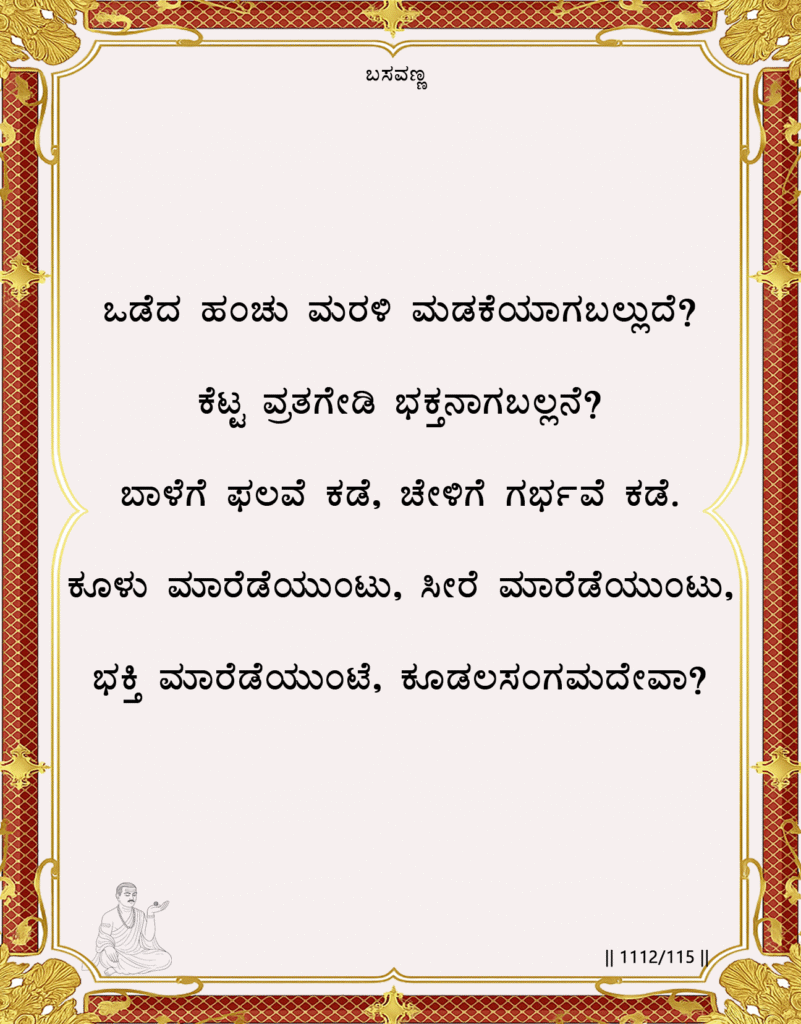
Can a pot once shattered
be made whole for sacred use?
Can a vow once broken
turn its keeper into a devotee?
The banana plant yields fruit but once;
the scorpion brings forth its young but once.
Each thing follows its own nature.
Can playful laughter hide a quarrel?
Can the soft tamarisk with its feathery grace
hide the thorn within it?
Can love or devotion
ever be bought or sold?
If the essence of a thing is pure and singular,
how can its truth be debated?
So tell me, O Koodalasangamadeva
how can true devotion,
which flowers only from the heart’s integrity,
ever become a matter of bargaining or trade?
Basavanna teaches that true devotion has an inherent naturepure, indivisible, and unmanufacturable. Just as a broken pot cannot serve in ritual and a banana plant fruits only once, devotion cannot be faked, divided, or restored once corrupted. Its authenticity is as unmistakable as laughter that cannot hide anger or a tree whose softness cannot conceal its thorns. Devotion is not a commodity, not earned by ritual or purchased by offerings; it is the natural flowering of an unbroken, truthful heart. Thus Basavanna declares: what is genuine cannot be bought, and what is bought can never be genuine.
Spiritual Context
Core Spiritual Principle: Bhakti (devotion) is not a commodity or a skill to be acquired; it is the innate, spontaneous expression of a heart that has realized its love for God. It cannot be faked, negotiated, or repaired once its essence is compromised by hypocrisy or a transactional attitude.
Cosmic Reality Perspective: The Linga is pure, unconditional Love and Truth. A transactional approach to devotion”I will do this for You if You do that for me”is a fundamental category error. It attempts to impose the dualistic, conditional laws of the marketplace upon the non-dual, unconditional reality of the Divine. The two are incompatible.
Historical Reality (Anubhava Mantapa Context): This is a direct critique of the priestly class that commercialized religion, selling rituals, blessings, and divine favor. Basavanna asserts that the path of the Sharana is one of inner integrity, where the relationship with the Divine is based on sincere love, not financial or ritual transactions.
Interpretation
1. “Can a pot once shattered be made whole…?”: The “shattered pot” represents a broken integrity. Once sincerity is lost, even if the external actions continue, the vessel is no longer fit to hold the sacred water of grace.
2. “The banana plant yields fruit but once…”: This illustrates the law of inherent nature (svabhava). Everything has a true, essential nature that cannot be fundamentally altered. The nature of true devotion is sincerity; it cannot, by its very definition, be insincere.
3. “Can playful laughter hide a quarrel?”: This exposes the impossibility of faking inner states. The truth of the heart (antahkarana) will always eventually reveal itself, just as anger undermines false laughter. Artificial devotion cannot hide the ego’s ulterior motives.
4. “Can love or devotion ever be bought or sold?”: This is the central, rhetorical question. Love, by its nature, is a gift. The moment it is demanded or purchased, it ceases to be love and becomes a transaction. Similarly, devotion is the gift of the self; to sell it is a contradiction in terms.
5. “how can its truth be debated?”: This concludes the argument. The authenticity of devotion, like the sweetness of sugar or the heat of fire, is self-evident and experiential (anubhava). It is not a subject for philosophical debate because its reality is confirmed only in the direct, sincere offering of the heart.
The Cosmic Reality
Achara (Personal Discipline): Make a vow of non-transactional spirituality. Refrain from making “deals” with God (e.g., “I will meditate every day if You give me this job”). Let your practice be an offering without expectations.
Kayaka (Sacred Action): Perform your work as an act of love for the Divine, not for reward or recognition. Let the quality of your work be your offering, and release all attachment to the outcome. This is Kayaka as genuine devotion.
Dasoha (Communal Offering): Give generously without expecting gratitude or reward. The purest Dasoha is given anonymously, where the left hand does not know what the right hand is doing, ensuring the act remains a genuine offering, not a social transaction.
Shatsthala
Primary Sthala: Bhakta Sthala. This Vachana defines the very heart of the devotee stage. A Bhakta is one whose practice is rooted in sraddha (sincere faith) and bhakti (loving devotion), not in a desire for spiritual profit.
Supporting Sthala: Maheshwara Sthala. The “heart’s integrity” is the purified state of the individual who has become a Maheshwaraa true vessel for the Divine, unbroken by hypocrisy.
Practical Integration
Arivu (Awareness Practices): Practice “Motivation Mining.” Before any spiritual act (prayer, service, donation), inquire deeply into your intention. Ask: “Am I doing this to connect with the Divine, or to get something? Am I trying to be seen as spiritual?” Purify the intention until it is as simple and direct as a child’s love.
Achara (Personal Discipline): Make a vow of non-transactional spirituality. Refrain from making “deals” with God (e.g., “I will meditate every day if You give me this job”). Let your practice be an offering without expectations.
Kayaka (Sacred Action): Perform your work as an act of love for the Divine, not for reward or recognition. Let the quality of your work be your offering, and release all attachment to the outcome. This is Kayaka as genuine devotion.
Dasoha (Communal Offering): Give generously without expecting gratitude or reward. The purest Dasoha is given anonymously, where the left hand does not know what the right hand is doing, ensuring the act remains a genuine offering, not a social transaction.
Modern Application
The Spiritual Marketplace and “Prosperity Gospel.” Modern spirituality is often commodified. We see the rise of expensive yoga teacher trainings, wellness retreats, and spiritual coaches promising enlightenment for a fee. In some religious circles, the “prosperity gospel” explicitly frames faith as a transaction for material wealth. This reduces the sacred to the commercial.
This Vachana liberates the seeker from the consumerist approach to spirituality. It affirms that the most precious spiritual gift slove, devotion, peace are utterly free and cannot be purchased. It directs the seeker inward, to the cultivation of a sincere and generous heart, which is the only genuine source of spiritual wealth. It calls for a religion of the heart, not of the wallet.
Essence
A broken pot holds no sacred rite.
A feigned laugh cannot hide the spite.
The tamarisk’s thorn, the scorpion’s brood,
Reveal a single, certain mood:
That what is true, by nature, stands,
Not bought or sold by human hands.
1. The Law of Spiritual Essence: In the material world, value can be assigned (e.g., the price of gold). In the spiritual world, value is intrinsic and self-evident (svatah-siddha). Devotion’s value is its own sincerity; it is not assigned by an external authority or a ritual’s cost. A billion dollars cannot buy one moment of genuine love, for love exists in a different economy altogetherthe economy of grace.
2. The Incompatibility of Frequencies: A transactional mindset operates at the frequency of duality (giver/receiver, cost/benefit). Genuine devotion operates at the frequency of non-dual unity (lover-beloved are one). These two frequencies cannot coexist. The “shattered pot” is a metaphor for a consciousness that has been fractured by this duality and can no longer hold the unified energy of true devotion.
3. Jangama as the Flow of Authentic Being: The functioning Jangama in a pure state is the unimpeded flow of one’s authentic being toward the Divine. It is not something you do; it is something you are. When Basavanna asks how it can be bargained, he is pointing out that you cannot bargain with your own nature. You can only be sincere or be insincere. The Linga, as absolute reality, responds only to what is realthe sincere offering of the self. Any other offering, no matter how costly, is an illusion and does not register in the economy of the real.
The most valuable things in life love, trust, integrity, and devotion are priceless precisely because they cannot be bought or sold. Their power lies in their authenticity. Do not cheapen your spiritual life by turning it into a business deal with the universe. The Divine desires not your transactions, but your heart. Offer yourself sincerely, without calculation, and you will participate in the only economy that ultimately matters: the boundless, gracious exchange of love.

Views: 5