Poetic Rendering

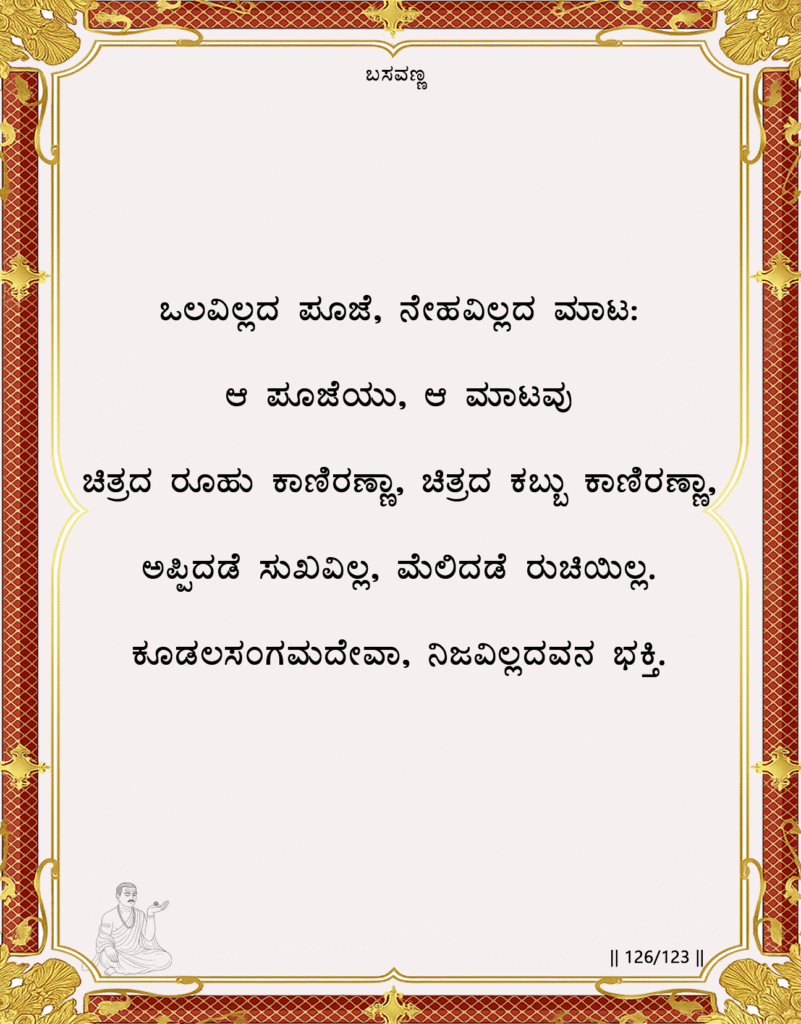
A worship offered without love
is mere performance
a ritual painted on the surface.
Look closely: it is only an act,
like a picture of sugarcane.
Hold it closeno fragrance.
Taste itno sweetness rises.
Such is devotion emptied of truth,
O Koodalasangamadeva
hollow, lifeless, without savor.
Basavanna exposes the emptiness of devotion practiced without inner sincerity. Rituals performed without love or awareness may look impressive from the outside, but they have no spiritual nourishmentjust like a painted picture of sugarcane cannot offer sweetness. True devotion is measured not by outward action but by the inner state of the heart. Without truth, feeling, and surrender, all worship becomes hollow imitation rather than living connection to the Divine.
Spiritual Context
Core Spiritual Principle: The essence of worship (bhakti) is the inner offering of the heart. The external ritual is merely the container; if the container is empty of sincere love and awareness, the offering is null. God desires the devotee’s heart, not their robotic performance.
Cosmic Reality Perspective: The Linga is absolute Truth and Consciousness (Sat-Chit). An offering made without awareness (chit) is not truly an offering to Consciousness. An offering made without love and truth (sat) is a falsehood that cannot commune with the Real. The painted sugarcane is asat (unreal); only the genuine sugarcane has rasa (essence/juice) that can be tasted.
Historical Reality (Anubhava Mantapa Context): This is a continuation of Basavanna’s core critique of Brahmanical ritualism, which emphasized precise external performance often at the expense of inner feeling. It establishes the Shivayoga standard: that the quality of one’s inner attention and emotional sincerity is the true measure of worship, making the path accessible to all, regardless of ritual knowledge.
Expanded Interpretation
1. “a ritual painted on the surface.”: The “paint” represents the external formthe chanting, the gestures, the offerings. Without the inner substance, it is a mere depiction of devotion, not devotion itself. It has color and shape, but no life.
2. “like a picture of sugarcane. Hold it closeno fragrance. Taste itno sweetness…”: This is a masterful three-sense metaphor:
Sight: It looks like sugarcane (the ritual looks correct).
Smell: It has no fragrance (it lacks the subtle, pervasive aroma of genuine love and piety).
Taste: It has no sweetness (it offers no spiritual nourishment or joy (ananda) to the devotee).
3. “hollow, lifeless, without savor.”: This is the final diagnosis. “Hollow” means empty of substance. “Lifeless” means devoid of the divine energy (shakti) that animates true worship. “Without savor” (rasa-hina) means it provides none of the blissful essence that is the true fruit of spiritual practice.
The Cosmic Reality
Anga (Human Dimension): The Anga must ensure that its outer actions are filled with inner meaning. It is not enough to be the painter of the ritual; one must become the gardener who grows the real sugarcane of devotion in the soil of the heart.
Linga (Divine Principle): The Linga is the ultimate connoisseur of rasa (essence). It cannot be nourished by a picture; it can only be “tasted” and “savored” through the genuine essence of love and awareness that a sincere heart offers. Jangama (Dynamic Interaction): The Jangama is the flow of rasathe sweet, fragrant, nourishing current of love that moves from the sincere heart of the devotee to the Divine. A ritual without this is a dead circuit; no energy is transferred.
Shatsthala
Primary Sthala: Bhakta Sthala. This Vachana is essential for the aspiring devotee. It defines the very heart of bhakti: it is not a performance for an audience but a sincere, private offering of love.
Supporting Sthala: Maheshwara Sthala. The inner purity and integrity required to ensure one’s practice is not “hollow” is the work of the Maheshwara, who purifies their inner being to make it a fit vessel.
Practical Integration
Arivu (Awareness Practices): Before any spiritual practice, perform a “Heart-Check.” Sit for a moment and ask: “What is the quality of my intention right now? Is it sincere, or am I just going through the motions?” Wait until you feel a genuine spark of longing or love before you begin. Let that be the “fragrance” you bring to your worship.
Achara (Personal Discipline): Prioritize sincerity over spectacle. It is better to offer a single, heartfelt breath to the Divine than to perform a elaborate, distracted ritual. Make authenticity your highest spiritual discipline.
Kayaka (Sacred Action): Infuse your daily work with this sincerity. Don’t just perform tasks; do them with mindful presence and a spirit of offering. Let the “sweetness” of your full attention be the real offering, transforming mundane work into kayaka.
Dasoha (Communal Offering): Foster a community culture that values genuine sharing over performative piety. Create spaces where people can be authentic about their struggles and doubts, where the “painted sugarcane” of spiritual pretense is gently seen through and the “real sugarcane” of mutual support is cultivated.
Modern Application
Performative Spirituality and Social Media Piety. In the age of social media, there is a strong temptation to present a “painted” version of one’s spiritual lifebeautiful altars, perfect yoga poses, inspirational quotesthat may be devoid of inner depth or consistent practice. This leads to spiritual inauthenticity and a disconnect between one’s online persona and one’s actual inner state.
This Vachana is a powerful call to spiritual authenticity. It liberates one from the pressure to maintain a spiritual image. It encourages a private, heartfelt relationship with the Divine, where the true measure is the “sweetness” and “fragrance” of one own inner experience, not the approval or admiration of others. It values the substance of practice over the show.
Essence
You paint the cane, so straight and tall,
A perfect form, that says it all.
But God wants not the painted art,
But just the humble, loving heart.
For He can smell the true and sweet,
And not the picture, false and neat.
This Vachana presents a metaphysics of spiritual substance versus form, introducing the concept of rasa (essential juice/nectar) as the currency of true devotion.
1. The Energetics of Rasa: Genuine devotion generates a subtle energy signaturerasathat is perceptible to the refined consciousness of the Divine. This rasa is the actual “offering” that is received. A performed ritual without heart generates no rasa; it is energetically inert. The painted sugarcane is a symbol for this inert, rasa-less offering.
2. The Linga as a Rasa-Receptor: The Divine is not a passive observer but an active “taster” of the devotee’s offering. The relationship is one of mutual flavoring: the devotee offers the rasa of their love, and the Linga returns the rasa of divine bliss (Brahmananda). A hollow ritual breaks this circuit of mutual enjoyment.
3. Jangama as the Conduit of Rasa: The functioning Jangama is the free flow of this essential nectar. It is the state where the devotee’s entire being is so saturated with sincere love that every action, word, and thought becomes a genuine offering, dripping with rasa. In this state, there is no distinction between the ritual and the devotee; the devotee becomes the living sugarcane, their very existence offering fragrance and sweetness to the Divine. The “painted” devotion is the ego’s attempt to mimic this state from the outside, a futile effort that can never produce the living rasa of authentic being.
In any relationship, especially with the Divine, authenticity is everything. A single, genuine tear is more powerful than a thousand perfect but empty words. Don’t waste your life painting pictures of love; grow the real thing within your own heart. For it is only the true fragrance of sincerity and the real sweetness of love that can ever truly touch the heart of God, or for that matter, any other heart.
Views: 0