Poetic Rendering

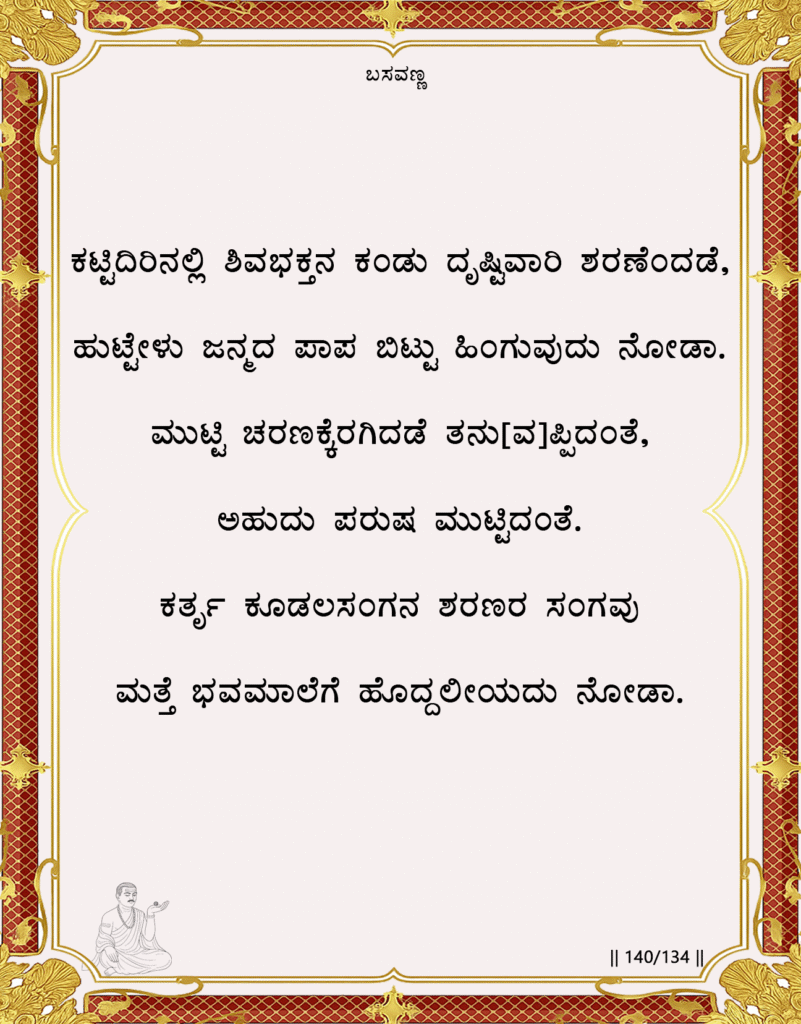
When the eyes fall upon a Sharana
with the purity of true reverence,
and the heart recognizes him
as the servant of Shiva
then the stains of seven births
dissolve like frost in morning light.
To bow to such a one
is to touch the threshold of liberation;
to honor him
is to step into the radiance of truth.
For the company of the Sharanas
of Kudalasangamadeva
is a path from which
one does not return to bondage.
Basavanna teaches that the presence of a true Sharana is spiritually transformative. A single moment of genuine reverence toward such a realized soul has the power to dissolve deep-seated karmic burdens. Their company elevates, purifies, and redirects the seeker toward freedom. The Vachana emphasizes that liberation is not gained through ritual or scripture, but through association with the awakened, whose very existence acts as a sacred alchemy that frees one from cycles of ignorance and rebirth.
Spiritual Context
Core Spiritual Principle: The awakened consciousness of a realized being (Jangama) is a direct conduit for divine grace (Shakti), capable of catalyzing instantaneous and profound spiritual purification in a receptive seeker.
Cosmic Reality Perspective: In the non-dual framework, the Linga (Shiva) and the Jangama (the moving, realized soul) are not separate. The Sharana is a focal point where the formless Absolute becomes dynamically active in the relative world. To see, honor, and associate with such a one is to interact directly with the transformative power of the Linga itself.
Historical Reality (Anubhava Mantapa Context): This Vachana establishes the Guru-shishya (Master-disciple) relationship and the sanctity of the Sangha (community) as central to the Lingayoga path. It democratizes grace, making it available not through priestly intervention but through the sincere reverence offered to any genuine Sharana, thus reinforcing the community’s egalitarian spiritual economy.
Interpretation
“When the eyes fall upon a Sharana with the purity of true reverence…”: The transformation begins with darshannot a casual look, but a seeing infused with bhava (devotional sentiment). The seeker’s reverence is the key that unlocks the flow of grace from the Sharana.
“…the stains of seven births dissolve like frost in morning light.”: “Seven births” signifies the totality of one’s karmic imprint (sanchita karma). The metaphor of frost dissolving in sunlight is crucial: the karma isn’t burned away through effort, but is simply revealed to be insubstantial in the radiant presence of a higher truth. The dissolution is natural and effortless.
“To bow… is to touch the threshold; to honor… is to step into the radiance.”: The physical act of bowing (namaskara) is the external signature of an internal surrender. This surrender moves one from the periphery of spiritual life to its very center. “Honoring” implies ongoing service and association, which fully immerses one in that radiance.
“…a path from which one does not return to bondage.”: This signifies the point of no return (nithya mukta). The influence of the Sharana’s company (Satsangha) irrevocably alters the seeker’s consciousness, setting them firmly on the path to liberation.
Practical Implications: The seeker is guided to cultivate reverence and to actively seek the company of those who embody wisdom and purity. The practice is one of humility, attentiveness, and service (Dasoha) towards the Jangama, understanding this as the most potent form of spiritual practice.
The Cosmic Reality
Anga (Human Dimension): The seeker with a receptive heart, whose “eyes” and “heart” are open. This Anga is characterized by the humility to bow and the discernment to recognize divinity in a human form.
Linga (Divine Principle): Kudalasangamadeva (Shiva) as the source of all grace and the ultimate reality that the Sharana embodies.
Jangama (Dynamic Interaction): The realized Sharana themself. They are the living, dynamic intersection of the Anga and Lingaa human who has become a perfect vessel for the Divine. Their glance, presence, and company are the active, grace-bestowing function of the Linga in the world.
Shatsthala
Primary Sthala: Sharana. This Vachana describes both the nature of a Sharana (as a grace-bestowing being) and the effect of encountering one. It is the full flowering of the Sharana stage.
Supporting Sthala: Bhakta. The Bhakta’s devotion is the necessary condition for this alchemy. Without the “purity of true reverence” from the Bhakta, the transformative potential of the Sharana’s presence may remain dormant for the seeker.
Practical Integration
Arivu (Awareness Practices): Practice seeing the divine in everyone you meet. Cultivate the “eyes of reverence,” looking for the Linga within each Anga. In meditation, visualize the form of your Guru or an ideal Sharana and receive their glance.
Achara (Personal Discipline): Cultivate humility and eradicate arrogance. Practice physical prostrations (or mental bows of respect) to those you recognize as spiritually advanced, not to demean yourself, but to symbolically surrender the ego.
Kayaka (Sacred Action): Offer your work at the feet of the Guru or the spiritual community. See your labor as a service to the Jangama principle.
Dasoha (Communal Offering): Prioritize service to the Sangha. Offer your time, resources, and skills to support the community of seekers and realized beings, understanding this as the most fruitful investment of your life.
Modern Application
Spiritual isolation, the “guru-shop” mentality, and a deep-seated cynicism that prevents genuine surrender and connection. The modern world often lacks containers of authentic spiritual transmission.
This Vachana instructs us to seek out true mentors and authentic community. It validates the profound human need for a living connection with wisdom, beyond books and online courses. It teaches that transformation is relational and that finding a genuine guide or a true spiritual friend (Satsangha) is a critical step on the path.
Essence
A single glance, a bow sincere,
Can melt the karma of many a year.
For in the presence of the free,
The bound soul finds its liberty.
The Deeper Pattern (The Subtle Body): This Vachana describes a Quantum Entanglement and Energy Transfer between a coherent and an incoherent system. The Sharana exists in a state of high coherence (enlightenment), while the seeker’s consciousness is a decoherent system of karmic impressions. The act of reverent seeing creates an entangled channel. Through this channel, the coherent state of the Sharana acts as a “quantum eraser,” not by deleting karma, but by providing a new, dominant context (the reality of the Linga) in which the karmic “waveforms” lose their defining power and collapse into insignificance. The company of Sharanas maintains this entangled state, preventing decoherence back into bondage.
In Simple Terms (The Gross Body): Imagine your mind is a cup of muddy water (karma). Meeting a true Sharana with reverence is like placing that cup under a powerful, clear waterfall. The waterfall doesn’t analyze or remove each speck of mud; its continuous, pure flow simply displaces the mud until the water in your cup becomes as clear as the waterfall itself.
The Human Truth (The Causal Body): We are transformed by what we behold with reverence. The greatest catalyst for change is not a concept, but a connection the radiant presence of another human being who embodies the freedom we seek. To find such a one and to learn to honor them is to find the shortest path home.

Views: 0