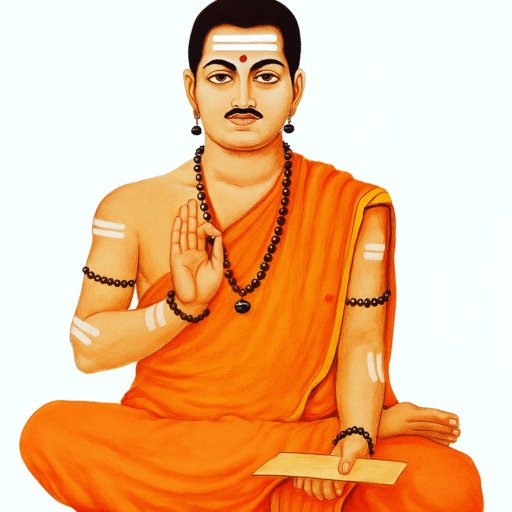

Poetic Rendering
Like a frog stunned beneath the serpent’s shadow,
so has my mind fallen still
caught in fear,
entangled in the illusions that coil around me.
O Lord…
before this helpless life of mine is swallowed whole,
lift me up, release me,
Koodalasangamadeva!
This Vachana is a raw cry of vulnerability. Basavanna compares the soul trapped in ignorance and fear to a frog paralyzed under a snake’s gazealive, but unable to move. He reveals how delusion (moha) can freeze spiritual progress, leaving one helpless. The only refuge in such a state, he declares, is divine intervention grace that frees the seeker from the consuming forces of inner darkness. It is an admission that human strength alone cannot break the grip of fear; one must surrender and call upon the Lord to rescue the soul from its own paralysis.
Spiritual Context
Core Spiritual Principle: In the deepest spiritual crises, where self-effort fails and the mind is captive to fear and delusion, the only authentic response is a total, helpless surrender to divine grace.
Cosmic Reality Perspective: The “serpent” represents the power of Maya (cosmic illusion) and the ego, which casts a shadow of fear and separation, paralyzing the individual soul (jiva). The Linga (Shiva) is the only power that can dispel this shadow, as light alone can remove darkness. The cry for help is the soul’s innate homing signal back to its source.
Historical Reality (Anubhava Mantapa Context): This Vachana validates the experience of struggle and despair on the path. It democratizes spirituality by showing that even a towering figure like Basavanna faced moments of utter helplessness, making the path accessible to all. It establishes that grace, not just personal striving, is central to Basavayoga.
Interpretation
“Like a frog stunned beneath the serpent’s shadow…”: The frog symbolizes the soul (Anga) in its natural, innocent state. The “serpent’s shadow” is not the serpent itself (death), but the fear of death, the anticipation of annihilationwhich is the root of all egoic activity and spiritual paralysis. The mind is “stunned,” meaning the faculties of discrimination and will are rendered inactive.
“…caught in fear, entangled in the illusions that coil around me.”: Fear (bhaya) and illusion (moha) are the twin coils of the serpent. They are not external forces but internal states that constrict consciousness, preventing movement, growth, and escape.
“Before this helpless life of mine is swallowed whole…”: “Swallowed whole” signifies complete identification with the ego and the material worlda spiritual death where the sense of being a separate, suffering self becomes absolute and inescapable.
“Lift me up, release me…”: This is a prayer not for material gain but for ontological liberation. “Lift me up” is a plea for a shift in consciousness. “Release me” is a cry to be freed from the internal binds of fear and delusion.
Practical Implications: The seeker learns that acknowledging one’s helplessness is not a failure but a profound spiritual step. When self-effort reaches its limit, the practice becomes one of sincere, desperate prayer and surrender (prapatti), trusting that grace will act where the ego cannot.
The Cosmic Reality
Anga (Human Dimension): The individual soul in a state of existential terror and paralysis, completely aware of its bondage and inability to save itself.
Linga (Divine Principle): Koodalasangamadeva as the ultimate source of freedom, the power that can dispel the shadow of fear and “swallow the serpent” of illusion itself.
Jangama (Dynamic Interaction): The heartfelt cry itself is the Jangama. It is the dynamic movement of the soul towards God. The subsequent “lifting up” is the responsive movement of divine grace (Shakti) into the soul, re-animating it and setting it free.
Shatsthala
Primary Sthala: Bhakta. This is the essence of the Bhakta stage: the realization of one’s dependence on the Divine. The devotee (Bhakta) is defined by this relationship of surrender and reliance, especially in times of crisis.
Supporting Sthala: Maheshwara. The state described is one of intense impurity and inner conflict. The plea for grace is, in fact, a plea for the purifying power of the Maheshwara stage to burn away the fear and delusion that have paralyzed the seeker.
Practical Integration
Arivu (Awareness Practices): When feeling trapped by fear or negative patterns, practice “surrender meditation.” Instead of fighting the feeling, name it (“This is the serpent’s shadow”) and then consciously offer it to Koodalasangamadeva, visualizing the divine light dissolving the paralysis.
Achara (Personal Discipline): Cultivate the discipline of honesty. Have the courage to admit your limitations, fears, and addictions to yourself and to God, without self-judgment. This honesty is the first step toward surrender.
Kayaka (Sacred Action): Even when feeling paralyzed, perform the smallest possible right action as an offering, a symbolic gesture of your desire to be free. This act can become the thread that grace pulls on.
Dasoha (Communal Offering): Share your vulnerability with a trusted spiritual friend or guide (Jangama). Allowing others to see your “helplessness” breaks the isolation of the ego and can be the channel through which grace arrives.
Modern Application
Anxiety disorders, depression, and feelings of powerlessness in the face of global crises, social pressures, and internal psychological patterns. The modern “solution” is often to numb, distract, or over-medicate, which only deepens the paralysis.
This Vachana offers a spiritual technology for mental health crises. It teaches that when therapy and self-help fail, the path of surrender admitting powerlessness and calling upon a Higher Poweris a valid and potent healing modality. It transforms the narrative from “I am broken and must fix myself” to “I am trapped and call upon the Liberator.”
Essence
In shadow’s grip, I cannot start,
The serpent’s fear has stalled my heart.
I cannot fight, I can but cry,
O Lord of Light, to You I fly.
The Deeper Pattern (The Subtle Body): This Vachana describes a Spiritual Event Horizon. The ego, with its fears and illusions, creates a gravitational field so dense that the light of consciousness cannot escapethis is the state of paralysis. The sincere cry for help is a quantum tunnel punched through this event horizon. It is a signal that travels faster than the speed of the mind’s own light, reaching the “singularity” of divine grace (Linga), which then responds by altering the very gravitational constant of the seeker’s consciousness, allowing them to escape the black hole of the ego.
In Simple Terms (The Gross Body): Imagine being trapped in quicksand. The more you struggle with your own strength, the faster you sink. The only way out is to stop struggling, lie flat to distribute your weight, and call for someone on solid ground to throw you a rope and pull you out. Basavanna is in the quicksand of his own mind, and his cry is for the rope of grace.
The Human Truth (The Causal Body): Our deepest fears and patterns can sometimes be prisons we cannot break out of by our own will. In these moments, the most powerful and intelligent act is to surrender and call for help. True strength is found not in never falling, but in having the humility to cry out when you cannot get up.

Views: 0