Poetic Rendering

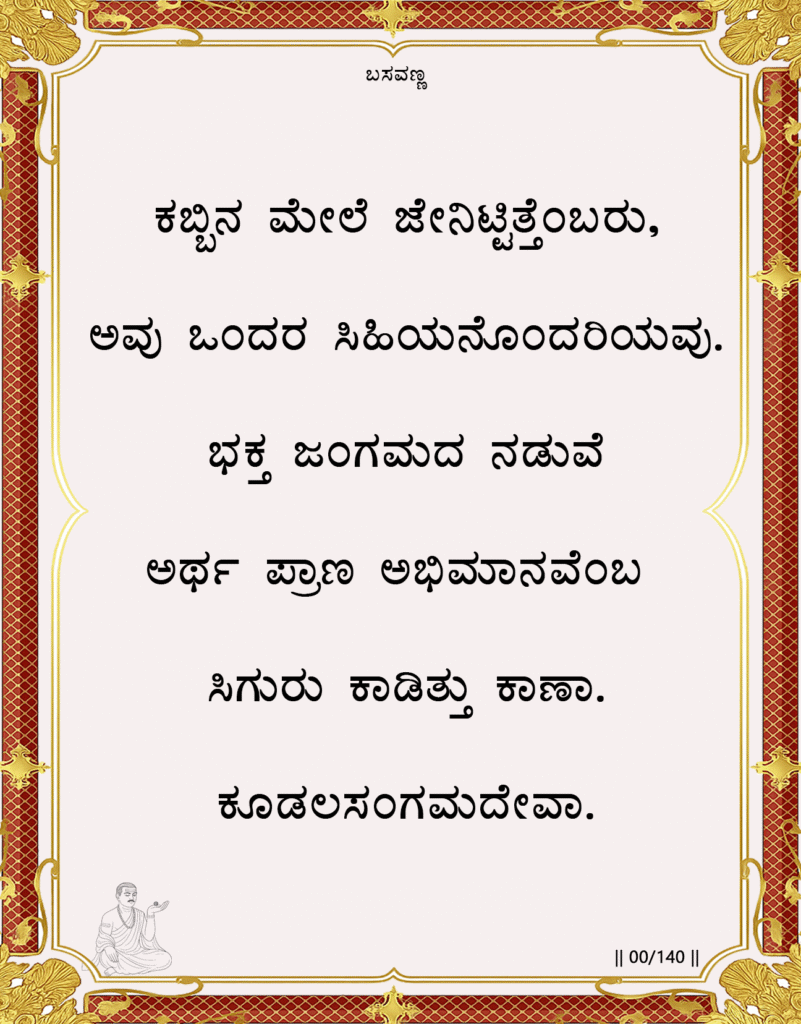
They say the honeycomb rests upon the sugarcane
yet neither ever tastes
the sweetness of the other.
So it is, when between Bhakta and Jangama,
between seeker and the inner Self,
grow the tangled weeds
of learning, wealth, pride, and ego.
Tell me, O Koodalasangamadeva
what concord can survive
when such barriers stand between us?
Basavanna uses the striking image of honeycomb resting on sugarcane to reveal a deep truth: closeness does not guarantee union. Two sweet things may touch, yet never share flavor. Likewise, a seeker may be near the Divine, near the Jangama, or near one’s own Self, but the presence of subtle inner obstacles intellectual pride, material attachment, self-importance, ego prevents true communion. The Vachana warns that spiritual proximity without inner purity leads to a sweetness that can never be tasted. Only when these inner weeds are uprooted can the soul fully unite with the Divine.
Spiritual Context
Core Spiritual Principle: Union with the Divine is not a matter of physical or philosophical proximity, but of inner resonance. The subtlest forms of egodisguised as knowledge, wealth, and social standingcreate an insulating barrier that prevents the final merging of the soul with God.
Cosmic Reality Perspective: The non-dual state (Aikya) is one of seamless flow and interpenetration. The “weeds” – learning, – wealth, – pride/ego) represent solidified, individual structures of consciousness that maintain separation. They are the final residues of duality that must dissolve for the Anga to realize its inherent oneness with the Linga.
Historical Reality (Anubhava Mantapa Context): This is a warning to the emerging spiritual community. Basavanna cautions that even within the revolutionary, egalitarian space of the Anubhava Mantapa, individuals could still be separated from true experience by their attachment to intellectual prowess, the prestige of donation, or spiritual pride. It is a call for relentless inner vigilance.
Interpretation
“They say the honeycomb rests upon the sugarcane…”: This is a metaphor of unfulfilled potential. Two of the sweetest substances in nature exist in intimate contact yet remain fundamentally separate. This symbolizes the tragic state of a seeker who is “close” to enlightenment but never tastes it… the tangled weeds of learning, wealth, pride, and ego.”: Basavanna identifies the specific barriers:
Learning : The pride of scholarship, using knowledge as a possession rather than a tool for liberation. Wealth : Attachment to material possessions or even the “wealth” of spiritual experiences. Pride/Ego : The sense of “I am a devotee,” “I am learned,” “I am a giver”the subtlest and most stubborn obstacle, which uses spirituality itself as its fuel.
“What concord can survive…?”: The word “concord” implies harmony, agreement, and union. The Vachana concludes that no true spiritual union is possible as long as these barriers exist. They create a static that disrupts the clear signal of grace.
Practical Implications: The seeker must engage in constant self-auditing. It is not enough to perform external acts of devotion; one must scrutinize the mind for the subtle sense of superiority, ownership, and separation that these “weeds” represent. The path requires the cultivation of genuine humility and self-effacement.
The Cosmic Reality
Anga (Human Dimension): The seeker who possesses the “weeds”the intellect that clings to learning, the identity that is bolstered by wealth and status. This Anga is not yet fully purified.
Linga (Divine Principle): Koodalasangamadeva as the pure, unadulterated “sweetness” of consciousness itself, which remains untasted.
Jangama (Dynamic Interaction): The ideal relationship of grace-flow between the Bhakta and the Guru/Jangama. This dynamic is blocked and fails to manifest because the Anga’s “weeds” act as an insulator, preventing the conductive connection required for transmission.
Shatsthala
Primary Sthala: Maheshwara. This stage is defined by the intense inner purification (Antah-Shuddhi) required to burn these subtle karmas and samskaras. The entire work of the Maheshwara is to uproot these very “weeds.”
Supporting Sthala: Bhakta. The Bhakta is often the one who accumulates these weedsseeking learning, performing charitable acts, and building a spiritual identity. This Vachana serves as a crucial warning to the Bhakta to purify their motivation.
Practical Integration
Arivu (Awareness Practices): Practice mindfulness of motivation. Before studying, giving, or practicing, ask: “Is this strengthening my ego or dissolving it?” Observe the sense of “I-ness” that arises with knowledge and possession.
Achara (Personal Discipline): Practice anonymity in charity. Give without leaving your name. Study with the attitude of a beginner, no matter how much you know. Actively cultivate simplicity and humility in your lifestyle.
Kayaka (Sacred Action): Perform your duty without claiming ownership of the results. Let your work be an offering that leaves no residue of pride.
Dasoha (Communal Offering): Share knowledge, wealth, and resources in a way that empowers others without creating a hierarchy of giver and receiver. See yourself as a mere channel, not the source.
Modern Application
“Spiritual Materialism” in its most refined forms: the accumulation of certifications, the branding of oneself as a guru, the pride in one’s meditation practice, the attachment to eco-friendly or “conscious” possessions, and the subtle competitiveness in spiritual circles.
This Vachana is a razor that cuts through spiritual pretense. It calls for an authenticity where spirituality is measured by the transparency of the ego, not the accumulation of attributes. It is a critical tool for anyone in the modern wellness or spiritual arena to ensure their path leads to genuine freedom, not a more refined prison.
Essence
The comb rests on the cane, so near,
Yet never tastes the other’s cheer.
So knowledge, wealth, and pride’s design,
Can keep the soul from the Sweet Divine.
The Deeper Pattern (The Subtle Body): This Vachana describes a failure in Quantum Coherence. The Bhakta and the Jangama/Linga are like two quantum systems that need to entangle to share a unified state (the “sweetness”). The “weeds” of learning, wealth, and pride act as localizing potentials or decoherence sources. They constantly measure and collapse the Bhakta’s wave function back into a defined, separate ego-state, preventing the sustained quantum entanglement with the divine field that is necessary for the non-dual taste of union. The proximity is classical, but the union requires a quantum connection that these impurities disrupt.
In Simple Terms (The Gross Body): Imagine two rooms with a thick, soundproof glass wall between them. In one room, a symphony is playing (the Linga); in the other, you sit (the Anga). You can see the musicians, you know the music is there, but you cannot hear a single note. The “weeds” are that soundproof glass. No matter how close you get, the experience of the music is blocked.
The Human Truth (The Causal Body): The things we often use to build our spiritual identity can become the very walls that separate us from the experience of the sacred. The final barrier to God is not your sin, but your spirituality when it is owned by the ego. To truly meet the Divine, you must arrive not with your resume, but with your surrender.

Views: 2