Poetic Rendering
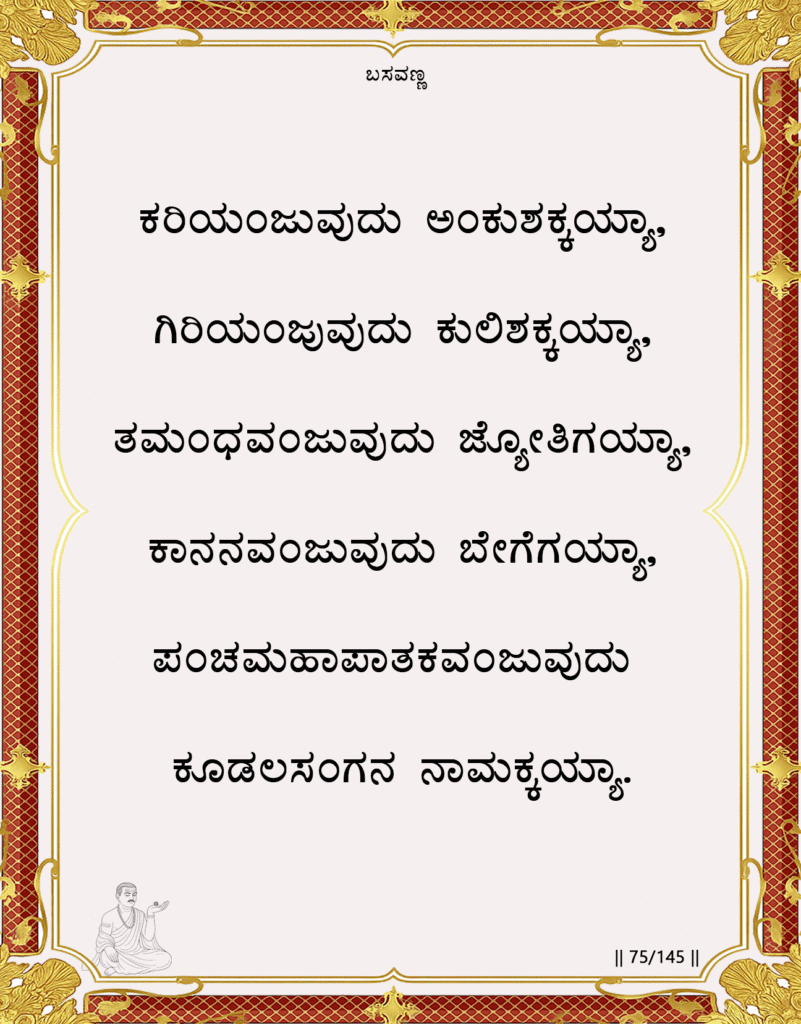
The elephant fears the ankusha’s sharp point.
The mountain fears the thunderbolt’s shattering strike.
The darkness fears the sun’s conquering light.
The forest fears the wildfire’s raging might.
And the five great sins, in all their terrible power,
fear but one thing: the Name of Koodalasangama.
This vachana proclaims the absolute, sovereign power of the Divine Name (Nāma) over the most formidable forces of the inner world. Basavanna systematically maps the hierarchy of power, showing that just as every mighty force in nature has a conqueror, the seemingly invincible army of the inner sins (pañcamahāpātaka) has one ultimate vanquisher: the conscious remembrance of God. This is not a passive prayer but an active, potent force that strikes like a goad, shatters like lightning, illuminates like the sun, and consumes like wildfire.
Spiritual Context
Core Spiritual Principle: The Divine Name (Nāma) is not a mere label, but a concentrated, potent manifestation of the Divine itself. It is the ultimate spiritual weapon, capable of subduing, destroying, illuminating, and burning away the most deep-rooted impurities of the soul.
Cosmic Reality Perspective: In the metaphysics of Shivayoga, Shiva (Linga) and His Name (Nāma) are non-different (abheda). To chant the Name with awareness is to invoke the very power and presence of the Absolute. It operates on the level of pure consciousness (Chit) and divine energy (Shakti), making it more fundamental and powerful than any karmic or psychological obstruction.
Historical Reality (Anubhava Mantapa Context): This Vachana empowers the layperson and the outcaste. It states that one does not need ritual purity, priestly intercession, or scholarly knowledge to combat inner demons. The Divine Name is a democratizing force, a weapon of spiritual warfare available to all, which can annihilate the sins that society uses to condemn and exclude.
Interpretation
The Ankusha and the Elephant: The elephant is the powerful, roaming mind. The Name acts as the ankusha (goad), providing the precise, penetrating focus that controls and directs this mental energy away from sensory temptations.
The Thunderbolt and the Mountain: The mountain is the accumulated, solidified mass of ego and past karma (sanchita), which seems eternal and immovable. The Name strikes like a thunderbolt (vajra), symbolizing the diamond-like, indestructible power of truth that can shatter this sense of a separate, solid self.
The Sun and the Darkness: Darkness is ignorance (avidya), the root of all suffering. The Name is the sunit does not “fight” darkness but simply reveals the true nature of reality by its own radiant presence, dispelling ignorance effortlessly and completely.
The Wildfire and the Forest: The forest represents the dense, tangled growth of desires, attachments, and latent tendencies (vasanas). The Name is the all-consuming wildfire of divine awareness (jnanagni) that burns this entire forest to ashes, leaving nothing but pure, fertile ground.
The Name and the Five Great Sins: The five great sins represent the totality of negative karmic potential. The Vachana culminates by stating that this entire army of inner corruption is routed by the one supreme power: the Name. It is the ultimate victor in the battle for the soul.
Practical Implications: The seeker is instructed to rely on the Divine Name as their primary spiritual practice (sadhana). It is to be used proactively as a weapon against negative thoughts and reactively as a refuge in times of temptation or despair.
The Cosmic Reality
Anga (Human Dimension): The individual consciousness that is vulnerable to the “elephant” of the mind, the “mountain” of karma, the “darkness” of ignorance, and the “forest” of desires.
Linga (Divine Principle): Koodalasangamadeva as the ultimate reality, whose essence is captured and made dynamically available in the Divine Name.
Jangama (Dynamic Interaction): The act of chanting, remembering, or invoking the Name. This is the living Jangamathe sacred vibration that actively interacts with the Anga, performing the functions of goading, shattering, illuminating, and consuming to bring it into alignment with the Linga.
Shatsthala
Primary Sthala: Bhakta. For the Bhakta, the Name is the essential practice. It is the boat that carries them across the ocean of worldly existence and the sword they wield against inner enemies.
Supporting Sthala: Maheshwara. The purificatory fire of the Maheshwara stage is ignited and sustained by the constant repetition of the Name, which burns away the impurities that separate the soul from God.
Practical Integration
Arivu (Awareness Practices): Practice Nama Japa (repetition of the Divine Name) as a form of mindful meditation. With each repetition, feel it as a goad bringing the mind back, a bolt shattering distraction, a light revealing truth, and a fire burning away attachment.
Achara (Personal Discipline): Make the remembrance of the Name your foundational discipline. Let it be the first thought upon waking and the last before sleeping. Use it as a mental filter for all sensory input and internal dialogue.
Kayaka (Sacred Action): Perform all work while mentally repeating the Name. This transforms Kayaka into a continuous stream of worship and protects the mind from being entangled in the results of action.
Dasoha (Communal Offering): The highest Dasoha is to share the gift of the Name. Singing devotional songs (bhajans) and chanting collectively amplifies its power and creates a protective, purifying field for the entire community.
Modern Application
The “five great sins” manifest as addictive behaviors, existential anxiety, chronic dissatisfaction, narcissism, and a pervasive sense of meaninglessness. The modern world offers countless distractions but few true remedies.
This Vachana offers a single, potent antidote to the complexity and fragmentation of modern life. In a world of noise, the Divine Name provides a coherent, calming, and empowering frequency. It is a portable practice that can be used anywhere, anytime, to reclaim one’s mind from the chaos of digital distraction, consumerism, and internal negativity.
Essence
The goad, the bolt, the sun, the fire,
To meet the soul’s deep, dark desire.
One Name, to which all foes succumb,
Before its power, all sins are dumb.
The Deeper Pattern (The Subtle Body): This Vachana is not merely about a sacred word, but a direct map for instantaneous self-realization. The Name Koodalasangamadeva is the encoded process: Koodala (“here and now”) is the Anga’s state of present-moment awareness. Sangama (“union”) is the Jangama’s dynamic act of merging individual consciousness with the universal. Deva (“Divine”) is the Linga, the realized state of Godhood. The “five great sins” are the very energies of separation that prevent this synthesis. The Vachana teaches that the power of the Name lies in its capacity to orchestrate this entire alchemy in a single moment of total remembrance, dissolving the sinner and revealing the Deva.
In Simple Terms (The Gross Body): The Name is not a plea to an external god, but a command for inner transformation. To chant “Koodalasangamadeva” with understanding is to command your own consciousness: “In this very moment (Koodala), merge utterly (Sangama) and become the Divine (Deva).” The sins fear this Name because it is the precise formula for their annihilation.
The Human Truth (The Causal Body): Your liberation is not a distant future event. It is the fundamental nature of the present moment, waiting to be claimed. The only thing standing between you and your own divinity is the illusion of separation. The Name is the key that collapses this illusion. When you fully embody its meaning, you do not reach God; you realize that you have never been anything else.

Views: 0