Poetic Rendering

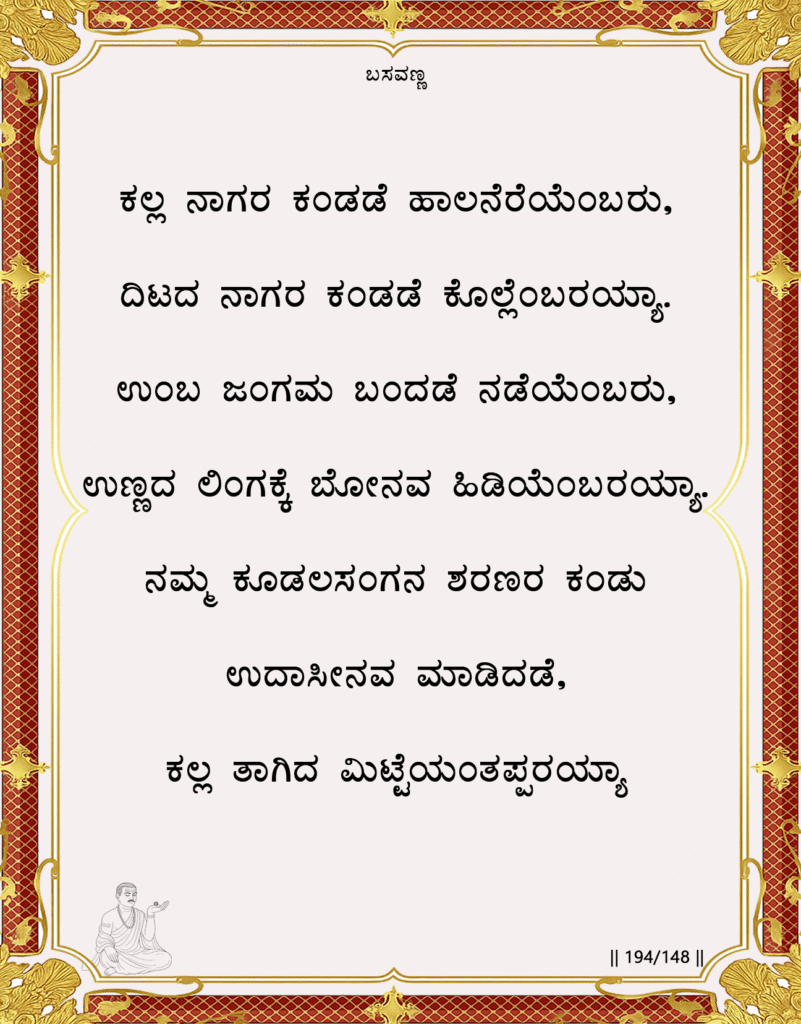
To the stone serpent they pour out milk,
but when a living serpent comes,
they strike it with a stick.
To the lifeless idol they offer grand feasts,
yet the living Jangama they ignore
as though he were nothing.
Blinded, they fail to see You
shining in the hearts of Your sharanas.
Even with the linga hanging upon their neck,
when will they truly awaken,
O Koodalasangamadeva?
Basavanna contrasts society’s reverence for lifeless symbols with its neglecteven hostilitytoward the living embodiments of divinity. People worship stone images and serpents carved in rock, yet mistreat the living saint, the Jangama, who carries the true presence of the Divine. Wearing a linga outwardly means nothing unless one recognizes and honors the divine in living beings. The vachana is a plea for spiritual awakening and genuine vision.
Spiritual Context
Core Spiritual Principle: True worship is the recognition and service of the Divine Consciousness as it manifests in living, breathing forms. Ritual worship of inert objects is spiritually inert if it does not translate into reverence for the living God in humanity.
Cosmic Reality Perspective: The non-dual truth of Shivayoga is that Shiva (Linga) is not confined to stone but is the very consciousness (Chit) animating all beings. The Jangama is the focal point where this formless consciousness becomes dynamically active and accessible. To worship a stone while ignoring the living Saint is to prefer the map to the territory, the shadow to the substance.
Historical Reality (Anubhava Mantapa Context): This is a foundational critique of Brahminical temple ritualism. Basavanna attacks the hypocrisy of a system that lavishes resources on stone deities while often oppressing the human beings from lower castes who were considered the living vessels of the same God. It establishes the Jangama as the central pillar of the new spiritual order.
Interpretation
“To the stone serpent they pour out milk, but when a living serpent comes, they strike it…”: The “stone serpent” represents all externalized, symbolic religion. The “living serpent” is the raw, unpredictable, and challenging presence of life itself, and of enlightened beings who do not conform to sterile ritual boxes. The metaphor exposes a preference for a controllable, sanitized God over the dynamic, demanding presence of the real.
“To the lifeless idol they offer grand feasts, yet the living Jangama they ignore…”: This is the core argument. The “lifeless idol” is God conceptualized and objectified. The “living Jangama” is God realized and personified. The failure to make this connection is the failure of spiritual perception.
“Blinded, they fail to see You shining in the hearts of Your sharanas.”: The “blindness” is not physical but perceptuala failure of darshan (sacred seeing). It is the inability to see the universal (Linga) within the particular (Jangama).
“Even with the linga hanging upon their neck, when will they truly awaken?”: This is the ultimate condemnation of empty orthodoxy. The external Linga is meant to be a reminder of the internal and universal reality. If wearing it does not open one’s eyes to the God in the living Jangama, then it is a mere ornament, a dead weight.
Practical Implications: The seeker is taught that the true test of their devotion is their conduct towards other beings, especially those who embody wisdom and compassion. Spiritual practice must refine one’s perception to recognize the Divine in life’s dynamic expressions, not just in its static symbols.
The Cosmic Reality
Anga (Human Dimension): The worshipper whose perception is clouded. They possess the external symbol (Linga) but lack the internal sight to see its living manifestation (Jangama).
Linga (Divine Principle): Koodalasangamadeva as the all-pervading consciousness that is equally present in the stone idol and the living Saint, but dynamically active and knowable only in the latter.
Jangama (Dynamic Interaction): The living, moving Saint is the true Jangamathe dynamic interface where the Linga becomes accessible, teachable, and serviceable. The lifeless idol represents a failed, non-functional Jangama relationship.
Shatsthala
Primary Sthala: Sharana. The Sharana is defined by this awakened perception. To be a Sharana is to have taken refuge in the Living Lord, which inherently means recognizing and honoring that Lord in the Jangama.
Supporting Sthala: Bhakta. The Bhakta often begins with external worship. This Vachana serves as a crucial evolutionary challenge for the Bhakta, pushing them from devotion to form towards devotion to the Formless within all forms.
Practical Integration
Arivu (Awareness Practices): Practice “seeing the Linga” in every person you meet. In meditation, visualize the light of the Linga not on an altar, but glowing within the heart of your Guru, your family, and even those you find difficult.
Achara (Personal Discipline): Cultivate reverence in action. Bow inwardly to the divine presence in others. Let your respect for people be the measure of your devotion to God.
Kayaka (Sacred Action): See your service to others, particularly the wise and the needy, as the highest form of puja. The food you offer to a hungry person is a more sacred feast than one offered to a stone idol.
Dasoha (Communal Offering): Direct your resources and service first and foremost to the sustenance of the living Sangha (community) and the support of the Jangamas, seeing this as the most direct worship.
Modern Application
“Spiritual Consumerism”the pursuit of sacred experiences in exotic temples, through expensive rituals, or by collecting spiritual artifacts, while remaining indifferent to social injustice, environmental degradation, and the suffering of living beings. The preference for the aesthetic of spirituality over its ethical demands.
This Vachana is a piercing call for authenticity. It demands that our spiritual practice be grounded in ethical, compassionate engagement with the world. It teaches that God is not found by escaping life, but by diving into it with reverence, seeing the temple in every heart and the idol in every face.
Essence
They milk the stone, but strike the living breath,
And honor gold, while shunning what it saith.
The form they serve, the Truth they will not see
When will the symbol set the spirit free?
The Deeper Pattern (The Subtle Body): This Vachana diagnoses a critical failure in Spiritual Perception, which is a failure in Quantum State Recognition. The stone idol exists in a collapsed, classical statepredictable, inert. The living Jangama exists in a quantum superpositionboth human and Divine, both particle and wave. The “blind” worshipper can only perceive and interact with collapsed classical states (the idol). They lack the observational capacity to collapse the wave function of the Jangama into the perceived reality of “Divine.” Their consciousness is not entangled with the living truth, only with its dead symbol. Wearing the Linga is meant to be an entanglement device, but if it doesn’t upgrade the perceptual software of the wearer, it remains a classical ornament.
In Simple Terms (The Gross Body): A person can own the most detailed map of a territorystudying its every contour, polishing the glass on the framebut if they walk into the actual forest and see only trees to be cut down, not the living ecosystem the map represents, the map is useless. The stone idol is the map. The Jangama is the living forest. Basavanna cries: “Stop worshipping the map! Learn to see the sacred life it represents!”
The Human Truth (The Causal Body): The ultimate test of your faith is how you treat the person in front of you. If your devotion does not make you more compassionate, respectful, and awake to the sacredness in living beings, then it is a hollow performance. God is not an object to be owned, but a presence to be recognized in every encounter. To see the Divine in stone is easy; to serve it in flesh and blood is the real worship.

Views: 0