Poetic Rendering

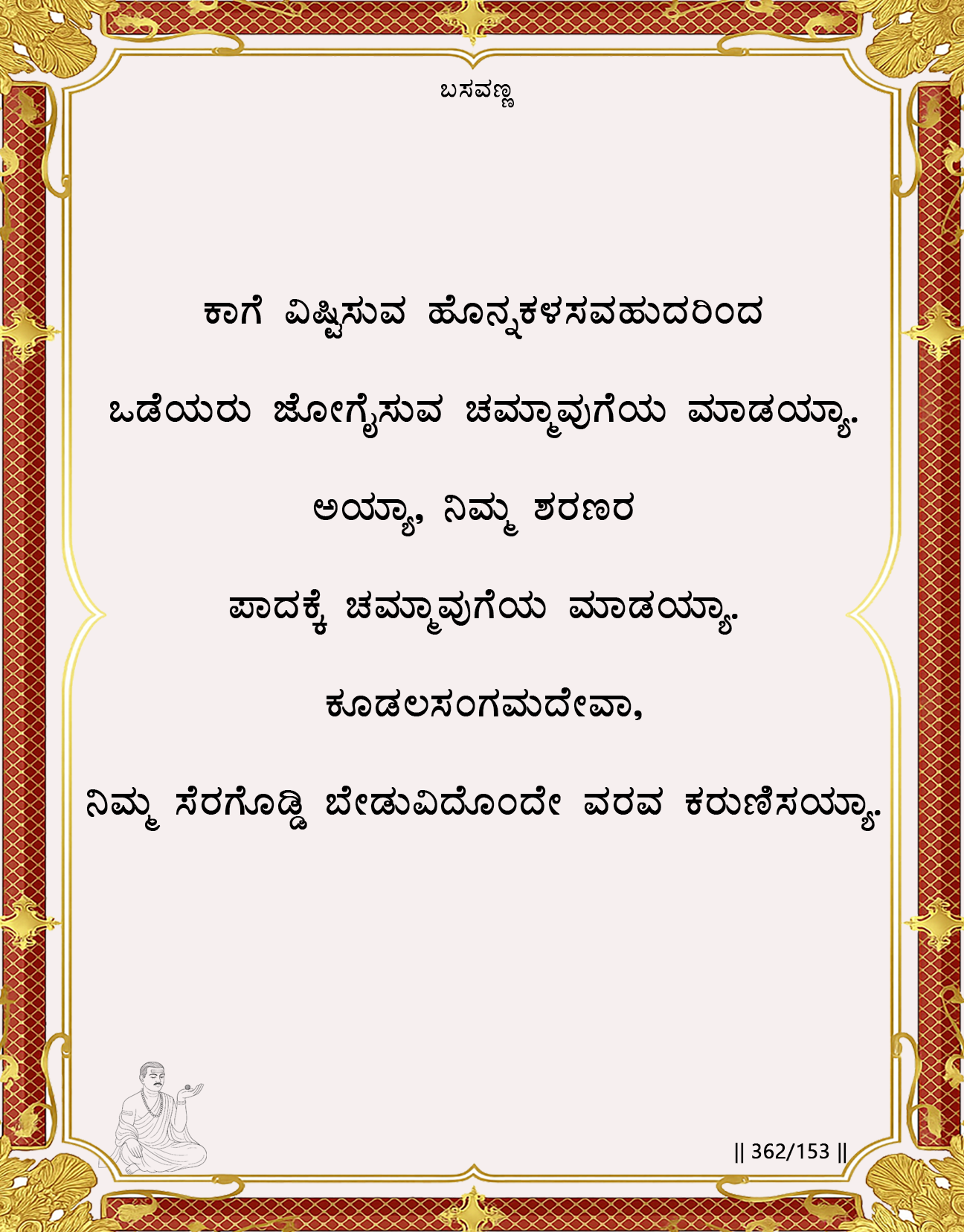
When the crow soils the gold,
does it become a king’s crown?
Can filth ever shape raw gold
into an ornament worthy of a throne?
So, O Kudalasangamadeva,
let me seek no false upliftment
from the hands of the unworthy.
Make me instead
the sandals at Your holy feet
simple, humble, ever-serving,
ever-close to You.
Grant me this grace.
Basavanna uses a sharp metaphor to expose the futility of seeking spiritual elevation from sources lacking purity and integrity. Just as a crow dirtying raw gold cannot transform it into a king’s crown, external contact with the unworthy cannot refine or uplift the seeker. True transformation comes only through surrender to the Divine. Instead of aspiring for status, titles, or recognition granted by worldly people, the devotee prays to become something simple yet sacredthe sandals at the Lord’s feet. This symbolizes humility, constant proximity to the Divine, and service over prestige. The core message: Do not seek honor from the world; seek nearness to the Divine through humility and service.
Spiritual Context
Core Spiritual Principle: Authentic spiritual refinement comes only from alignment with the Divine, never from worldly or impure sources. The highest aspiration is not for honor, but for the humility of direct service, which guarantees true proximity to God.
Cosmic Reality Perspective: In the non-dual reality of Shivayoga, the Linga is the only true refiner and source of value. The soul (Anga) is like gold, whose inherent divinity can only be revealed by the divine fire of grace, not by the corrupting touch of worldly ego (the “crow”). To seek validation from the world is to be mis-shaped by ignorance.
Historical Reality (Anubhava Mantapa Context): This Vachana is a radical critique of spiritual hierarchy and the pursuit of titles within religious communities. It rejects the idea that honor from priests, kings, or institutions has any spiritual value. It establishes that in the true spiritual economy, the most humble position in direct service to the Divine is infinitely more valuable than the highest rank conferred by society.
Interpretation
“When the crow soils the gold, does it become a king’s crown?”: The “crow” represents anyone or anything that is spiritually unrefinedfalse gurus, worldly praise, ego-driven ambitions. Its touch (“soiling”) cannot elevate; it can only corrupt. The “king’s crown” symbolizes spiritual realization, which cannot be manufactured by impurity.
“Let me seek no false upliftment from the hands of the unworthy.”: This is a vow of spiritual independence and discernment. The seeker consciously renounces the desire for validation from any source other than the Divine itself, protecting their inner practice from corruption.
“Make me instead the sandals at Your holy feet…”: This is one of the most powerful images of surrender in mystic literature. The “sandals” represent the ultimate in humility, utility, and intimacy. They are trod upon, yet they are constantly in touch with the feet of the Lord. They serve a essential, protective function. This prayer encapsulates the essence of Dasoha: to be a humble, useful instrument in direct service to the Divine.
Practical Implications: The seeker is guided to scrutinize their motives. Are they practicing for inner transformation or for external recognition? The goal is to cultivate such humility that one finds supreme joy in being of use, in being the “sandals” for the Divine will, rather than seeking to be the “crown” in the eyes of the world.
The Cosmic Reality
Anga (Human Dimension): The raw gold of the soul, and the aspirant praying to become the “sandals.” This Anga is defined by its desire for purification through service, not elevation through status.
Linga (Divine Principle): Koodalasangamadeva as the King, the wearer of the sandals, the source of all value and the goal of service.
Jangama (Dynamic Interaction): The dynamic is the state of being the “sandals.” This is the living Jangamaa relationship of continuous, humble, and intimate service. The “false upliftment” from the unworthy represents a corrupted, dysfunctional Jangama.
Shatsthala
Primary Sthala: Sharana (The stage of taking refuge, where the ego is surrendered and the soul’s only desire is to be an instrument of the Divine, perfectly expressed as the prayer to be the “sandals” in humble service).
Supporting Sthala: Bhakta (The stage of devotion, which must be purified of the desire for worldly or spiritual status and mature into the self-offering of the Sharana).
Practical Integration
Arivu (Awareness Practices): Meditate on the image of being the sandals at the Lord’s feet. Feel the humility, the closeness, and the purpose of that role. Use this to root out any internal desire for recognition or status.
Achara (Personal Discipline): Actively seek out opportunities for humble service. Perform tasks that are necessary but go unnoticed. Reject praise and titles, offering any credit received back to the Divine.
Kayaka (Sacred Action): Perform your work as an act of service to a higher principle, not for personal advancement. Let the quality of your service be your offering, not the recognition it brings.
Dasoha (Communal Offering): Become the “sandals” for your community the supportive, humble foundation that carries the weight of collective effort without seeking to be the “crown” that is seen and admired.
Modern Application
The “influencer” culture, the relentless pursuit of likes, followers, and titles; spiritual materialism where gurus seek fame and disciples seek association with powerful teachers for status; the fear of being ordinary or unseen.
This Vachana is a profound antidote to the age of personal branding. It offers the freedom of humility. It redefines success as proximity to the sacred through service, rather than visibility in the world. It validates a life of quiet integrity and purpose over one of noisy self-promotion, teaching that the greatest freedom is found in joyful servitude to what is truly Divine.
Essence
The crow defiles the golden ore,
No crown is made by filth’s poor chore.
Let me be, Lord, the sandals’ grace,
That touches, serves, and knows its place.
The Deeper Pattern (The Subtle Body): This Vachana outlines the Spiritual Law of Affinity. A substance can only be transformed by something of its own nature or higher. Gold (the soul) can only be shaped by a goldsmith (the Divine) in a forge (spiritual practice). The crow (worldly ego) is of a fundamentally different, lower order; its interaction with gold is not transformation but contamination. The prayer to be sandals is an application of this law: the soul seeks to bond with the Divine (the feet) through a relationship of congruent humility and service, which is a state of high spiritual affinity, ensuring true union.
In Simple Terms (The Gross Body): You cannot clean a muddy cloth with more mud. You need pure water. The soul is the cloth, the world’s praise is mud, and God’s service is the pure water. Basavanna says: stop trying to get clean by rolling in the mud of worldly honor. Immerse yourself completely in the cleansing, humble waters of divine service.
The Human Truth (The Causal Body): The world’s honors are a trap that chain you to the world. Divine service is a liberation that chain you to God. In the end, the greatest power and peace are found not in being served, but in serving; not in being above others, but in being so close to the Source that you become a support for all. The lowest place in God’s house is infinitely higher than the highest throne in the palace of man.

Views: 0