
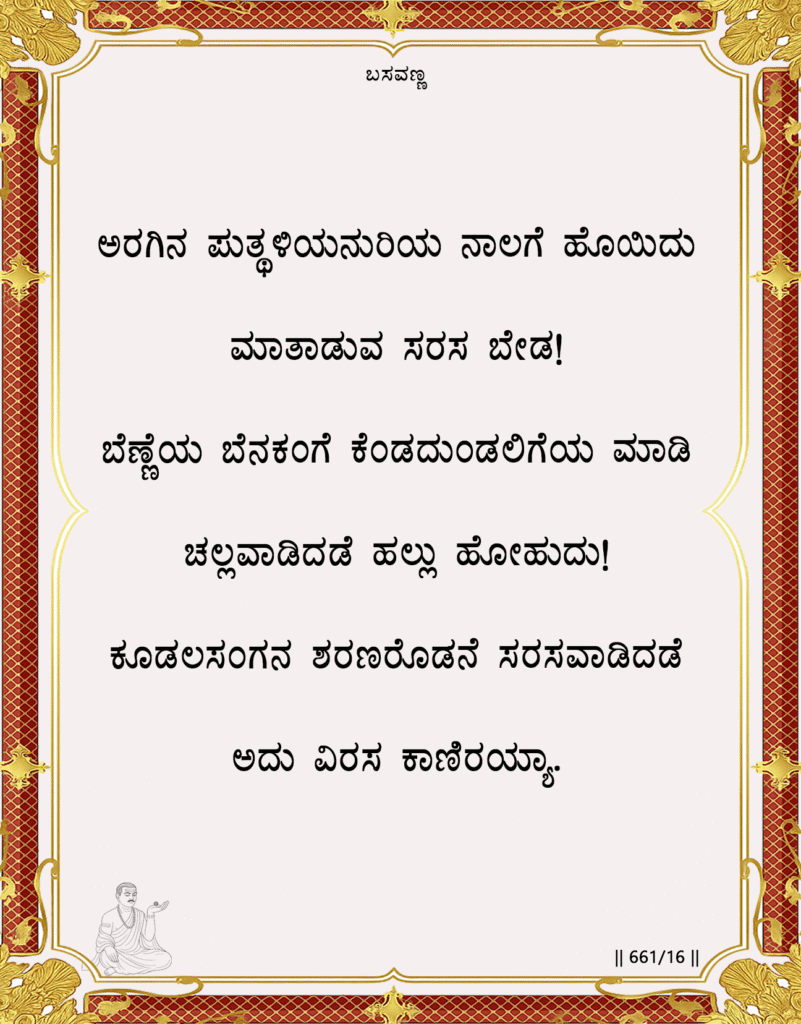
Poetic Rendering

Like an idol of butter placed near the fire
how long will it last? Tell me, O mind!
So too, this tongue, these teeth, this smile
what worth are they if used for jest
before the holy ones, the Śharaṇas of Kudalasangamadeva?
When the body itself is melting away,
should laughter mock the sacred?
Let speech be solemn, heart aware,
and silence be worship.
Basavanna here evokes a striking image a butter idol set near a flame, destined to melt away. Just as such an idol cannot endure heat, the human body too is fragile and fleeting. Within this temporary vessel reside instruments of speech the tongue, teeth, and smile meant for the praise of the divine, not for idle talk or mockery among the saints. He warns that to use these perishable tools for frivolous laughter in sacred company is to forget the gravity of human existence. Awareness (Ariwu) of impermanence (mrityu-jñāna) is the foundation of true reverence. Basavanna calls the seeker to a higher mindfulness: to let speech become prayer, thought become humility, and silence itself become an act of devotion.
Spiritual Context
Core Spiritual Principle: A profound awareness of impermanence (Anitya Bhava) is the essential foundation for right thought, speech, and action. It instills a natural gravity and reverence, directing one’s fleeting life-energy toward the eternal (the Linga and its manifestations) and away from the trivial.
Cosmic Reality Perspective: The entire manifest world, including the body, is in a constant state of flux (Prakriti). Only the Linga (consciousness) is eternal. To engage in idle or mocking behavior is to be hypnotized by the transient and to ignore the enduring reality that the Sharanas embody.
Historical Reality (Anubhava Mantapa context): This vachana outlines the code of conduct within the sacred community. It was not about suppressing joy, but about ensuring that the Sangha remained a protected space for deep spiritual work, free from the dissipating energy of frivolous gossip and mockery that characterizes worldly society.
Interpretation
1. “Like an idol of butter placed near the fire…” : The “idol of butter” is a powerful metaphor for the human body seemingly solid and beautifully formed, but inherently unstable and destined to dissolve. The “fire” is the heat of time, karma, and ultimately, death.
2. “Tell me, O mind!” : This is a direct call for introspection. The poet forces the mind, which is usually lost in distraction, to confront the reality of its own fragile housing.
3. “So too, this tongue, these teeth, this smile what worth are they if used for jest…” : He deconstructs the very instruments of social interaction. These faculties are not condemned, but their purpose is questioned. When life is so short, should these precious tools be wasted on what is trivial and irreverent?
4. “…before the holy ones, the Śharaṇas of Kudalasangamadeva?” : The context is crucial. The greatest folly is to be frivolous in the presence of those who have realized the eternal. It is a failure to recognize the sacred (Linga) in the Jangama (moving saint).
5. “When the body itself is melting away, should laughter mock the sacred?” : This is the logical conclusion. Awareness of impermanence (Arivu) naturally gives rise to a sense of urgency and solemnity. “Mocking” laughter represents a consciousness that is asleep to the gravity of existence.
Practical Implications: The seeker must cultivate mindfulness of impermanence. This awareness should inform all speech and action, especially within the spiritual community. Speech should be purposeful, truthful, and uplifting, preserving the sacred atmosphere necessary for inner growth.
The Cosmic Reality
Anga (Human Dimension): The human as the “butter idol” the transient, perishable body-mind complex that must use its brief existence wisely.
Linga (Divine Principle): Kudalasangama Deva as the eternal, unchanging reality, the “fire” of pure consciousness that ultimately reveals the impermanence of all forms.
Jangama (Dynamic Interaction): The Jangama is the community of Sharanas, who live in conscious alignment with the eternal Linga. To be in their presence is to be near the “fire” of truth, which should melt away our pretenses and frivolity, not be mocked by them.
Shata Sthala
Primary Sthala: Bhakta. This vachana is a foundational teaching for the Bhakta, instilling the reverence, humility, and mindful conduct required to progress on the path. It is the cultivation of right attitude.
Supporting Sthala: Maheshwara. The ability to maintain this solemn awareness and resist the pull of trivial distractions requires the inner fortitude and discipline characteristic of the Maheshwara stage.
Practical Integration
Arivu (Awareness): Practice regular reflection on impermanence. Contemplate the transient nature of the body, thoughts, and circumstances. Let this awareness infuse your moments with depth and purpose.
Achara (Personal Discipline): Practice mindful speech (Vak Tapas). Before speaking, especially in spiritual settings, ask: “Is it true? Is it necessary? Is it kind?” Avoid gossip, idle chatter, and sarcasm.
Kayaka (Sacred Action): Let your work be a sincere offering, not a subject for boastful or frivolous discussion. Perform your duties with the gravity of knowing this action is part of your fleeting opportunity for spiritual growth.
Dasoha (Communal Offering): Contribute to the Sangha by maintaining a respectful and focused presence. Your disciplined speech and reverent demeanor are a Dasoha that helps preserve the sanctity of the collective spiritual space.
Modern Application
We live in a culture of casual irreverence, constant distraction, and “hot takes,” where sarcasm and mockery are often mistaken for intelligence. Social media encourages performative and trivial communication. This leads to a life lacking in depth, meaning, and genuine connection.
This vachana liberates by calling for a life of intention and reverence. It teaches us to use our precious human faculties our voice, our attention, our time for what is truly meaningful. It is an invitation to step away from the noise and cultivate a inner and outer environment where silence is valued, speech is sacred, and life is lived with the profound awareness of its own fleeting beauty.
Essence
A butter form before the flame,
A fleeting breath, a passing name.
Why waste the speech, so brief and dear,
On jest, when sacred truth is near?
Metaphysically, this vachana deals with the relationship between Nitya (the eternal) and Anitya (the impermanent). The body is Anitya, a product of the five elements. The “jest” represents the activities of the unsteady mind (Chanchala Manas) engaged with transient phenomena. The “Sharanas” represent the gateway to the Nitya. The practice is to use the awareness of Anitya (the melting butter) to dis-identify from the mind-body complex and re-orient the consciousness toward the Nitya (the Linga in the Jangama).
Life is short and incredibly precious. To squander our energy on trivialities, especially in the presence of wisdom and sanctity, is the height of foolishness. True intelligence lies in recognizing the gravity of our existence and choosing to speak, act, and live with a purpose that honors this profound, fleeting opportunity.

Views: 3