Poetic Rendering
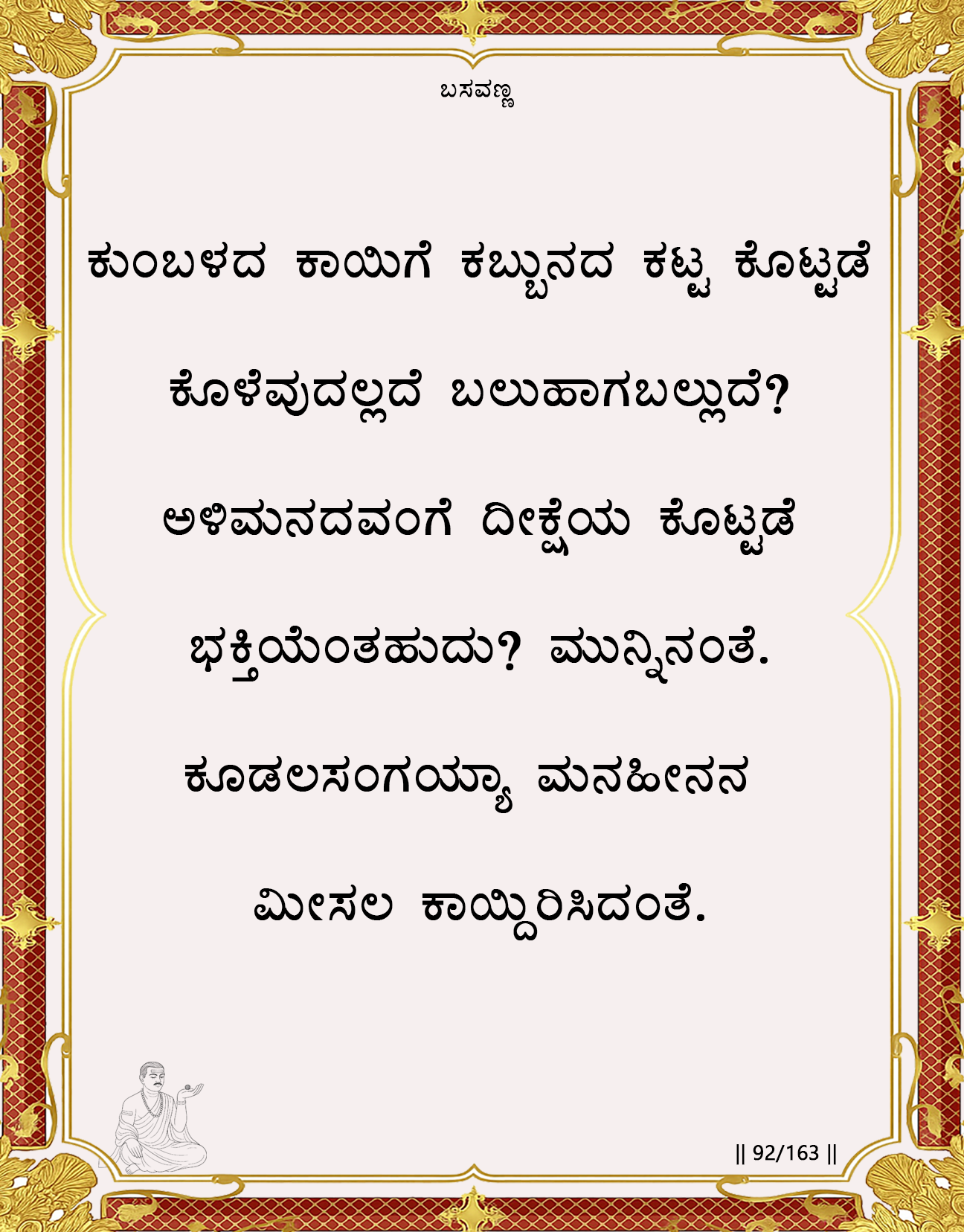
Decorate the pumpkin as you please,
paint it, garland it, worship it
will its inner rot depart?
Never.
Give the Linga to one
whose heart is weak,
whose mind has no resolve
will the light of Shiva shine in him?
It will not.
O Kudalasangamadeva,
without steadfast will,
without inner cleansing,
the sacred seed will not sprout.
He remains far from Your grace.
Basavanna teaches that spiritual transformation cannot occur through outward rituals or appearances alone. Just as a decorated pumpkin still rots from within, a person who receives the Linga without inner sincerity, discipline, and firm resolve remains unchanged. Initiation, symbols, and sacred status have no power unless the heart is prepared and the mind is steadfast. True spiritual growth begins with inner cleansing and commitment; only then can the light of Kudalasangamadeva take root and flourish within. True transformation begins inside, not in outward ritual.
Spiritual Context
Core Spiritual Principle: The primacy of inner qualification (adhikara). Spiritual realization is not a transactional result of external rites but an organic flowering that requires the right internal conditions. The external symbol (Linga) is a potent seed, but it must fall on the fertile soil of a sincere heart to germinate.
Cosmic Reality Perspective: This vachana clarifies the Shiva-Shakti dynamic from the human side. Shiva (as Linga) is the ever-present, limitless potential of grace. However, for this potential to manifest as actualized consciousness, Shakti (the individual’s energy) must be oriented, purified, and made receptive. If Shakti is inert, weak, or “rotten” (dominated by tamas and rajas), the union cannot fructify.
Historical Reality (Anubhava Mantapa Context): This is a crucial corrective against the potential for spiritual hypocrisy within the Lingayoga community. It prevents the Ishta-Linga from becoming a mere empty talisman or a badge of social identity. Basavanna insists that the revolutionary act of giving the Linga to all must be matched by an equally revolutionary commitment to inner transformation from the recipient. It upholds the community’s spiritual integrity over mere membership.
Interpretation
“Decorate the pumpkin… will its inner rot depart?” The “pumpkin” symbolizes the unregenerate ego. External decorations represent all forms of superficial religiosity: rituals, titles, sacred attire, and social status within a spiritual community. The “inner rot” is the core of ego, desire, and ignorance that remains untouched by these externals.
“Give the Linga to one whose heart is weak… will the light of Shiva shine in him?” This confronts the misunderstanding that initiation alone confers liberation. The Linga is a catalyst, not a magician. If the individual’s consciousness (chitta) is weak, unstable, and unprepared, the Linga’s light cannot be reflected or held; it is like sunlight falling on muddy water.
“Without steadfast will… the sacred seed will not sprout.” This establishes the necessary conditions for growth. “Steadfast will” (dridha sankalpa) is the disciplined focus of the mind. “Inner cleansing” is the removal of the “rot” the vasanas and samskaras that constitute the separate self.
Practical Implications: The practitioner must focus relentlessly on inner work (antaranga sadhana). This includes self-examination, cultivating virtues like humility and patience, and developing unwavering devotion. The external practice of wearing the Linga and participating in community must be a reflection of this inner commitment, not a substitute for it.
The Cosmic Reality
Anga (Human Dimension): The Anga is the field to be cultivated. Its quality determines the entire spiritual harvest. A neglected field (a weak heart) will yield nothing, no matter how precious the seed. The seeker’s primary responsibility is to till, weed, and nourish this inner landscape.
Linga (Divine Principle): The Linga is the perfect, potent seed of divine consciousness. It contains the entire blueprint for liberation. However, it operates according to the divine law of cause and effect; it cannot force its growth in unsuitable conditions. It gives itself completely but requires reciprocity.
Jangama (Dynamic Interaction): The Jangama is the diligent work of farming the soul. It is the dynamic, daily practice of weeding out negative tendencies, watering the heart with remembrance, and exposing the mind to the sunlight of sacred company. It is the bridge that connects the potential of the Linga to the preparedness of the Anga.
Shatsthala
Primary Sthala: Bhakta (Devotee) The vachana is a direct address to the aspiring Bhakta, outlining the essential qualifications for the path. It defines the stage where one must move beyond initial faith to develop the inner strength, resolve, and purity necessary to truly receive the grace that is always being offered.
Supporting Sthala: Prasadi (Recipient of Grace) The vachana implicitly defines what it means to be a true Prasadi. One does not become a recipient of grace passively; one must become a worthy vessel through sincere effort. Grace floods in when the vessel is clean, strong, and open.
Practical Integration
Arivu (Awareness Practices): Regularly “inspect the pumpkin.” Practice rigorous self-inquiry to identify areas of “inner rot” hidden motives, cherished prejudices, and subtle arrogance. Shine the light of awareness on them without decoration or excuse.
Achara (Personal Discipline): Build “steadfast will” through consistent spiritual discipline (abhyasa). This could be a fixed time for meditation, adherence to ethical vows, and the conscious practice of turning the mind toward the Linga throughout the day.
Kayaka (Sacred Action): Use your work as the primary ground for “inner cleansing.” Let labor reveal your impatience, pride, or laziness, and consciously work to transform those impulses into dedication, humility, and diligence.
Dasoha (Communal Offering): In the community, offer support that helps others strengthen their “heart soil.” This means fostering an environment of honest self-reflection and mutual encouragement in the inner journey, rather than just celebrating external displays of piety.
Modern Application
We live in a culture of quick fixes and external validation, from spiritual consumerism to social media curation. We often seek the appearance of wellness, success, or enlightenment without doing the hard, inner work. This leads to “decorated pumpkins” beautiful lives on the outside that feel hollow, anxious, or unfulfilled within.
This vachana is an antidote to spiritual bypassing. It calls for authentic, grounded work on the self. It teaches that true peace and power come not from acquiring more symbols, status, or techniques, but from the courageous and unglamorous process of cleaning the “inner rot” and cultivating genuine inner strength. It is a call to integrity over image.
Essence
A gilded gourd still hides its decay,
A weak-willed heart will waste the Way.
The seed is perfect, potent, true,
But only in soil that’s prepared and new.
So cleanse the ground and firm the will,
For Grace to root and grow until.
The Deeper Pattern: This vachana describes the necessary conditions for a successful symbiotic relationship between consciousness (Linga) and the psycho-physical system (Anga). The system must achieve a minimum state of coherence, stability, and receptivity (low entropy) for the higher-dimensional consciousness to “dock” and express itself. Without this, the system remains a closed loop of its own inherent patterns (“rot”), and the transformative potential remains unactualized.
In Simple Terms: It is the difference between planting a seed in a pot of fertile soil versus a pot of concrete. The seed (Linga) is genetically perfect in both cases. But in the concrete (the unprepared heart), it has no chance. It is only in the soft, nourishing, receptive soil (the sincere heart) that the seed can break open, send down roots, and sprout into a plant. The decoration of the pot is irrelevant.
The Human Truth: The universal human temptation is to seek change by altering our circumstances, appearance, or external affiliations, while leaving our core patterns untouched. The timeless truth here is that all real and lasting transformation is an inside-out process. The outer forms be they rituals, relationships, or possessions are meaningless unless the inner vessel is strong, clean, and ready to receive their true essence.

Views: 1