Poetic Rendering

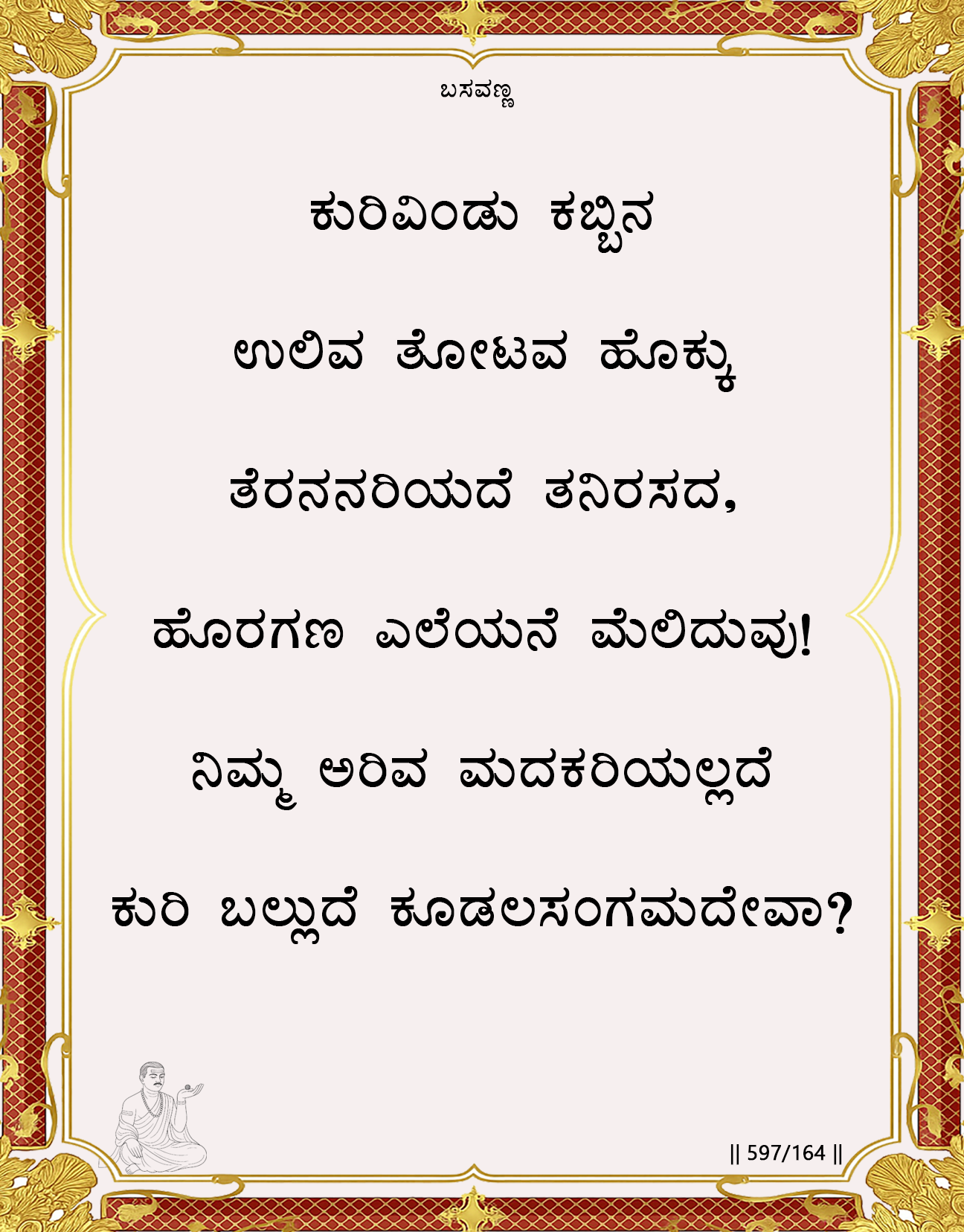
The sheep wanders in the sugarcane field
yet knows nothing of sweetness
it nibbles the dry leaves
and walks away satisfied.
Only the great elephant
presses the cane and drinks its essence.
So too, O Koodalasangamadeva,
those without depth and resolve
taste only the husk of devotion
never the nectar of You.
Basavanna teaches that many engage in religion only at the surface level, content with rituals, symbols, and outward practice. Like a sheep that enters a field of sugarcane but chews only the leaves, they never experience the inner sweetness of spiritual realization. Only those with sincerity, strength of intention, and inner discipline can press through the outer forms and taste the true essence of divine experience. The vachana emphasizes depth over appearance, urging seekers to move beyond superficial devotion and into genuine communion with Koodalasangamadeva.
Spiritual Context
Core Spiritual Principle: The distinction between the husk (sthula) and the essence (sara). True spirituality is about extracting the essence from all experiences and practices. It requires more than passive participation; it demands the active, pressing force of intense longing, discernment, and one-pointed focus to break open the outer form and access the inner reality.
Cosmic Reality Perspective: This vachana describes the process of moving from the gross (sthula) to the subtle (sukshma) aspect of Shakti. The world, the body, and religious forms are the gross, outer cane. The sweet juice is the subtle, conscious energy of Shiva itself, which animates and is hidden within all forms. The “elephant” represents the integrated power of a focused Shakti that can pierce through the veil of form to unite with its source.
Historical Reality (Anubhava Mantapa Context): Within the burgeoning Lingayoga movement, this vachana serves as a critical internal critique. It warns against the complacency of merely wearing the external symbols (the Ishta-Linga) or performing community rites without the inner, pressing devotion. It calls the Sharanas beyond a communal identity to the demanding, personal work of essence-extraction, ensuring the revolution remains spiritual at its core and not just social.
Interpretation
“The sheep wanders… nibbles the dry leaves and walks away satisfied.” The “sheep” symbolizes a passive, herd-like mentality in spirituality. It is content with superficial engagement: routine prayer, intellectual knowledge, or social belonging. The “dry leaves” are the external, non-nutritious aspects of religiondogma, ritualistic repetition, and ego-gratificationthat provide a false sense of satisfaction.
“Only the great elephant presses the cane and drinks its essence.” The “elephant” represents the individual with dridha sankalpa (steadfast resolve) and viveka (discernment). Its “greatness” is its spiritual strength and capacity for deep practice (sadhana). “Pressing the cane” is the intense effort of meditation, self-surrender, and penetrating inquiry that breaks the hard bark of the ego to release the sweet “nectar” of direct, non-dual experience (anubhava).
“Those without depth and resolve taste only the husk of devotionnever the nectar of You.” This is the explicit application. “Depth” is the inner capacity to go beyond appearances. “Resolve” is the unwavering commitment to this inner journey. Without these, one remains a consumer of religion, never a knower of God.
Practical Implications: The practitioner must constantly ask: “Am I being a sheep or an elephant in my practice?” This means moving beyond comfort, challenging one’s own superficial understandings, and applying greater intensity and presence in prayer, meditation, and service to “press” for the direct taste of the Divine.
The Cosmic Reality
Anga (Human Dimension): The Anga is the instrument of tasting. It can be configured as a “sheep”a superficial sensorium that registers only external stimuli and remains content with bland sustenance. Or, it can be cultivated as an “elephant”a powerful, integrated being capable of applying immense pressure to break through to the sublime.
Linga (Divine Principle): The Linga is the sweet, essential nectarthe rasa of existence. It is the core reality, the divine consciousness that is the true substance and sustenance within all forms. It is Koodalasangamadeva as the ultimate essence to be tasted and known directly.
Jangama (Dynamic Interaction): The Jangama is the entire process of “pressing and drinking.” It is the dynamic, energetic engagement with spiritual life. It is not static belief but the active, often forceful, application of one’s entire being in devotion and practice to effect the transformation of form into essence.
Shatsthala
Primary Sthala: Maheshwara (Lord of the Cosmic Play) The “elephant” who can access the essence embodies the Maheshwara stage. This stage involves a masterful understanding and engagement with the world of forms. The Maheshwara knows how to navigate the “sugarcane field” of existence, not as a passive wanderer, but as a powerful lord who can extract the supreme essence (sara) from it.
Supporting Sthala: Sharana (Total Refuge) The intensity of the “elephant’s” pressing is the stance of the Sharanaone who has taken total refuge and therefore engages with the path with total commitment and force. This is not a casual devotion but a whole-hearted pressing into the divine.
Practical Integration
Arivu (Awareness Practices): Cultivate the discernment (viveka) to distinguish the “leaf” from the “juice” in your own spiritual life. In every practice, ask: “Where is the essence here? Am I just going through the motions (nibbling leaves), or am I applying my full awareness to press out a direct taste of the Divine?”
Achara (Personal Discipline): Develop the “elephant’s” strength through disciplined, one-pointed practice (ekagrata). This could mean deepening a single practice like meditation or japa rather than skimming many. It means bringing intensity and focus to your spiritual commitments.
Kayaka (Sacred Action): Let your work be a process of “pressing the cane.” Engage with your labor so deeply and with such presence that you extract the divine essence from the activity itself, transforming duty into a source of direct spiritual joy and realization.
Dasoha (Communal Offering): In the community, encourage and exemplify the pursuit of essence. Share not just the “leaves” (doctrines and rituals) but the “nectar” (your direct experiences and insights). Foster an environment that values depth and authenticity over mere conformity.
Modern Application
We live in an age of spiritual consumerism and distraction. We “nibble” on a smorgasbord of wellness trends, mindfulness apps, and online teachings, never committing deeply to one path long enough to “press out the juice.” This leads to a state of spiritual satiation without nourishment, leaving us with a collection of dry leaves but still thirsty for the real nectar.
This vachana is a call to depth in a shallow world. It urges us to choose one path and commit to it with the strength and focus of an elephant. It teaches that true fulfillment comes not from consuming more spiritual content, but from a profound, sustained engagement that breaks open the shell of practice to reveal the sweet, transformative essence within.
Essence
The sheep but nibbles on the leaf,
And finds in surface, brief relief.
The mighty elephant knows the core,
And presses till it drinks the pour.
So too in faith, let depth commence,
And press the form to taste the Essence.
The Deeper Pattern: This vachana maps the difference between linear, surface-level interaction with a system and a non-linear, transformative penetration of it. The sheep engages with the field’s topology (the leaves), while the elephant engages with its underlying energy state (the sugar-rich sap). Spiritually, this is the difference between engaging with the exoteric, manifest world and accessing the esoteric, immanent energy that gives it life and sweetness. The “pressing” is the application of conscious energy to collapse the potential of the essence into a kinetic experience.
In Simple Terms: It is the difference between looking at a sealed bottle of fine perfume and actually opening it and smelling its fragrance. The sheep looks at the bottle, reads the label, and is satisfied. The elephant opens the bottle, allowing the essence to fill the room and transform the atmosphere. One is an external observation; the other is an immersive, transformative experience.
The Human Truth: The universal human tendency is to confuse familiarity with knowledge and participation with realization. We often mistake being in a tradition for knowing its truth. The timeless truth here is that the deepest joys and profoundest truths are never on the surface; they are hidden in the core. They demand our full strength, our deepest intention, and a willingness to break open the superficial to access the sublime. The most satisfying sustenance requires effort to extract.

Views: 0