Poetic Rendering
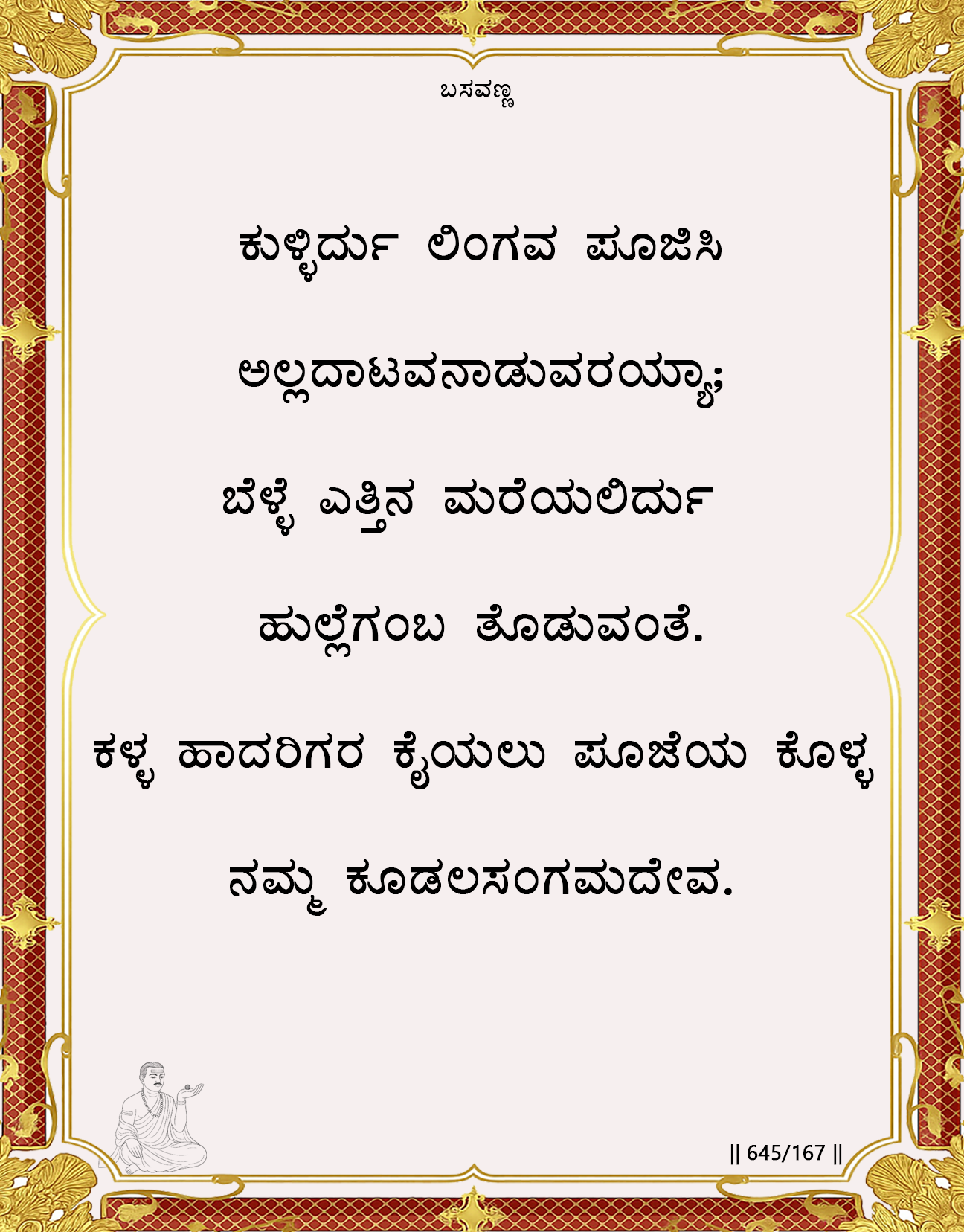
They sit before the Linga in show of prayer,
yet their hearts wander into idle talk and deceit.
It is like lurking in tall grass, to strike the innocent deer cruel, greedy, inhuman.
How can worship from the hands of thieves and liars
ever reach You, O Koodalasangama?
This vachana performs a radical dissection of religious hypocrisy, separating the outer performance of devotion from the inner state of consciousness. Basavanna exposes the fundamental incompatibility between ritual worship and unethical conduct. The metaphor of the hunter in the grass reveals that using spiritual practice to conceal cruel intentions is not just ineffectiveit is a profound desecration that turns worship into its opposite.
Spiritual Context
Core Spiritual Principle: The non-duality of ethics and spirituality. Worship is not a compartmentalized ritual but a total state of being. If one’s consciousness is rooted in deceit (maya) and harm (himsa), then the external performance of devotion is not just ineffectiveit is a form of spiritual adultery, a lie told in the court of truth.
Cosmic Reality Perspective: This vachana illustrates the absolute dissonance between different frequencies of Shakti. The Linga represents pure, sattvic consciousness. The worshipper whose heart is filled with rajas (greed) and tamas (deceit) emits a chaotic, destructive energy. These energies cannot harmonize; they cancel each other out. The hunter’s energy is antithetical to the deer’s, just as a liar’s energy is antithetical to God’s.
Historical Reality (Anubhava Mantapa Context): Basavanna directly confronts the religious establishment of his time, where Brahmin priests often performed elaborate rituals while upholding social injustices and personal corruptions. This vachana declares that no amount of ritual expertise or sacred knowledge can sanctify an unethical life. It establishes Lingayoga as an integral path where personal integrity (aachara) is the very foundation of devotion (bhakti), not an optional addition.
Interpretation
“They sit before the Linga in show of prayer, yet their hearts wander into idle talk and deceit.” This highlights the split between action and intention. The body is oriented towards the Divine, but the mind, the true instrument of connection, is oriented towards worldly cunning and gossip, which fractures inner unity.
“It is like lurking in tall grass, to strike the innocent deer cruel, greedy, inhuman.” The “tall grass” is the sanctity of the temple or the appearance of piety, used as camouflage. The “innocent deer” represents either the trust of the community or the Divine itself, which is approached not with love but with a predatory intent to “take” (blessings, status, merit) rather than to offer.
“How can worship from the hands of thieves and liars ever reach You…?” This is a rhetorical question based on the law of resonance. A “thief” is one who steals, here meaning one who tries to steal spiritual merit without offering a sincere heart. A “liar” is one whose inner state contradicts their outer action. Such a person’s worship is a dead letter, lacking the vibrational quality to reach the divine realm.
Practical Implications: The practitioner must constantly ensure that their inner state aligns with their outer practice. Before worship, one must purify the heart of malice, deceit, and greed. Spiritual practice begins with rigorous self-honesty and ethical living.
The Cosmic Reality
Anga (Human Dimension): The Anga is the potential instrument of devotion, but here it is weaponized. The hands are folded in prayer, but the heart is a hunter’s snare. This represents a profound inner contradiction where the human capacity for sanctity is corrupted into a tool for deception.
Linga (Divine Principle): The Linga is the ultimate standard of purity and truth. It cannot be bribed by ritual nor deceived by appearance. It responds only to the authentic frequency of a sincere heart. It is the “innocent deer”pure, aware, and vulnerable only to love, not to predation.
Jangama (Dynamic Interaction): The Jangama is meant to be the flowing stream of love between devotee and God. Here, it is perverted into a stalking maneuver. The dynamic is one of concealment and attack, not openness and surrender. This perverted Jangama severs the connection it pretends to cultivate.
Shata Sthala
Primary Sthala: Bhakta (Devotee) The vachana serves as a crucial qualification for the Bhakta stage. It defines what a devotee is not. True devotion (bhakti) is incompatible with hypocrisy and cruelty. One cannot enter the gate of Bhakta without first purifying the heart of its “hunter” instincts.
Supporting Sthala: Prasadi (Recipient of Grace) The vachana implicitly defines who can truly be a Prasadi. Grace flows towards integrity and sincerity. A heart that is “cruel, greedy, inhuman” builds a dam against that flow, making it an unworthy vessel to receive anything.
Practical Integration
Arivu (Awareness Practices): Before and during worship, practice “inner scanning.” Observe the mind for hidden motives, judgments, or deceitful plans. If the “hunter” is present, do not proceed with the ritual. First, sit in silence and cultivate a heart of openness and harmlessness.
Achara (Personal Discipline): Make truthfulness (satyam) and non-harm (ahimsa) the non-negotiable foundation of your spiritual life. Let your personal discipline extend to your speech and thoughts, ensuring they are not weapons that “strike the innocent.”
Kayaka (Sacred Action): Ensure your work is transparent and ethical. Do not use your spiritual identity or community standing as “tall grass” to conceal exploitative or dishonest business practices.
Dasoha (Communal Offering): Foster a community culture of gentle accountability. Encourage an environment where individuals can honestly confront their own hypocrisies without shame, supporting each other in aligning inner truth with outer practice.
Modern Application
We live in an age of curated personas and performative virtue. “Spiritual” influencers and leaders often project an image of holiness while engaging in unethical behavior behind the scenes. Similarly, individuals may attend religious services or practice mindfulness while their business or personal lives are marked by exploitation, gossip, or deceit. This creates profound psychological fragmentation and public cynicism towards religion.
This vachana is a call to radical integrity. It liberates us from the pressure to perform spirituality and invites us to embody it. It teaches that true peace comes from the unity of inner and outer life. The most profound worship is to live ethically, to speak truthfully, and to relate to others without a hidden agenda, making one’s entire life a genuine temple.
Essence
The hands are folded, lips in prayer,
But in the heart, a hunter’s snare.
The grass of piety hides the blade,
For trust and innocence, betrayed.
No rite can bless the lying soul,
Make my worship, Lord, a single, truthful whole.
The Deeper Pattern: This vachana describes a catastrophic system error in the human spiritual interface. The system is running a sacred program (worship) with a corrupted operating system (a deceitful mind). The output is not devotion, but a malicious exploit that uses the sacred protocol to try and gain unauthorized access to divine “resources.” The system’s inherent firewall (the law of karma/dharma) rejects this connection, as the source IP (the individual’s consciousness) is blacklisted for malicious intent.
In Simple Terms: It is like trying to light a pure, clean candle with a blowtorch. The blowtorch (the aggressive, deceitful mind) has fire, but it is the wrong kind of fireit is destructive, chaotic, and will only melt the wax and extinguish the wick. The gentle, steady flame of a match (a sincere heart) is the only thing that can correctly ignite the candle of devotion.
The Human Truth: The universal human temptation is to use external formsincluding religionto mask internal flaws and to gain advantage. We believe we can hide our true selves. The timeless truth here is that reality is not fooled. The Divine perceives the heart, not the costume. The most damaging lie is the one we tell in the name of truth, and the greatest spiritual progress begins when we stop performing and start being, in raw and honest authenticity.

Views: 0