Poetic Rendering

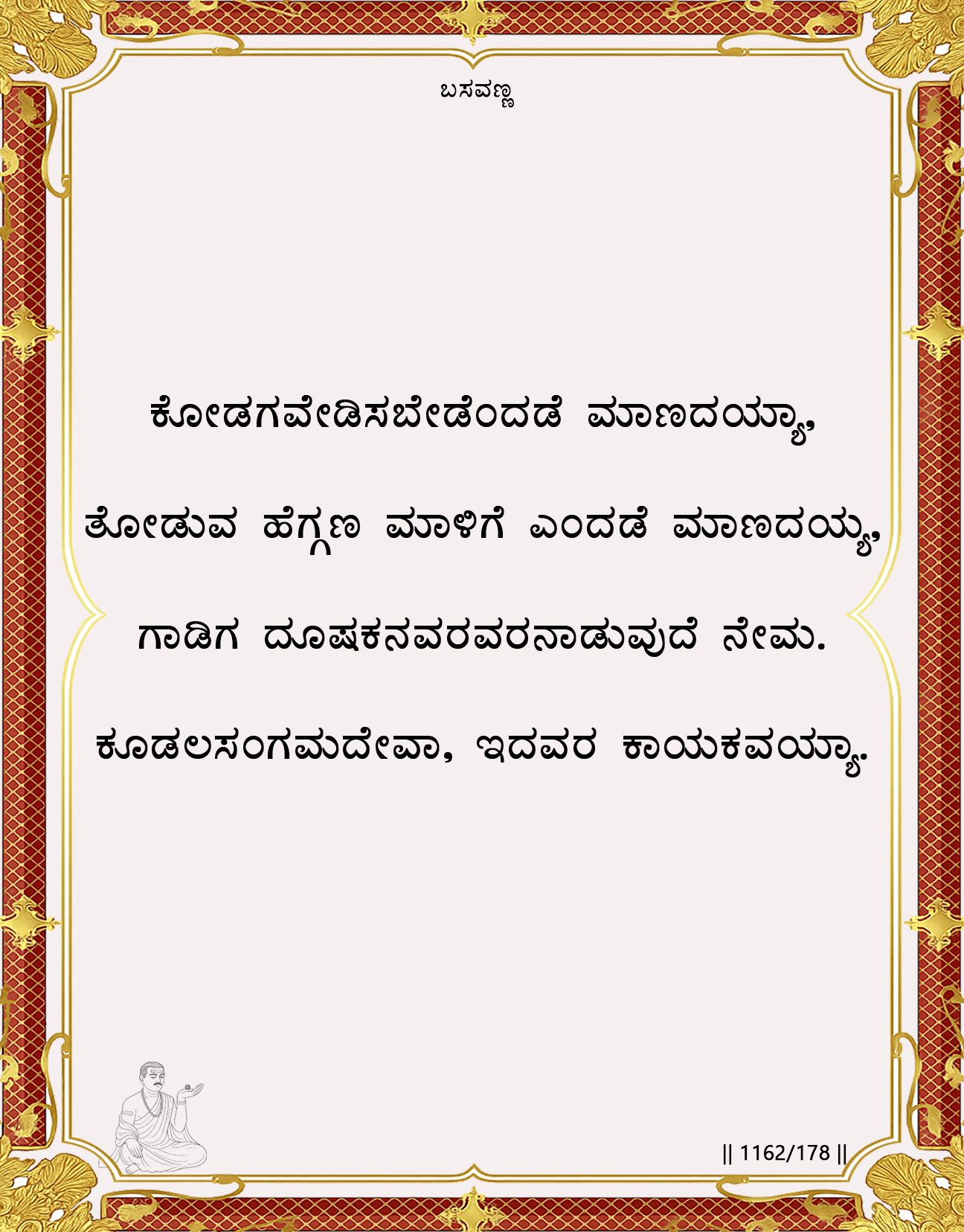
“Do not hunt with the bow,” they say,
yet they build grand halls on ivory pillars.
The world’s tongue is ever double condemnation its custom.
Such is their way of work, O Koodalasangama.
This vachana emerges from Basavanna’s penetrating insight into the moral schizophrenia of human society. He exposes how power distorts ethical perception, creating a system where the same action is judged not by its intrinsic morality but by the social status of the actor. The vachana serves as both social critique and spiritual revelationun masking the illusion of human justice while pointing toward the absolute justice of divine consciousness.
Spiritual Context
Core Spiritual Principle: The inseparability of social justice and spiritual integrity. A consciousness that tolerates or engages in hypocrisy is fundamentally divided and cannot perceive non-dual reality. True spirituality requires the courage to see and name societal illusions, aligning one’s life with a consistent, divine ethic rather than a convenient, human one.
Cosmic Reality Perspective: This vachana illustrates the state of maya (cosmic illusion) at the social level. The “double tongue” is a manifestation of a consciousness split from the unified truth of Shiva. In the non-dual reality of Shiva, thought, word, and deed are one. The hypocrisy Basavanna exposes is a direct violation of this cosmic law, creating a karmic dissonance that keeps one trapped in illusion.
Historical Reality (Anubhava Mantapa Context): This vachana is a direct challenge to the ruling and priestly classes of 12th-century Karnataka. It unmasks the ethical bankruptcy of a social order that preached non-violence (ahimsa) while its luxury was built on violence and exploitation. For the Lingayoga community, it was a declaration of intellectual and spiritual independence, establishing that their moral compass was divine grace, not the contradictory dictates of a corrupt establishment.
Interpretation
“‘Do not hunt with the bow,’ they say, yet they build grand halls on ivory pillars.” This is the core image of hypocrisy. The “bow” represents the direct, visible tool of violence used by the common person. The “ivory pillars” represent the indirect, sanitized, and celebrated violence of the powerful. The same act of killing is condemned in one form and glorified in another, revealing that the judgment is not about the act itself, but about who performs it.
“The world’s tongue is ever double condemnation its custom.” This generalizes the observation. The “double tongue” is not an exception but the rule (custom) of worldly (samsaric) interaction. It is the language of a reality based on duality and power, not truth.
“Such is their way of work, O Koodalasangama.” This concluding statement is not one of resignation, but of revelation and renunciation. By presenting this observation to the Divine, Basavanna simultaneously exposes the false system and takes refuge in the one source of unwavering truth.
Practical Implications: The practitioner must cultivate a fierce inner honesty and consistency. This involves scrutinizing one’s own life for hidden hypocrisies where one’s comforts might be built on the exploitation of others or where one’s words are not aligned with one’s actions. Spiritual practice includes the work of ethical alignment.
The Cosmic Reality
Anga (Human Dimension): The Anga,when identified with social power and privilege, becomes the instrument of this “double tongue.” It is a consciousness that has externalized its shadow, condemning in others what it refuses to see in itself. Its purification requires the recognition of this split.
Linga (Divine Principle): The Linga is the ultimate standard of non-dual truth. Koodalasangamadeva is the consciousness where word and deed are identical. In this light, all hypocrisy is revealed and dissolved. The Divine is the final court where the “ivory pillars” are seen as no different from the “bow.
” Jangama (Dynamic Interaction): The Jangama is the active process of holding the “double tongue” of the world against the single, pure standard of the Linga. It is the dynamic of a conscience in protest, the act of speaking truth to power, and the inner movement of withdrawing allegiance from worldly “justice” in favor of divine truth.
Shata Sthala
Primary Sthala: Maheshwara (Lord of the Cosmic Play) To see and understand this societal “play” of hypocrisy from a higher vantage point is the perspective of the Maheshwara. This stage involves seeing through the games of power and illusion without being entangled by them, understanding the mechanics of the cosmic drama.
Supporting Sthala: Sharana (Total Refuge) The act of turning away from this corrupt world system and presenting the observation to Koodalasangamadeva is the stance of the Sharana. It is a declaration that one’s refuge and source of validation is the Divine, not the fickle and hypocritical judgments of society.
Practical Integration
Arivu (Awareness Practices): Cultivate the “Mirror of Conscience.” Regularly reflect on your own life: Where are my “ivory pillars”? In what ways do I benefit from systems or actions that I would condemn in others? Practice seeing the unified chain of cause and effect that links luxury to suffering.
Achara (Personal Discipline): Strive for radical consistency between your values and your lifestyle. Make conscious choices to simplify your life and reduce your complicity in exploitative systems. Let your personal discipline be a protest against the “double tongue.”
Kayaka (Sacred Action): Engage in work that actively repairs the damage of societal hypocrisy. Choose a profession or dedicate part of your labor to initiatives that promote true justice, transparency, and equity, building with ethical “materials.”
Dasoha (Communal Offering): Build communities based on transparent, consistent ethics. Foster a culture where members hold each other accountable with compassion, ensuring that the community’s collective life is not built on any form of “ivory pillars.”
Modern Application
We live in an age of pervasive “virtue signaling” and corporate “greenwashing,” where institutions and individuals loudly proclaim ethical stances while their practices and investments tell a different story. Politicians condemn corruption while being embroiled in it; corporations champion sustainability while being major polluters. This erodes trust and creates widespread cynicism.
This vachana gives us the lens to cut through the noise. It liberates us from the need for validation from hypocritical systems and empowers us to build our lives on a foundation of personal integrity. It calls us to be ethical consumers, conscious citizens, and spiritual practitioners whose inner truth matches their outer life, creating islands of authentic justice in a sea of contradiction.
Essence
They scorn the bow, the hunter’s hand,
While on the tusks of death, they stand.
A forked tongue, a custom stale,
To make the weak and powerless wail.
I see your game, this world’s disgrace,
And turn, O Lord, to seek Your face.
The Deeper Pattern: This vachana describes a systemic cognitive dissonance, a persistent error in the social operating system. The system runs on a code that applies one set of rules (condemnation) to one user class (the weak) and a completely different set of rules (celebration) to another (the powerful). This is not a bug but a feature of a system built on dualism and hierarchy. The spiritual seeker must install a new “kernel” of consciousness non-dual awareness that sees this error and operates on the unified code of divine justice.
In Simple Terms: It is like a corrupt judge who jails a poor man for stealing a loaf of bread to eat, while honoring a wealthy man who has stolen land from a thousand poor families. The law is the same, but its application is perverted by power. Basavanna points to a higher, divine court where the law is applied equally to all, and the true crime is the hypocrisy itself.
The Human Truth: We are often complicit in, or silently accept, societal hypocrisies because it is easier than confronting power or examining our own privileges. The timeless truth here is that spiritual awakening demands that we see this clearly. To be free from the world’s illusion (maya), we must first see the illusion in the world’s judgments. Our peace and integrity depend on aligning with a justice far greater than the flawed, self-serving justice of humanity.

Views: 0