Poetic Rendering
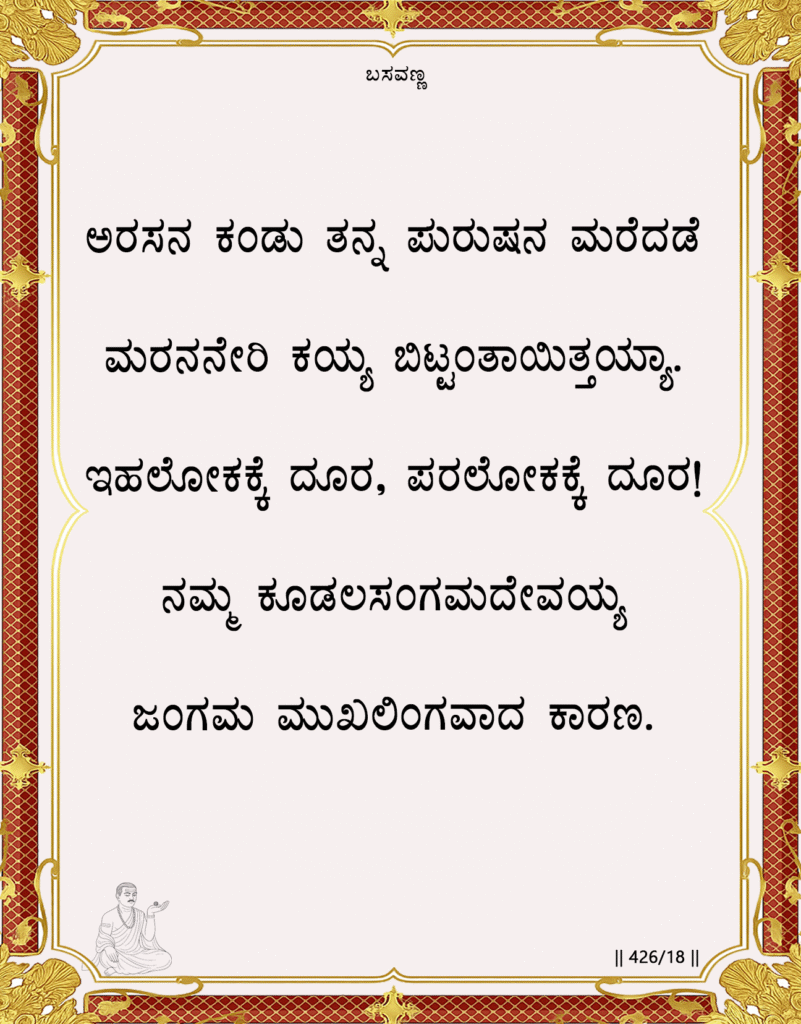
If, seeing the king,
one forgets her own husband,
it is like climbing a tree only to let go and fall.
Lost to this world, lost to the next!
But my Koodalasangamadeva
is the Linga revealed
through the face of the jangama.
This vachana presents spirituality as a relationship of absolute fidelity. Using the powerful metaphor of a wife forsaking her husband for a king, Basavanna illustrates the catastrophic error of abandoning the intimate, inner Divine (Liṅga) for the allure of external, worldly power and prestige. The “king” represents all that glitters in the material world wealth, status, political favor, and even other distracting spiritual paths. The “fall from the tree” signifies the utter ruin that follows this betrayal: a loss of spiritual grounding in this life and a severance from grace in the next. The vachana culminates by offering the true object of devotion: the Jangama, in whom the formless Liṅga becomes a visible, living reality.
Spiritual Context
Core Spiritual Principle: The relationship with the Divine is one of absolute, exclusive commitment and fidelity (Eka Nistha). To divert one’s devotion to worldly powers or other distracting spiritual paths is a form of “adultery” that severs the sacred connection and leads to spiritual ruin.
Cosmic Reality Perspective: The Linga is the one, non-dual reality. Chasing after worldly “kings” (power, wealth, fame) is a fundamental error, as it involves forsaking the universal source for a fragmented, transient part of creation. This duality leads to bondage.
Historical Reality (Anubhava Mantapa context): In 12th-century Karnataka, political and royal patronage often influenced religious life. This vachana is a powerful assertion of spiritual independence, declaring that a Sharana’s sole allegiance is to the Divine as experienced in the community (Sangha), not to any temporal ruler or external institution.
Interpretation
1. “If, seeing the king, one forgets her own husband…” : The “husband” is the Ishta Linga, the chosen, intimate form of the Divine. The “king” represents all external lures political power, social status, material wealth, or even other spiritual teachers that appeal to the ego.
2. “…it is like climbing a tree only to let go and fall.” : This is a vivid image of self-destruction. The “tree” may represent the initial effort of spiritual practice. To abandon the Linga for worldly gain at the height of one’s practice is to voluntarily throw oneself into a fall, losing all progress.
3. “Lost to this world, lost to the next!” : This signifies total loss. The betrayer loses the peace and integrity of a devoted life in this world and severs the connection to divine grace, which is the only true wealth for the next life or future state.
4. “But my Koodalasangamadeva is the Linga revealed through the face of the jangama.” : This is the triumphant conclusion and the safeguard against betrayal. The Jangama the wandering saint or the enlightened guru is not a separate object of worship. They are the transparent medium through which the formless Linga becomes visible and accessible. Devotion to the Jangama is devotion to the Linga.
Practical Implications: The seeker must cultivate unwavering loyalty to their Ishta Linga and their Guru. This means making conscious choices that prioritize this sacred relationship over worldly temptations and distractions. The company of the Jangama (Satsangha) is the means to strengthen this fidelity.
The Cosmic Reality
Anga (Human Dimension): The human soul in the role of the devoted spouse, whose sole purpose is to love and remain faithful to the Divine.
Linga (Divine Principle): Kudalasangama Deva as the true “Husband” the eternal, beloved source and goal of the soul.
Jangama (Dynamic Interaction):The Jangama is the living proof and embodiment of this sacred union. They are the “face” that makes the invisible “Husband” (Linga) visible, thus providing a tangible focal point for the Anga’s devotion and ensuring its fidelity.
Shata Sthala
Primary Sthala: Bhakta. This vachana defines the essence of the Bhakta stage: single-minded, emotional devotion to the Lord, characterized by a fear of separation and a fierce protectiveness of the relationship.
Supporting Sthala: Maheshwara. The ability to resist the “king” the temptations of power and prestige requires the inner strength, courage, and resolve that are hallmarks of the Maheshwara stage.
Practical Integration
Arivu (Awareness): Cultivate awareness of your “spiritual loyalty.” Regularly check within: “Where is my heart’s true allegiance? Is it with the Inner Lord, or am I being seduced by the ‘kings’ of money, status, or other paths?”
Achara (Personal Discipline): Make a conscious vow of fidelity to your spiritual path and your Guru. Let this vow guide your decisions and help you say “no” to distractions that would pull you away from your core commitment.
Kayaka (Sacred Action): Perform your duty in the world without becoming enslaved by its rewards. See your work as a service offered to the Linga, not as a means to gain the favor of worldly “kings.”
Dasoha (Communal Offering): The Sangha exists to reinforce this fidelity. Share your struggles and triumphs in remaining steadfast. The community provides the strength and reminder to stay true to the path when worldly temptations arise.
Modern Application
We live in a world of endless options and distractions the “kings” of consumerism, corporate ladders, social media fame, and a spiritual marketplace offering countless paths. This leads to a fragmented heart, a lack of depth, and a “spiritual adultery” where we dabble in many practices but commit to none, never experiencing the profound transformation that comes from unwavering fidelity.
This vachana liberates by calling for a profound commitment. It suggests that true spiritual growth requires “marrying” your path choosing one authentic way and diving deep with absolute loyalty. It is the antidote to the modern anxiety of missing out, teaching that the deepest fulfillment is found not in keeping our options open, but in the fearless, wholehearted surrender to one truth.
Essence
Why trade the Sun for a spark’s brief light?
Why choose the king and lose the night?
My heart has one, my Lord, my own,
In the Jangama’s face, Your love is shown.
Metaphysically, this vachana deals with the principle of Ista Devata (the chosen deity). The “husband” is the Ista Devata, the personal form of the absolute that the soul is attuned to. Abandoning it for a “king” (another, more alluring but ultimately foreign spiritual energy) creates a karmic rupture and destabilizes the subtle body. The Jangama represents the living Guru-tattva (Guru principle), which is a pure channel for the Ista Devata. By serving the Jangama, the seeker’s connection to their Ista Devata is purified and strengthened, preventing such a catastrophic fall.
Depth and mastery in any aspect of life a craft, a relationship, or a spiritual path require unwavering commitment. Chasing every new temptation leads to a life of superficiality and ultimate failure. True success and fulfillment are born from the fidelity of a heart that has chosen its one true love and remains loyal through all distractions.

Views: 3