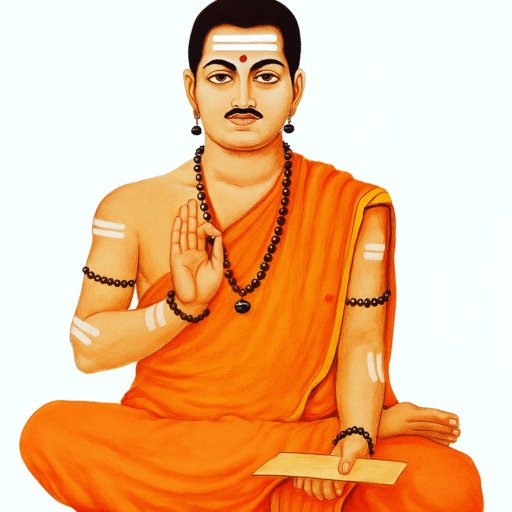

Poetic Rendering
The husband bows to Shiva,
the wife delights in meat and liquor.
He offers holy water and prasāda,
she hungers for taste and intoxication.
How can such divided living
be called pure devotion?
It is like washing a liquor pot only on the outside
while the inside stinks and stains,
O Kudalasangamadeva.
Basavanna uses the metaphor of a discordant couple to reveal a deeper reality within every seeker: the inner division between the self that longs for Shiva and the self that clings to sensory pleasure. Devotion fractured by opposing desires becomes powerless, like a vessel washed only on its exterior while its interior remains polluted. True bhakti arises only when the whole being thought, desire, and action turns in one direction. Basavanna’s teaching is clear: liberation requires inner unity, where every part of oneself aligns with the Linga, leaving no hidden corner loyal to worldly intoxications.
Spiritual Context
Core Spiritual Principle: The necessity of inner integrity for spiritual efficacy. Devotion is not a part-time activity but a total orientation of one’s being. A divided heart, where spiritual aspirations coexist with unrefined sensory cravings, creates a state of internal conflict (mano-daurbalyam) that nullifies the power of any external ritual. Purity must be from the inside out.
Cosmic Reality Perspective: This vachana illustrates the dissonance between different frequencies of Shakti. The “husband” represents sattvic Shakti (oriented toward Shiva/light). The “wife” represents tamasic Shakti (oriented toward inertia and sensory intoxication). These two energies are in conflict, preventing the unified flow of consciousness necessary for union with the singular, sattvic reality of the Linga.
Historical Reality (Anubhava Mantapa Context): This vachana provided a profound psychological framework for the Lingayoga community’s social revolution. While the movement was open to all, it demanded a high degree of personal integrity. It wasn’t enough to simply wear the Linga; one’s entire lifestyle, including diet and conduct, had to reflect an inner purity. This teaching prevented hypocrisy and ensured that the community’s radical external equality was matched by a commitment to inner transformation.
Interpretation
“The husband bows to Shiva, the wife delights in meat and liquor.” This symbolizes the internal civil war. The “husband” is the higher mind/intellect seeking liberation. The “wife” is the lower mind/body complex still identified with primal pleasures and intoxication (mada).
“He offers holy water and prasāda, she hungers for taste and intoxication.” This shows the contradiction in action. The same life force is being used for opposing purposes: one for sanctification, the other for sensory gratification. This creates a karmic stalemate.
“How can such divided living be called pure devotion?” This is the central, rhetorical question. The answer is implicit: it cannot. Devotion (bhakti) implies love and one-pointedness. Division is the antithesis of love.
“It is like washing a liquor pot only on the outside while the inside stinks and stains…” This is the masterful metaphor. The external washing is the performance of ritual. The foul interior is the unchanged state of desire and attachment. God perceives the inner reality, not the external show.
Practical Implications: The practitioner must engage in rigorous self-examination to identify their own inner divisions. Spiritual practice involves consciously aligning one’s desires, habits, and lifestyle with one’s spiritual goals, ensuring that there is no part of one’s life that is “off-limits” to the transformative power of devotion.
The Cosmic Reality
Anga (Human Dimension): The Anga is the “liquor pot.” Its sacred purpose is to be a clean vessel for divine grace. If it is only cleaned externally (through ritual) but not internally (through purification of desire), it remains unfit for its purpose.
Linga (Divine Principle): The Linga is the pure substance that is to be held within the vessel. It cannot be poured into a stained pot without being contaminated. The Divine, as absolute purity, requires a corresponding purity in the recipient.
Jangama (Dynamic Interaction): The Jangama is the scouring of the pot’s interior. It is the difficult, often uncomfortable work of self-purification facing one’s cravings, transforming one’s habits, and integrating the fragmented self into a single, pointed instrument of devotion.
Shata Sthala
Primary Sthala: Bhakta (Devotee) This vachana is a critical teaching for the aspiring Bhakta. It moves the devotee beyond superficial practice and challenges them to achieve inner consistency, which is the true foundation of sustained devotion.
Supporting Sthala: Sharana (Total Refuge) The state prayed for freedom from “divided living” is the state of the Sharana. Taking total refuge means there is no part of one’s life that is not offered to the Divine. It is the ultimate integration.
Practical Integration
Arivu (Awareness Practices): Practice “Inner Parliament Meditation.” Sit quietly and witness the different “voices” or desires within you the one that wants to meditate and the one that wants distraction. Acknowledge them without judgment, but consciously affirm the intention to align all parts under the leadership of your highest Self (the Linga within).
Achara (Personal Discipline): Simplify your life to reduce internal conflict. This may involve adopting a sattvic diet, reducing intoxicants, or curating your media consumption to support your spiritual goals, thereby creating an external environment that fosters inner unity.
Kayaka (Sacred Action): Ensure your work does not force you into a state of ethical or spiritual compromise. Seek to earn a livelihood in a way that is congruent with your inner values, unifying your professional and spiritual lives.
Dasoha (Communal Offering): Foster a community culture that supports holistic integrity. Encourage open discussions about the challenges of integrating spirituality into all aspects of life, offering support and accountability without judgment.
Modern Application
We live in an age of hyper-compartmentalization. We are one person at work, another on social media, and another in our private indulgences. We may practice mindfulness for ten minutes but spend the rest of the day in a state of anxious distraction and consumption. This leads to a profound sense of inauthenticity and a feeling that our spiritual practice is not “working.”
This vachana offers the cure for this modern fragmentation. It calls for a life of integrity, where our deepest values inform our smallest actions. It liberates us from the exhaustion of maintaining multiple personas and leads to a life of singular purpose and profound peace, where every action becomes an expression of a unified self.
Essence
One hand in prayer, one holds the wine,
A fractured soul, a broken line.
The outside scrubbed, a pious show,
The inside rots, where foul things grow.
Make whole my heart, one wish, one way,
To match the dawn of Your pure day.
The Deeper Pattern: This vachana describes a system with contradictory operating instructions. The “husband” is running Program: Liberation. OS, while the “wife” is running Program: Sensation. OS. These two programs are incompatible and cause the system (the individual) to freeze or crash. Spiritual progress requires a full system wipe and the installation of a single, unified operating system (Linga-Consciousness) that governs all processes.
In Simple Terms: It is like trying to drive a car with one foot on the accelerator and the other on the brake. The car (your spiritual progress) may shudder and make noise (the performance of ritual), but it cannot move forward. Only by lifting the foot off the brake (relinquishing contradictory desires) can the car proceed smoothly toward its destination.
The Human Truth: We all struggle with conflicting desires. We want the peace of God but also the pleasures of the world. The timeless truth here is that we cannot serve two masters. The path to liberation requires making a fundamental choice and then diligently, through discipline and grace, bringing every aspect of our being into alignment with that choice. There is no peace in a divided house.

Views: 0