Poetic Rendering
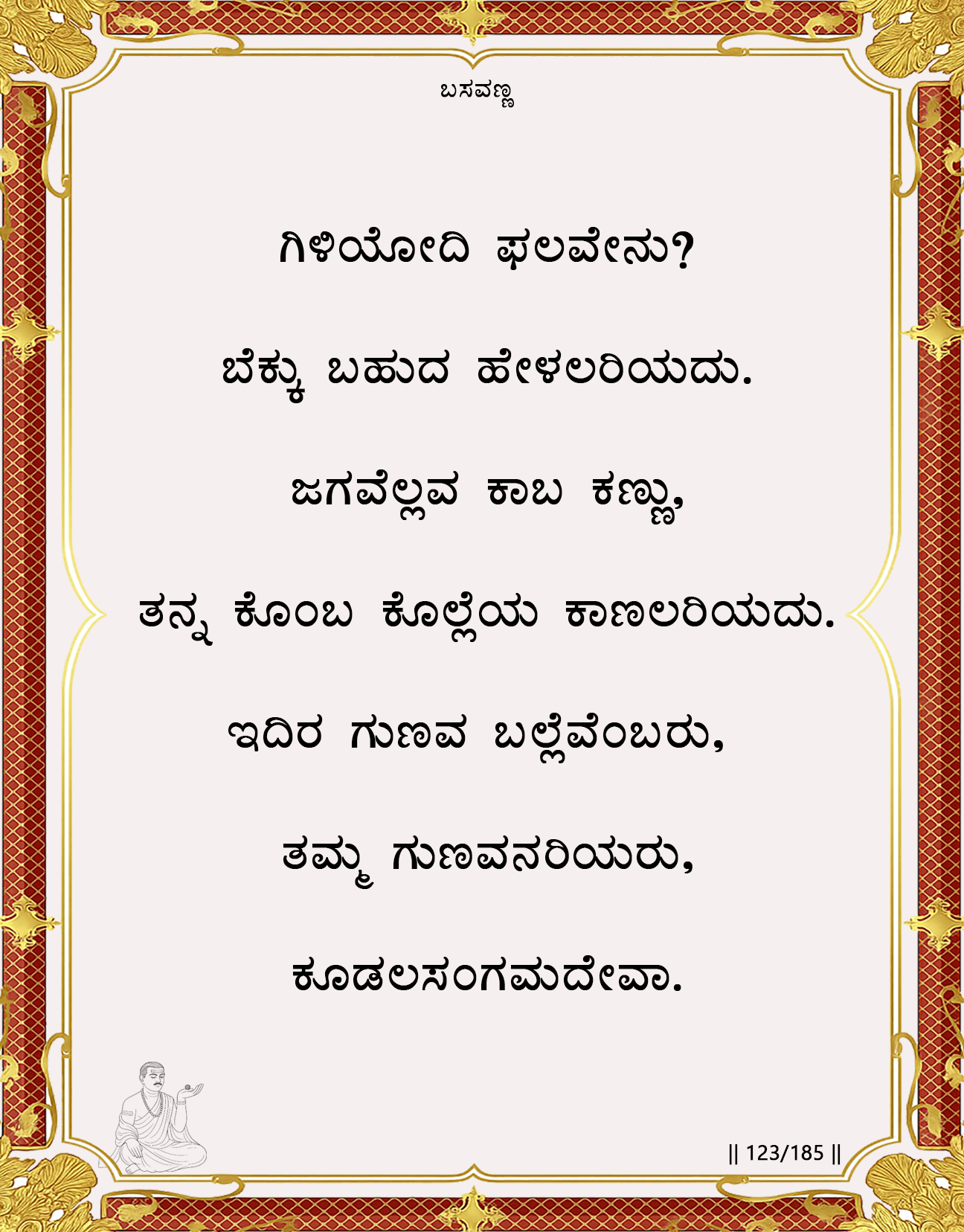
What use is it if the parrot recites scriptures?
It cannot save itself when the cat draws near.
The world peers sharply at others,
seeing everything outward
yet remains blind to the death stalking its own self.
Quick to announce the faults of others,
never once turning inward
to behold its own blemish
such is the folly of people,
O Kudalasangamadeva.
Basavanna uses a vivid paradox: external knowledge without inner awareness is as useless as a parrot that reads but cannot guard its life. Human beings too become sharp observers of others while remaining blind to their own vulnerabilities, their own mortality, and their own flaws. The essence of the vachana is a call to self-seeing the gaze turned in ward without which no spiritual practice has meaning.
Spiritual Context
Core Spiritual Principle: The primacy of self-knowledge (Atma Vichara). Spirituality begins not with judging the world but with understanding the self that is doing the judging. Intellectual or scriptural knowledge (para vidya) is futile if it does not lead to self-awareness (atma vidya). The most dangerous ignorance is the failure to see one’s own ignorance.
Cosmic Reality Perspective: This vachana describes the state of Shakti turned entirely outward, identified with the objects of perception. In this state, it is powerless against the “cat” of maya (illusion) and death. For Shakti to realize its true nature as one with Shiva, it must turn its energy inward (pratya-hara and dhyana), withdrawing from external projection to discover its source.
Historical Reality (Anubhava Mantapa Context): In a scholarly and ritualistic religious environment, this vachana was a radical critique of priestly and academic hypocrisy. It ensured that the Lingayoga movement remained a path of experiential transformation, not just intellectual debate. It fostered a culture of personal accountability and inner work, where a humble, self-aware sharana was valued over a learned but egoistic pandit.
Interpretation
“What use is it if the parrot recites scriptures? It cannot save itself when the cat draws near.” The “parrot” symbolizes the intellect that can mimic sacred texts without embodying their truth. The “cat” represents the inevitable challenges of life death, loss, desire, and the ego’s dissolution which theoretical knowledge cannot overcome.
“The world peers sharply at others, seeing everything out ward yet remains blind to the death stalking its own self.” This is the core human folly. The “death stalking its own self” is the ego’s resistance to its own transformation. We are experts in diagnosing others’ illnesses but are in denial about our own terminal condition the condition of a separate self that must “die” for liberation to occur.
“Quick to announce the faults of others, never once turning inward to behold its own blemish” This describes the mechanical habit of the mind. Judgment of others is a defense mechanism that protects the ego from having to look at its own imperfections.
Practical Implications: The practitioner must make introspection their primary practice. Whenever the impulse to judge or criticize another arises, use it as a mirror to ask, “What does this reaction reveal about a similar tendency within me?” The focus must shift from reforming the world to reforming the self.
The Cosmic Reality
Anga (Human Dimension): The Anga as the “parrot” is a talented but misguided instrument. Its potential is wasted on mere repetition. Its sacred purpose is to turn its “recitation” inward, to inquire “Who am I?” until it discovers its true nature beyond the cage of the body-mind.
Linga (Divine Principle): The Linga is the silent, witnessing consciousness within that is aware of both the “parrot” and the “cat.” It is the true self that cannot be threatened. Realizing this inner Linga is the only true salvation.
Jangama (Dynamic Interaction): The Jangama is the process of the “parrot” turning its head away from the external world and looking back at its own source. It is the dynamic movement of self-inquiry, where the energy usually spent on judgment is redirected toward self-discovery.
Shata Sthala
Primary Sthala: Bhakta (Devotee) This vachana is essential guidance for the Bhakta. It corrects a fundamental error on the path: the tendency toward spiritual pride and criticism. It reorients the devotee toward the humble, essential work of self-purification.
Supporting Sthala: Maheshwara (Lord of the Cosmic Play) To understand this universal human folly to see the “parrot and cat” dynamic playing out in all of society is the perspective of the Maheshwara. This stage involves a masterful understanding of the games of the ego, which allows one to navigate the world without being caught in its judgments.
Practical Integration
Arivu (Awareness Practices): Practice the “Mirror of Judgment.” Every time you catch yourself criticizing someone, immediately pause and ask: “Where does this same quality, perhaps in a different form, exist within me?” Use the outer world as a reflection of your inner state.
Achara (Personal Discipline): Make a vow of self-observation. Dedicate a certain period each day to observing your own thoughts and motivations without judgment. Let your primary discipline be the cultivation of self-awareness over the accumulation of external knowledge.
Kayaka (Sacred Action): In your work, focus on your own performance and integrity rather than comparing yourself to or criticizing colleagues. Let your labor be a field for perfecting your own character.
Dasoha (Communal Offering): In community, foster an environment of gentle self-disclosure and mutual support in inner work, rather than one of gossip and fault-finding. Help create a culture where it is safe to acknowledge one’s own “blemishes.”
Modern Application
We live in a “call-out culture” fueled by social media, where people are quick to virtue-signal and publicly shame others for their flaws and missteps. This creates a society of “parrots” expertly critiquing each other while remaining oblivious to their own pervasive biases, addictions, and inner conflicts. This leads to societal fragmentation and personal anxiety.
This vachana is an urgent antidote to our judgmental age. It liberates us from the exhausting and divisive game of fixing others and invites us into the transformative work of self-awareness. It teaches that the only world we can truly change is our inner world, and that this inner change is the most profound contribution we can make to the whole.
Essence
The parrot scholar, scripture-skilled,
By the simplest cat is killed.
The eye that peers at others’ sin,
Is blind to the death that lurks within.
Turn, O mind, turn the gaze inside,
And in that seeing, truly abide.
The Deeper Pattern: This vachana describes a critical error in the perceptual feedback loop. The system (the individual) is configured to process external data (others’ faults) with high resolution, but has a blind spot for its own internal system errors. This creates a state where the system is constantly trying to debug other systems while its own core programming is corrupted, leading to eventual system failure (spiritual ignorance). The solution is to redirect the processing power to run a continuous internal system diagnostic (self-inquiry).
In Simple Terms: It is like having a security camera perfectly trained on your neighbor’s house to catch every trespass, while a thief is actively robbing your own home. The camera (our judgmental mind) is functional, but its direction is wrong. Spirituality is the act of turning the camera around to monitor the only house you can truly protect: your own mind.
The Human Truth: It is psychologically easier to project our shadows onto others than to face them within ourselves. The timeless truth here is that until we courageously turn the light of awareness inward, we remain like the helpless parrot possessing the appearance of knowledge but utterly vulnerable to the realities of life, death, and our own unconsciousness. The path to freedom begins with a single, honest look in the mirror.

Views: 0